AI-powered search is rapidly changing how people find information. Today, when users ask ChatGPT, Google’s AI Overviews, or Perplexity a question, those systems often cite the exact sources they use. In other words, instead of a list of blue links, your content can become the answer itself. These AI citations are now a primary measure of visibility in Answer Engine Optimization (AEO).
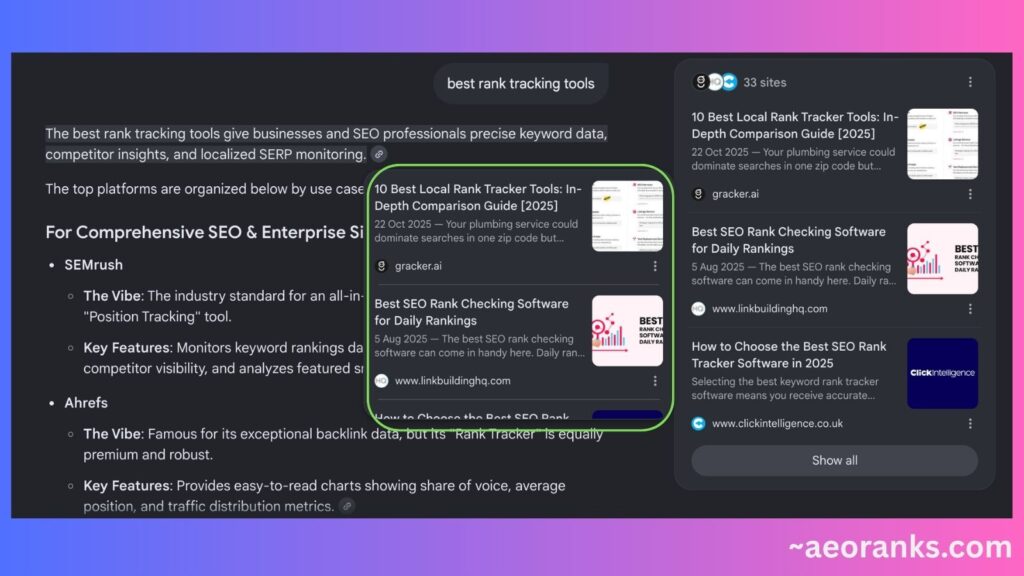
For decision-makers, this means traditional SEO tactics alone aren’t enough. Even if you rank #1 in Google, AI answers may pull from deeper pages or alternate content. We at AEORanks have seen that optimizing for AI citations – the links attached to AI answers – is the new frontier for online visibility. In this article, we explain what AI citations are, why they matter more than ever, and how to earn them to improve your brand’s presence in AI-powered search. We also touch on AEO vs. Generative Engine Optimization (GEO) and how to track AI Citation.
What Are AI Citations?
AI citations are the links an AI answer engine attaches to the sources it used to generate a response. When ChatGPT, Google AI Overviews, Gemini, or Perplexity answer a question, they retrieve information from external webpages and link back to the ones they actually used. That link is the citation – it’s what “ranking” used to mean, translated for a search experience that often has no results page at all.
- If your article appears in an AI-generated answer with your domain linked, you’ve earned an AI citation.
2. Citations come in three main types
- Informational citations (citing blog posts, guides, research to support facts)
- Product citations (citing product pages or reviews in commercial queries)
- Multimedia citations (citing videos, images, or interactive tools when they provide the answer)
Importantly, AI citations are not the same as backlinks. A backlink is an endorsement from another site. An AI citation means the answer engine chose your content as the source behind its answer. Both are trust signals, but AI citations now drive visibility in the AI search layer.
AI answers are only as trustworthy as the sources they cite. In the era of Answer Engines, citations have become the new backlinks.
Role of Citations in AI Answers
The role of AI citations in AEO is simple: they’re the mechanism by which an AI system proves its answer is trustworthy. AI-generated answers are built to save users time by summarizing information from multiple sources – but without citations, there’d be no way to verify any of it. That’s why citations function as the trust layer of AI search, and why earning them is the central objective of Answer Engine Optimization itself. AEO isn’t really about ranking pages, it’s about becoming one of the sources an AI system trusts enough to cite.
Think of citations as the extended knowledge base behind an AI answer. They show users where the AI extracted facts, examples, statistics, and recommendations from.
- Build Trust: Citations make AI answers more credible by showing the original sources behind the information.
- Enable Verification: Users can click through to fact-check claims and explore topics in more depth.
- Reduce Hallucinations: Referencing authoritative sources helps ground AI-generated responses in real, indexable information.
- Improve User Experience: Instead of opening ten tabs, users get a summarized answer with links to continue their research.
- Create Transparency: Citations reveal why a particular recommendation or answer was generated. AI systems increasingly rely on cited sources to justify their responses.
Rank Across AI Search Platforms
Grow visibility across ChatGPT, Claude, Gemini & Perplexity with AI-first SEO strategies.
Book Free Strategy Call ChatGPT
 Claude
 Gemini
 Perplexity
 Grok
Grok
Citations vs. Backlinks: Changing the SEO Equation
With AI taking a bigger role, backlinks remain valuable but function differently. Traditionally, high-quality backlinks helped your page rank higher in Google’s search results by signaling authority. In AI-driven search, however, link quality and content relevance are paramount.
- Backlinks (SEO): Other sites link to yours; this boosts domain authority and list rankings in SERPs.
- Citations (AEO): AI engines link to your content directly in answers; this shows your page directly answered the question.
Backlinks drive visibility on search results pages. Citations drive visibility within the answers themselves”. In fact, only about 38% of AI-cited pages rank in Google’s top 10. AI is more interested in content quality and structure than in traditional keyword/link metrics.
The upshot? Even if you have great SEO rankings, you must also optimize for AI citations to capture high-intent traffic from AI platforms. AEORanks focuses on this new visibility layer: helping clients build content that gets cited by ChatGPT, Google AI Overviews, and more.
Why AI Citations Matter for Your Brand
Getting cited by an AI answer engine isn’t just a vanity metric – it has real business impact. Studies from HubSpot and industry reports highlight that AI-generated referrals often convert far better than traditional search traffic. For example, HubSpot found that traffic coming from AI answers converted three times higher than organic search referrals. Leads from LLM sources surged 1,850%, emphasizing that being the source in an AI answer can directly drive pipeline.
Consider these points:
- Trust and Credibility: When an AI answer cites your page, it’s essentially endorsing your content as the best answer. That trust transfers to your brand. Users may act on a recommendation without even clicking through. If you’re not cited, you risk being invisible in that crucial decision-making moment.
- Higher Intent Traffic: AI search users often ask complex or comparison questions. Citing your content at the answer stage means you’re reaching people deeper in the funnel. AEORanks has seen that AI referral traffic has higher intent and conversion rates.
- Brand Awareness: Multiple citations (or mentions) across AI answers build familiarity. Every time an answer engine references your brand, it boosts brand recognition over time. Citations and mentions together create a compounding effect on visibility.
- Future-Proofing: AI adoption is accelerating. Gartner projects traditional search volume will drop significantly in the coming years, as AI chatbots take share. The early adopters who build “citation authority” now will hold a major advantage as AI search grows
In short, AI citations are the new entry point into user’s answers. Instead of counting clicks, think of visibility as how often your content is used by an AI answer. AEO and SEO work in tandem: strong organic rankings give you a head start, but to own the answer, you need content designed for AI extraction.
Start a conversation today ›How AI Engines Select Citations
AI answer engines use a Retrieval-Augmented Generation (RAG) process. They don’t hallucinate answers from thin air – they retrieve relevant content at query time, evaluate it, and synthesize responses. Here’s a simplified outline of the steps they take:
- Query Understanding: The AI interprets your query’s intent (informational, navigational, commercial). This guides which types of sources to cite.
- Retrieval: The system queries indexes or the live web (as Perplexity does) to gather candidate sources that semantically match the question. Pages with clear headings, definitions, and structured data are more likely to surface here.
- Source Evaluation: Each candidate is scored on relevance, authority, clarity, and trust. AI looks for factual density and clear answers, not keyword stuffing. It heavily weighs E‑E‑A‑T signals (experience, expertise, authoritativeness, trustworthiness). Brand reputation and backlink profiles still matter here, but as trust cues rather than page rank.
- Answer Synthesis: The model combines content from top sources into a cohesive answer. Your content may contribute facts or sentences even if it isn’t ultimately cited.
- Citation Assignment: Finally, the AI chooses which sources to cite with links. It picks the ones that provided the most direct, verifiable claims to the answer.
AI models also cross-validate claims across multiple sources during this step – content that’s consistent with how the rest of the web describes a topic earns more trust, while outlier claims with no corroborating evidence tend to get quietly deprioritized, even if the writing is technically clear.
Different AI platforms have variations:
- Perplexity performs live web searches and cites frequently (often 5–15 links per answer).
- ChatGPT (browsing-enabled) is more selective and cites fewer sources.
- Google’s AI Overviews (Gemini) typically cite moderately and favor content from high-authority domains.
- Gemini (Google) uses Google’s index, emphasizing structured, authority content.
But across the board, AI engines converge on core signals. If your content scores high on those, it has a much better chance of being cited.
Signals That Earn AI Citations
AI engines don’t rank content the way traditional search engines do. They extract, summarize, and cite information from sources they trust. The following signals consistently increase your chances of being referenced in AI-generated answers.
Clear, Direct Answers
Start sections with a concise answer to the user’s question. AI systems often extract content from the beginning of a paragraph or section.
Structured Content
Use descriptive headings, bullet lists, FAQs, and schema markup so AI engines can easily understand and retrieve information.
Topical Authority
Build content clusters and topic hubs that demonstrate expertise across an entire subject, not just a single keyword.
Factual Specificity
Include data, statistics, examples, research, and verifiable claims. AI engines prefer content they can confidently cite.
Freshness Signals
Update key pages regularly with new data, examples, and insights. Current information is more likely to be surfaced by AI.
Source Reputation
Brand mentions, backlinks, industry recognition, and third-party validation increase trust and citation confidence.
Ranking → Citation
Traditional SEO focuses on ranking pages. AI Search focuses on extracting answers. The brands that win are those that make their expertise easy for AI systems to understand, verify, and cite.
Strategies to Increase AI Citations & Brand Visibility
A practical framework for making your brand the source AI engines understand, trust, and reference.
| Strategy | Why It Matters | What To Do |
|---|---|---|
| Create Citable Content | AI engines prioritize unique insights, research, statistics, and expert perspectives that cannot be found elsewhere. | Publish original research, industry studies, case studies, benchmarks, comparison pages, and comprehensive guides. |
| Build Topical Authority | Brands with deep coverage across a topic are more likely to be trusted and cited. | Create pillar pages, supporting content clusters, internal links, and topic-specific resource hubs. |
| Strengthen Entity Signals | AI systems evaluate authors, organizations, and expertise before citing content. | Implement Organization, Author and Article schema. Maintain strong About, Team and Author pages. |
| Earn External Validation | Third-party mentions help AI systems verify credibility and authority. | Secure mentions through PR, podcasts, guest posts, LinkedIn, Reddit, industry communities and interviews. |
| Structure For Extraction | AI engines retrieve content in fragments, not entire pages. | Use clear headings, concise answers, FAQs, schema markup, bullet lists, tables and semantic page structure. |
| Monitor & Refresh | AI visibility changes over time as models discover new information. | Track brand mentions, citation frequency, AI visibility trends and update high-value content regularly. |
AEO vs. GEO: Where Do Citations Fit?
It helps to understand the landscape of AI discovery. AEO (Answer Engine Optimization) focuses on search engines that provide answers (like Google AI Overviews, voice assistants, featured snippets). GEO (Generative Engine Optimization) targets large language model outputs (ChatGPT, Perplexity, Bing Copilot, etc.).
- In AEO (e.g. Google’s AI Overviews), the emphasis is on making content extractable: good use of schema, FAQ sections, clear bullet lists and summary definitions. AEORanks’ AEO services often stress E‑E‑A‑T and structured markup to win the featured snippet and AI summary citations. Getting cited in Google’s AI Overviews can put you above traditional results (the “zero position”), recovering traffic lost to no-click answers.
- In GEO, LLMs like ChatGPT synthesize answers from multiple sources. To appear here, the strategy overlaps but also includes building a broad topic footprint. ChatGPT (with browsing) and Perplexity rely on content clarity (which we’ve covered) but also on overall topical presence. So GEO optimization involves having your brand cited across the AI ecosystem (e.g., through AI Q&A, social/Reddit visibility, etc.).
While the tactics overlap, it’s key to note: AI citations are not limited to one platform. AEO and GEO work together. For example, Google’s Gemini AI shares knowledge with ChatGPT’s model (both from Google’s ecosystem). So a well-structured, authoritative piece might earn citations in Google AI Overviews and get referenced by ChatGPT or Bing. AEORanks leverages data from all major answer engines to optimize content that satisfies both AEO and GEO criteria.
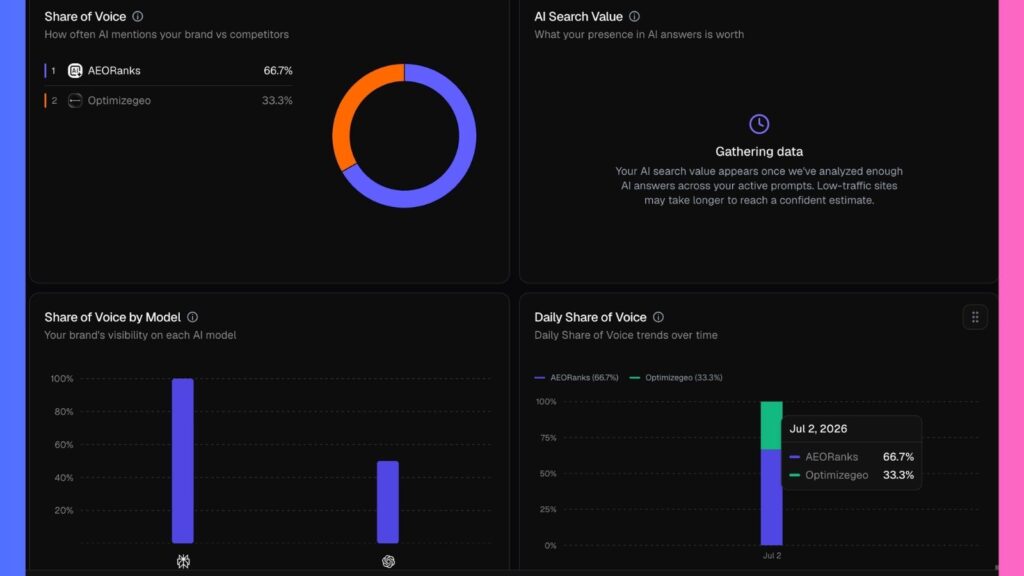
Measuring AI Citation Success
Finally, you need to track the right metrics. Traditional tools like Google Analytics and GSC don’t directly report AI citations. Instead, measure:
- Citation Rate: The percentage of AI answers (for your target queries) that include a link to your site. For example, a 10% citation rate on a high-volume query means you’re cited in 1 out of 10 AI answers for that term.
- Mention Rate: The percentage of AI answers that mention your brand without linking. High mentions with low citations indicate brand awareness is there, but content structure needs work.
- Share of Voice: Your proportion of total citations/mentions in a topic relative to competitors. If you have a 20% share of a topic, you’re cited once for every five citations on that topic.
- AI Referral Traffic: Track any clicks coming from AI answers (often visible in GA4 as a referral from Google’s “AI” or similar). Also, track assisted conversions from these visits. HubSpot’s data shows AI-generated answer traffic has high conversion rates.
- Answer Inclusion Rate: How often your content appears (with or without a link) in AI-generated responses.
What is the role of AI citations in AEO?
AI citations are the core mechanism of Answer Engine Optimization. AEO isn’t about ranking a page on a results list – it’s about becoming one of the sources an AI system trusts enough to cite when it answers a question. Every AEO strategy (structured content, E-E-A-T signals, schema markup) exists to increase the odds that your content earns that citation.
Why are AI citations important?
AI citations determine whether your brand is part of the answer a buyer sees, not just a link they might click. AI citations are important because they show that an AI tool trusts your content enough to use it as a source. This can increase your brand visibility, bring more traffic, and build credibility when people see your brand mentioned in AI answers.
How are AI citations different from backlinks?
A backlink is one site vouching for another and mainly affects traditional search rankings. An AI citation means an answer engine selected your content as the actual source behind its response, in real time, for that specific query. Both are trust signals, but citations are what drives visibility inside AI-generated answers specifically.
How do I know if my content is earning AI citations?
Track three metrics: citation rate (how often AI answers link to you), mention rate (how often they name your brand without linking), and share of voice (your citations relative to competitors on a topic). See our full guide to track AEO and GEO performance for the exact method.
Why does my content rank well on Google but never get cited by AI?
This usually comes down to structure, not quality. AI engines cite content that answers a question directly within the first 30% of the page, in a self-contained, extractable block – not content that’s well-optimized for keywords but buries its actual answer under introductions and context. See why AI finds content but doesn’t cite it for a full breakdown.
Want to Know Which of Your Pages Are Already Getting Cited?
We’ll benchmark your citation rate, mention rate, and share of voice across ChatGPT, Gemini, Perplexity, and Google AI Overviews – then show you exactly which pages to restructure first. Book your free strategy call →