

The way people discover information online has shifted dramatically since the introduction of generative AI. Rather than entering a few keywords and wading through ten blue links, users increasingly ask full questions and expect a direct response. Large language models (LLMs) such as ChatGPT, Google’s AI Overviews and AI Mode, Perplexity and other answer engines now synthesise content from across the web to deliver concise answers. This shift has created a citation economy – being mentioned by AI systems is becoming more valuable than ranking at the top of a search results page. To thrive in this environment, marketers must understand and embrace Answer Engine Optimization (AEO), a discipline that complements traditional SEO but focuses on becoming the cited answer rather than merely ranking.
This guide will provide you with insights from leading AEO research and high‑performing companies to help businesses dominate AI‑powered search. We examine how answer engines work, why AEO matters in 2026, differences from SEO, critical ranking factors, and hands‑on techniques – including schema markup, content structure, and authority building – to ensure your content becomes the answer.
How Answer Engines Works
Answer engines harness retrieval‑augmented generation (RAG) to provide users with concise, authoritative responses. The process generally involves three steps:
- Interpreting the question. The AI uses natural language processing to understand the intent behind the query. It isn’t matching keywords but comprehending context – “best accounting software for a freelancer” implies multi‑currency invoicing needs and freelance workflows.
- Searching and retrieving content. The model breaks complex questions into fan‑out queries, each targeting a sub‑topic, then searches across web indexes. ChatGPT uses Google’s index via SerpAPI, Perplexity runs its own PerplexityBot crawler and Google AI Overviews taps Google’s index. The engine selects passages and facts from multiple sources.
- Generating and citing answers. Information from various pages is synthesized into a coherent response. Advanced answer engines cite their sources so users can verify claims. To be cited, your content must match not only the user’s full question but the shorter fan‑out queries the AI generates.
Understanding this workflow clarifies why answer engines favor clear, structured content and why topical breadth and authority matter. It also reveals the importance of accessible HTML – AI crawlers read raw HTML and may not execute JavaScript, so server‑side rendering and open access (no hidden tabs, logins or paywalls) are critical
AI Search Landscape in 2026
Several AI platforms dominate user attention and require distinct optimizations:
- ChatGPT and Bing Copilot. ChatGPT has over 400 million weekly active users and accounts for roughly 70 % of AI‑powered search. Bing Copilot incorporates OpenAI’s models into Microsoft products, enabling conversational search across Windows and Office.
- Google AI Overviews and AI Mode. AI Overviews insert generative summaries at the top of Google’s search results, often citing sources outside the top 10 organic results. AI Mode offers a full conversational interface with query fan‑out that combines web results, Knowledge Graph, weather, shopping and other sources.
- Perplexity. This AI‑native search engine provides concise answers with explicit citations. Its click‑through rates can be 6–10 times higher than ChatGPT, and brands report conversion rates of 20–30 % from Perplexity traffic.
- Voice assistants. Siri, Alexa and similar assistants apply the same RAG principles and will cite web content when providing answers.
These platforms share a goal: deliver the best possible answer, not a list of links. Consequently, user queries tend to be longer and conversational, and follow‑up questions are common. Traffic arriving from AI engines also converts at much higher rates (up to 4.4× traditional search) because users have already validated information via the AI.
Why AEO Matters in 2026
The shift from search engines to answer engines has profound implications for businesses:
- Zero‑click dominance. Over 65 % of Google searches end without a click as users obtain answers directly on the results page. When AI Overviews appear, click‑through rates drop by approximately 34 %.
- Rapid AI adoption. AI search traffic grew 527 % year‑over‑year. Estimates indicate that about 105 million adults in the US used generative AI in 2025, and ChatGPT’s share of global search traffic increased 740 % in one year.
- Higher conversion. AI traffic converts 4.4× better than traditional organic traffic, partly because AI engines filter and validate the content users see..
- Rising competition. Only 46 % of AI Overview citations come from the top 10 organic results. This means traditional rankings alone won’t guarantee AI visibility.
Given these trends, ignoring AEO risks losing visibility and market share. Businesses focusing solely on traditional SEO will see competitors capture the AI citation space. AEO therefore complements SEO – by building content that answer engines can easily find, extract and cite, you maintain discoverability across emerging search channels.
AEO vs. SEO: What’s Different and What Overlaps
AEO and SEO share foundational elements – quality content, E‑E‑A‑T, backlinks and technical health still matter – but the objectives and metrics differ. Table 1 summarizes these differences.
| Aspect | Traditional SEO | Answer Engine Optimization (AEO) |
|---|---|---|
| Primary goal | Rank higher to earn clicks | Become the cited answer |
| Success metrics | Rankings, click‑through rate, organic traffic | AI citations, share of voice, brand mentions |
| Query style | Short keyword phrases | Conversational questions |
| Content focus | Keyword targeting, backlink building | Answer clarity, structure, authority signals |
| Primary platforms | Google/Bing search results | ChatGPT, Perplexity, Google AI Overviews, voice assistants |
| Update frequency | Algorithm updates (quarterly) | Model updates (often continuous) |
Despite these differences, SEO and AEO work together. High‑ranking pages supply AI systems with credible sources, so strong technical SEO and backlink profiles still help AEO. AEO builds on that foundation by structuring content for AI extraction and focusing on being the answer rather than just ranking.
Ranking Factors for Answer Engines

1. Comprehensive topical authority
Answer engines favor pages that offer deep, authoritative coverage of their subjects rather than thinly separated pages. DOJO AI’s research shows that answer engines reward depth over breadth; a single comprehensive guide covering multiple aspects performs better than separate pages for each subtopic. Such guides should include logical information hierarchies, entity relationships and conceptual frameworks. Building hub‑and‑spoke content clusters—where a core hub page links to deeper spokes—helps demonstrate expertise.
2. Content clarity and structure
Clear, structured content makes it easier for AI systems to extract relevant information. Effective practices include:
- Lead with the answer. Place the key takeaway or definition in the first 30–60 words of each section. Inverted pyramid writing ensures that AIs can find the answer quickly.
- Use question‑driven headings. Headings such as “How much does accounting software cost?” reflect real user queries. They also help AI break content into semantic chunks for extraction.
- Write scannable paragraphs and lists. Short paragraphs (2–3 sentences) and bullet or numbered lists allow models to extract information easily. Step‑by‑step instructions, feature comparisons, pros/cons lists and tables are particularly effective.
- Include FAQs. Well‑structured FAQ sections with self‑contained answers (100–200 words) align directly with how users query AI assistants.
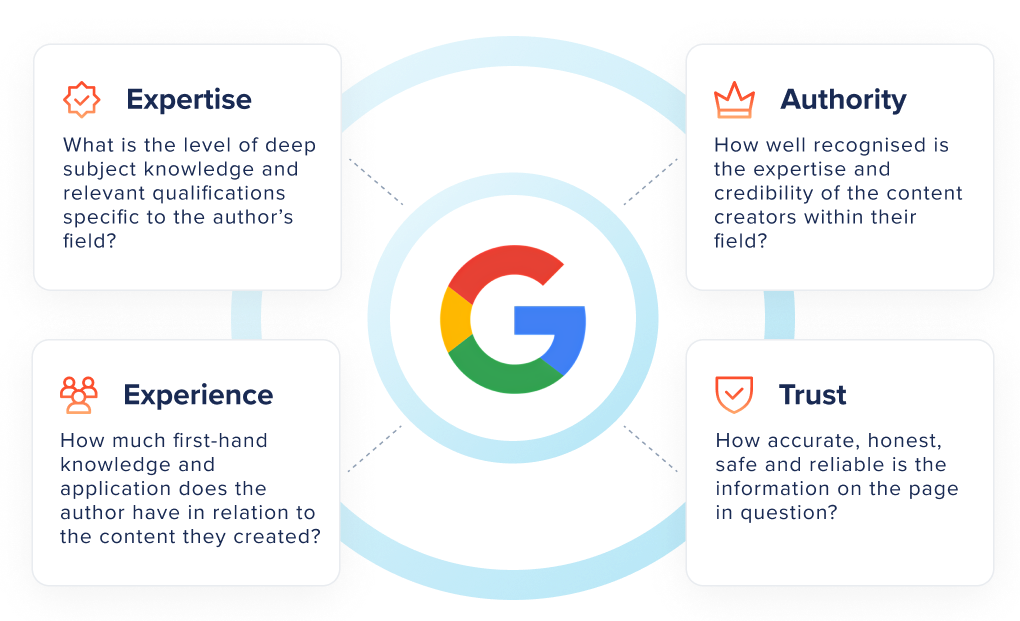
3. Factual credibility and E‑E‑A‑T
AIs prefer citing content that demonstrates verifiable expertise. Recommendations include:
- Cite sources and data. Referencing statistics with dates and sources signals credibility. According to LLMrefs, quoting expert forecasts carries more weight with AI than unsourced claims.
- Use bylines and author credentials. Publishing author information and including expert quotes help models assess experience and authority.
- Employ structured author schema. Adding author or organization schema can improve citation of older content.
4. Technical readiness and schema markup
Proper technical implementation is essential for AI crawlers:
- Expose content in raw HTML. Avoid relying on JavaScript to load critical text—many AI crawlers cannot execute scripts. Use server‑side rendering and ensure no important information is hidden behind tabs or interactive elements.
- Allow AI bots in robots.txt. Check that your robots.txt and CDN/firewall settings permit legitimate AI crawlers like OAI‑SearchBot, PerplexityBot and Google‑Extended.
- Implement schema. FAQPage and HowTo schema help AIs understand question–answer pairs. Article schema clarifies headline, author and publication date, and speakable schema marks segments suitable for voice assistants. Use JSON‑LD format because it’s easy to implement.
- LLMs.txt and llms‑full.txt. Emerging standards such as llms.txt and llms‑full.txt can improve crawl rates by 5–10 %, though evidence is still limited. These files guide AI crawlers to important content.
5. Content freshness and recency signals
AIs strongly favor recent content. Citation windows can be short – most LLM citations occur within 2–3 days of publishing and drop drastically after 1–2 months. Therefore:
- Include publication and last‑updated dates in your metadata.
- Update AEO‑optimized pages at least quarterly. Refresh data, examples and analyses.
- Add the current year to titles and URLs; LLMs prefer recent content.
6. Cross‑platform authority and external signals
Answer engines learn from the entire web, not just your site. Building authority involves:
- Earning backlinks and mentions. Quality backlinks help AI systems identify authoritative sources.
- Cross‑posting. Publishing the same core content across platforms such as LinkedIn Pulse or industry forums increases trust and ensures multiple opportunities for AIs to encounter your brand.
- Participating in communities. Engage in forums and social networks that AI models frequently cite, like Reddit and Quora.
7. Local optimization for AI
Google’s AI Mode often serves geolocated results even for non‑local queries. Thus:
- Optimize Google Business Profiles with accurate NAP (Name, Address, Phone) data, professional photos and authentic reviews. Ensure each location’s listing is updated.
- Create location‑specific content that demonstrates expertise in each geographic market.
- Monitor local performance to identify and optimize underperforming locations.
AEO Techniques and Implementation Roadmap
Phase 1: Benchmark Current Visibility
Before optimizing, benchmark your AI visibility:
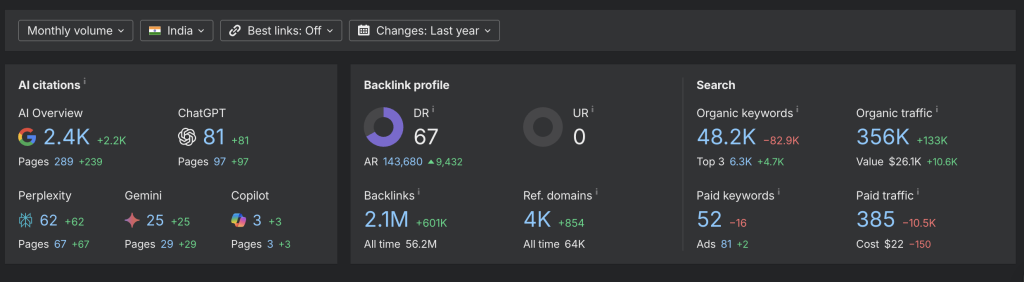
- Track AI citations. Identify how often your brand appears in responses from ChatGPT, Google AI Overviews, Perplexity and Copilot using monitoring tools such as Profound or by manually querying AI platforms.
- Configure analytics. In GA4, create segments to track traffic from AI referrer domains. Use query parameters to distinguish AI visitors.
- Set baseline metrics. Measure share of voice (percentage of AI responses that cite you), citation frequency and accuracy, and AI referral traffic volume.
Phase 2: Content Audit and Optimization
Audit Existing Content
- Evaluate the clarity, structure and authority signals of existing pages. Identify top pages for AEO optimization.
- Manually test AI platforms using your core keywords to see which pages are cited.
Optimize Top Pages
- Restructure with the inverted pyramid format. Put definitions and key messages in the first 100 words.
- Add or expand FAQ sections. Use direct questions and self‑contained answers (100–200 words) with explicit facts or data.
- Enhance factual credibility. Add citations, statistics and expert quotes; link to authoritative sources.
- Insert schema markup. Apply FAQPage, HowTo or Article schema using JSON‑LD.
- Refresh dates and examples. Ensure your last‑updated date is recent and that examples reflect current conditions.
Phase 3: Technical Implementation
- Implement server‑side rendering to ensure AI crawlers can read content.
- Update robots.txt and firewall settings to allow AI crawlers.
- Add llms.txt or llms‑full.txt to guide AI crawlers.
- Optimize heading hierarchy and internal linking. Ensure proper H1–H3 structure and create topic clusters.
- Use tables and lists for data and comparisons.
Phase 4: Measurement and Iteration
- Monitor citations weekly and compare against baseline. Track changes after publishing updates..
- Analyze AI referral traffic in analytics; note engagement and conversion metrics..
- Identify new questions users ask and create content to answer them. Look at “People Also Ask” boxes, site search logs and customer support conversations.
- Refresh content quarterly or sooner as citations drop. Add new data, update statistics and refine structure.
Common AEO Mistakes to Avoid
- Ignoring AI search. Assuming traditional SEO is sufficient leaves your brand uncited while competitors gain AI visibility.
- Producing thin answer‑only content. Short posts created solely to capture AI citations often fail quality thresholds and harm both SEO and AEO. Instead, build comprehensive guides with AEO‑optimized sections.
- Neglecting content freshness. Publishing once and forgetting results in declining citations as models favor recent content.
- Blocking AI crawlers. Misconfigured robots.txt or CDNs can inadvertently exclude AI bots.
- Overlooking local optimization. AI engines may replace website links with Google Business Profiles for local queries. Ensure local listings are optimized.
- Relying solely on on‑site signals. Off‑site brand mentions and cross‑platform presence are vital; AIs cite what they see across the web.
Future Trends and Considerations

Generative Engine Optimization (GEO) and narrative control
Some practitioners use AEO and generative engine optimization (GEO) interchangeably. AEO focuses on delivering direct answers to specific questions; GEO expands to shaping how AI systems describe and recommend your brand across broader conversations. In practice, content strategies should integrate both by ensuring your brand appears in direct answers and influences the narrative by providing thought leadership and opinion pieces.
Emerging AI platforms
Beyond current leaders, new platforms such as Apple Intelligence and Meta AI may integrate AI search into their ecosystems, expanding where AEO matters. Keeping abreast of platform‑specific guidelines and differences will be crucial.
Dynamic AEO and citation volatility
LLM responses change frequently; citations can vary month to month across platforms. This volatility requires dynamic AEO, where content is continually refined based on citation patterns and performance feedback. Tools like DOJO AI’s dynamic AEO agent analyze citation patterns and provide real‑time content recommendations.
Ethical considerations and source quality
AI models can propagate misinformation if they cite unverified sources. By publishing accurate, well‑sourced content and ensuring transparency through author credentials and citations, businesses help maintain information integrity and foster user trust.
Answer Engine Optimization is not a replacement for SEO but an evolution of search strategy that targets how AI systems discover and deliver answers. As zero‑click searches rise and AI engines become default search entry points, becoming the cited answer is essential for maintaining visibility, authority and conversion. By focusing on comprehensive content, clear structure, authoritative signals, technical readiness, freshness and cross‑platform presence, businesses can secure their place in the emerging citation economy.
How do I use Answer Engine Optimization?
Answer Engine Optimization (AEO) involves structuring your content so AI‑powered answer engines can easily find, understand and cite it. Start by leading with the answer: put the key takeaway or definition in the first 30–60 words of each section, then expand with supporting details. Use clear headings framed as questions, short paragraphs and bullet or numbered lists to help AI systems extract information. Add an FAQ section with self‑contained answers (100–200 words) that match common user questions. Implement structured data using FAQPage, HowTo and Article schema to signal question–answer pairs. Finally, keep content fresh by adding publication and last‑updated dates and updating statistics regularly. Combining these practices makes your content more discoverable and citable.
Is ChatGPT an answer engine?
Yes. ChatGPT is a conversational AI model that functions as an answer engine. It uses retrieval‑augmented generation to interpret user questions, search for relevant information and generate a synthesized answer. ChatGPT’s popularity—over 400 million weekly active users and roughly 70 % of the AI search market—demonstrates how answer engines are becoming mainstream. When users ask a question, ChatGPT often provides an authoritative response and cites sources if available, making it a key platform for AEO.
How is answer engine optimization different from SEO?
Traditional SEO focuses on ranking web pages in search results to earn clicks, whereas AEO aims to become the cited answer within AI‑generated responses. Success metrics differ: SEO measures rankings, click‑through rates and organic traffic, while AEO tracks AI citations, share of voice and brand mentions. The content focus also changes; SEO often targets specific keywords, whereas AEO prioritizes clear, direct answers, question‑driven headings and structured information. Both disciplines share foundations – quality content, strong technical health, backlinks and E‑E‑A‑T—but AEO builds on SEO to ensure visibility in AI‑powered experiences.
What are the best AEO techniques for AI?
The most effective AEO strategies revolve around comprehensive topical authority, clarity, credibility, technical readiness, freshness, and cross‑platform authority. Create in‑depth guides that cover topics holistically; answer engines reward depth over breadth. Structure content with question‑based headings, short paragraphs and lists so AI can extract answers. Cite data and sources, include author credentials and use schema markup (FAQPage, HowTo, Article) to enhance credibility. Ensure AI crawlers can access your content by serving it in raw HTML and allowing legitimate bots in robots.txt. Add freshness signals by displaying publication and last‑updated dates and regularly updating content. Finally, build authority beyond your own site by earning backlinks and sharing content across platforms; cross‑posting reinforces trust and creates more opportunities for AI to encounter your brand.
Which is better: SEO or AEO?
Neither approach is inherently “better”; they serve complementary purposes. SEO ensures your pages rank in traditional search results, while AEO ensures your content is the answer that AI engines cite. Many AI citations still come from high‑ranking pages, so a strong SEO foundation supports AEO. Conversely, AI overviews often cite sources outside the top 10 organic results, so optimizing for AEO can increase visibility even if you don’t rank on page one. The best strategy is to combine both: maintain technical SEO, high‑quality content and backlinks while also structuring content for AI extraction and focusing on direct answers.
Can ChatGPT perform an SEO audit?
ChatGPT can assist with many aspects of an SEO audit but should be used alongside specialized tools. As a large language model, ChatGPT can analyze queries, generate keyword ideas, suggest content improvements and even perform high‑level SEO content auditing. It can write meta descriptions, recommend on‑page optimizations and help brainstorm technical checks. However, it does not have built‑in access to your website’s technical data; therefore, it cannot fully replace tools like Google Search Console or dedicated crawlers for tasks such as identifying broken links or crawl errors. Use ChatGPT as a supplement to generate ideas and interpret data, and rely on professional SEO software for comprehensive audits.
What are the four pillars of SEO?
Most practitioners agree that effective SEO rests on four pillars: Technical SEO, On‑Page SEO, Content, and Off‑Page SEO. Technical SEO addresses crawlability, site speed and mobile responsiveness. On‑Page SEO focuses on on‑site elements such as navigation, headlines, URLs and user experience. Content involves creating valuable information optimized for strategic keywords. Off‑Page SEO includes acquiring backlinks, increasing social engagement and building brand awareness to strengthen trust and authority. Working on all four areas simultaneously helps improve visibility, targeting and engagement.

Leave a Reply