

Search behaviour in 2026 looks nothing like the “ten blue links” era. Over 800 million people use ChatGPT every week and Google’s Gemini app has over 750 million monthly users. Google’s AI Overviews (and the related AI Mode) already appear on 16 % of all searches. Instead of scanning a list of links, users increasingly ask questions in AI‑powered tools such as ChatGPT, Perplexity, Claude, Gemini and Copilot. These systems compile answers from multiple sources without always sending traffic back to the originating sites. Brands that only optimise for traditional search risk disappearing from AI‑generated answers.
This guide explains Generative Engine Optimization (GEO) – a guide to make your content and brand visible inside AI‑generated responses. It synthesises insights from leading references (SEO.com, Search Engine Land, Backlinko and Mangools) and recent trends to help you build a comprehensive GEO strategy for 2026.
What is Generative Engine Optimization?
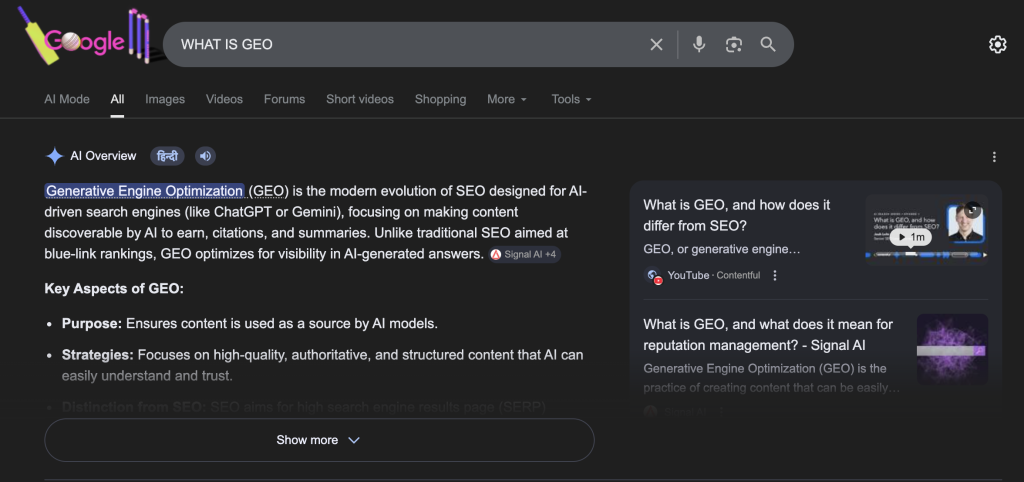
Generative Engine Optimization (GEO) is the practice of positioning your content and brand so that AI platforms cite or recommend you when generating answers. Search Engine Land defines GEO as the practice of arranging your brand and content so that AI platforms such as Google AI Overviews, ChatGPT and Perplexity cite, recommend or mention you when users search for answers. Backlinko echoes this definition, describing GEO as the practice of creating and optimising content so that it appears in AI‑generated answers on platforms like Google AI Mode, ChatGPT and Perplexity.
In other words, GEO shifts the objective from winning a search ranking to becoming part of the answer. Traditional SEO remains crucial – you still need crawlable, authoritative pages – but GEO expands optimisation across AI‑driven surfaces and emphasises extractable information, entity clarity and off‑site credibility.
Why GEO matters in 2026
The explosion of AI‑powered search changes how people discover information. Instead of clicking links, users now ask conversational questions and receive compiled answers. Backlinko notes that ChatGPT reached 100 million users faster than any app in history and surpassed 400 million weekly users by early 2025. Search Engine Land’s research shows that AI citations can change by 40–60 % month to month, yet the brands that consistently appear share structural characteristics such as entity clarity, extractable content and multi‑platform presence.
GEO matters because:
- Visibility shrinks: AI answers cite only a handful of sources. Failing to appear means invisibility.
- New metrics emerge: Conversions may come indirectly (a user may later search your brand). Metrics like citation frequency, share of voice and sentiment become important.
- Search is everywhere: Users ask questions across ChatGPT, Perplexity, Gemini, Claude, Copilot, Reddit and YouTube. GEO ensures your brand is present on all relevant surfaces.
GEO vs. SEO vs. AEO/LLMO
Traditional SEO and GEO share a foundation but have distinct goals. Mangools summarises the differences:
| Aspect | Search Engine Optimization (SEO) | Generative Engine Optimization (GEO) | Answer Engine Optimization / LLM Optimization |
|---|---|---|---|
| Objective | Rank web pages in search engines like Google and Bing | Become a source cited by AI engines such as ChatGPT, Perplexity and Gemini | Optimise content for direct answers in featured snippets and answer boxes |
| Content display | Results appear as ranked lists; users click links | AI composes real‑time responses summarising multiple sources | Systems display short answers extracted from content |
| User interaction | Users click individual links to access pages | Users receive compiled responses with cited sources, reducing clicks | Users read answer boxes without leaving the SERP |
| Content structure | Pages are optimised for keywords and technical SEO | Content must be extractable (self‑contained paragraphs, clear headings) and entity‑focused | Structured Q&A and How‑To formats increase snippet eligibility |
| Performance metrics | Traffic, rankings and conversions | Citation frequency, share of voice and sentiment | Featured snippet presence and click‑through |
GEO builds on SEO fundamentals but shifts the focus from rankings to citations and recommendations inside AI answers.
How Generative AI Engines Work
Understanding how AI systems generate answers helps us optimise for them. Mangools explains that generative AI models leverage large language models (LLMs) to produce comprehensive responses. These models are trained on huge datasets of books, articles and web pages, learning patterns in grammar, context and tone. Key components include:
- Data training: LLMs learn patterns by ingesting large datasets.
- Natural language processing: They comprehend the context and intent of a user’s query.
- Pattern recognition: Models recognise patterns in the training data to choose relevant information.
- Context awareness: Unlike keyword‑only search, LLMs interpret entire queries, including tone and context.
- Continuous learning: Models are frequently updated to incorporate new information and trends.
These AI engines may employ query fan‑out, where they break a complex question into sub‑queries, search multiple sources and assemble the answer. They also use passage retrieval: content is split into chunks, converted into vectors and ranked for relevance. Passages that make sense on their own (without references like “as noted above”) are more likely to be used.
How Generative Engines Choose What to Cite
Based on Search Engine Land’s analysis, AI engines favour content that is accessible, clear and trustworthy. The process typically involves:
- Expansion of the query: For multi‑step questions, AI tools may run several searches to gather supporting information.
- Passage retrieval: LLMs break content into vectors and retrieve the most relevant self‑contained passages.
- Synthesis: Retrieved passages are combined to generate the answer.
- Attribution: Some AI systems provide citations for extracted passages.
This implies that your content must be easy to extract and reuse. Passages that include definitions, statistics or concise explanations and stand on their own are more likely to be cited. Clarity matters more than length; burying important information in long paragraphs reduces the chance of being cited.
The Five Core Principles of GEO
Search Engine Land outlines five principles that underpin effective GEO. These principles are stable even as AI platforms evolve.
- SEO fundamentals remain the foundation.
Your site must still be crawlable, fast, mobile‑friendly and secure. Technical accessibility ensures AI crawlers can fetch your content. Basic SEO practices like optimised titles, metadata, internal linking and strong user experience remain essential. - Entity clarity shapes AI understanding.
AI systems need to distinguish your brand from others. Clear signals about who you are, what you offer and which topics you’re authoritative for are critical. Consistent descriptions across your site, schema, social profiles and directories reinforce entity clarity. - Content must be easy to extract and reuse.
Passages that stand alone, use specific facts and have clear headings are more likely to be retrieved and cited. Place the answer at the beginning of each section and avoid conversational fillers. Provide statistics, definitions and quotes that AI can repurpose. - AI visibility extends beyond your website.
AI systems gather information from YouTube, Reddit, review sites, industry publications and social platforms. A strong presence across these platforms – through owned content (videos, podcasts, Q&A) and earned mentions – signals credibility. Consistent participation in forums and social discussions increases the likelihood of being cited. - Visibility is measured differently.
Traditional metrics (rankings, clicks, traffic) don’t capture AI citations. GEO adds metrics such as citation frequency, share of voice, context coverage and sentiment. Tools like Semrush’s AI Visibility Index or Backlinko’s LLM visibility checker help track where and how often your brand appears.
1. Define your GEO goals and KPIs
Decide whether you’re optimising for visibility (show up in AI answers for a topic cluster), reputation (control sentiment) or acquisition (drive assisted conversions). Establish KPIs such as citation frequency, share of voice, sentiment and prompt coverage.
2. Build your “prompt universe”
GEO keyword research is really prompt and intent research. Mangools suggests performing holistic research: study your market, users and competitors; identify long‑tail queries and questions; and analyse competitor strategies. Use sources like customer support tickets, sales calls, Reddit threads and “People Also Ask” suggestions to collect natural‑language prompts. Organise prompts by intent (learn, compare, decide) and funnel stage.
3. Establish a visibility baseline
Conduct a manual audit: ask your prompts in ChatGPT, Perplexity and Google AI Mode, and record whether your brand appears and which sources are cited. Note competitor mentions and sentiment. This baseline informs where you need improvement.
4. Create topic hubs and structured content
Because AI may use query fan‑out, a single page isn’t enough. Build a cornerstone guide covering the broad topic and supporting pages addressing sub‑questions. Include a FAQ section for quick answers. Each page should have:
- A descriptive heading (H2/H3) signalling the question.
- An answer-first paragraph directly beneath the heading.
- Additional paragraphs expanding on the answer.
- Bullet lists, tables or checklists where appropriate.
5. Write for extractability
Follow Backlinko and Search Engine Land’s guidelines to maximise extractability:
- Use one idea per paragraph; avoid referencing earlier text.
- Provide clear definitions and numbers. Pages with quotes or statistics have 30–40 % higher visibility in AI answers.
- Front‑load the main point at the beginning of paragraphs.
- Use specific facts and avoid vague generalities.
- Add schema markup (FAQ, HowTo, Article, Product) to reinforce structure.
6. Build credibility hooks and E‑E‑A‑T signals
AI engines favour content from trustworthy sources. Enhance credibility by:
- Publishing author bios and citing sources.
- Highlighting Experience, Expertise, Authoritativeness and Trustworthiness (E‑E‑A‑T) as Mangools recommends.
- Including references, external citations and quotes from experts.
- Building brand authority through thought leadership articles and guest contributions.
7. Strengthen entity clarity and brand signals
Ensure consistency across your website, schema, social profiles and external listings. Use organisation and person schema to clearly describe your brand, products and authors. Align descriptions on LinkedIn, Crunchbase, review sites and Google Business Profile. Create or update your About page, author pages and contact information to reinforce trust.
8. Expand presence beyond your site
GEO success depends heavily on off‑site presence. Search Engine Land notes that AI systems pull from Reddit, YouTube, industry publications and communities. Backlinko emphasises building mentions and co‑citations across high‑authority websites. Practical tactics include:
- Getting included in comparison articles and industry roundups.
- Participating in surveys and research studies.
- Engaging authentically on Reddit, LinkedIn, Quora and relevant forums, providing helpful answers without overt promotion.
- Building presence on YouTube through tutorials, reviews and webinars.
- Earning positive reviews on trusted platforms (G2, Trustpilot).
The more often your brand appears in credible contexts, the more likely AI systems will recognise and recommend you.
9. Optimise technical accessibility and policies
Technical SEO remains essential.
- Optimise page speed and mobile friendliness, as slow or clunky sites hinder AI interaction.
- Use clear URL structures and internal links to help users and AI navigate the site.
- Monitor technical performance for issues such as broken links or redirects.
- Implement SSL and prefer server‑side rendering (AI crawlers still struggle with client‑side rendering).
Beyond standard SEO, decide how your site interacts with AI crawlers:
- Configure robots.txt to allow or block AI crawlers depending on your visibility goals. For example, OpenAI and Perplexity have documented user‑agent names and respect robots directives.
- For AI training opt‑outs, use
User-agent: GPTBotorAnthropicblocks as needed. - A proposed
llms.txtfile is optional; Google states that no special file is required for AI Overviews.
10. Platform‑specific considerations
Different AI platforms have slightly different visibility signals.
- Brand mentions and domain authority: Acquire mentions on high‑authority sites; build backlinks from authoritative, niche‑specific outlets.
- Relevancy and content quality: Align content with topics that appear in the model’s training data and address user queries directly.
- Age of content and domain: Older, well‑documented products tend to be recommended; keep evergreen content updated.
- Reviews and conversational tone: Encourage positive reviews and write in a natural, user‑friendly style.
- Content updates: Regularly update content to stay relevant; ChatGPT’s knowledge cutoff is static, but newer versions may incorporate more recent training data.
For Perplexity, Gemini, Claude and others, the same principles apply: be present on platforms they cite (e.g., Reddit, YouTube), provide authoritative content and maintain clarity.
11. Measure and iterate
GEO measurement goes beyond clicks. Key metrics include:
- Citation frequency: How often AI platforms mention your brand.
- Share of voice: Your share of mentions compared to competitors.
- Context/prompt coverage: Which prompts trigger your mentions.
- Sentiment: Positive, neutral or negative framing in AI answers.
- Assisted conversions: Brand searches or conversions correlated with AI exposure.
Manual testing (asking AI tools and recording citations) provides an initial view. For scale, use tools like Semrush’s AI Visibility Index, Backlinko’s AI visibility checker, Ziptie.dev or Profound to monitor citations and sentiment across AI platforms. Combine this with traditional SEO metrics to understand the full picture.
Common GEO Mistakes to Avoid
Measuring only clicks and rankings. GEO success involves citations, share of voice and sentiment. Incorporate AI visibility metrics into your reporting.
Long introductory fluff. AI engines favour answer‑first content. Put the answer in the first sentence after the heading to maximise extractability.
Treating GEO like keyword SEO. Optimising only for keywords misses conversational prompts. Focus on topics, intents and user questions.
Ignoring off‑site presence. Without mentions on trusted platforms, your authority signals are weak. Engage in communities, get cited and build co‑citations.
Inconsistent entity information. Ensure your brand description and categories match across your site, schema, social profiles and directories.
2026 GEO Trends and How to Prepare
SEO.com’s 2026 GEO trends report notes several shifts:
- Topic targeting > keyword targeting. Generative engines prioritise comprehensive coverage of a subject rather than individual keywords. Build topic hubs with sub‑sections and FAQs.
- Structured, succinct content. Content should offer immediate answers after questions, clear headings, summaries and citable information.
- Brand mentions become critical. Generative engines don’t use traditional rankings; mentions across third‑party sites, guest posts and community engagement increase citation likelihood.
- Personalisation. AI systems tailor answers by user need and expertise level. Create sections for beginners, evaluators and buyers. Offer “choose your path” guides to address different intents.
- Platform loyalty. Users and AI models develop preferences for specific engines. Diversify your content across platforms to avoid dependence on a single algorithm.
- Investment in AI search performance tracking. As GEO becomes a significant channel, more tools emerge to measure AI visibility.
Is GEO replacing SEO?
No. GEO builds on SEO fundamentals but shifts the goal to citations and mentions inside AI answers. You still need well‑structured, authoritative pages and backlinks. Think of GEO as an extension of SEO to new discovery surfaces.
Do I need special schema or a special file (like llms.txt) to appear in Google AI Overviews?
Google states that no extra files or special schema are required to appear in AI Overviews. Being indexed, following traditional SEO best practices and providing extractable content are what matter. The proposed llms.txt file is optional and not necessary for Google’s features.
What kind of content is most likely to appear in generative AI responses?
Content that is easy to retrieve and reuse: direct answers to specific questions, self‑contained explanations, fact‑based comparisons, concise definitions and clear headings. Pages with quotes and statistics have higher visibility. FAQs, comparison tables and step‑by‑step guides are effective because they mirror the way people ask questions.
How do I know if my GEO efforts are working?
Track citation frequency, share of voice, sentiment and prompt coverage across AI platforms. Tools like Semrush’s AI Visibility Index or Backlinko’s AI visibility checker show how often and where your brand is mentioned. Also monitor assisted conversions: increases in brand searches or direct traffic after being cited by an AI tool.
Does GEO favour large brands?
Well‑known brands may start with more authority, but smaller publishers can compete by owning specific topics, providing clear and authoritative content, and showing up consistently across platforms. AI engines evaluate clarity, relevance and credibility rather than size alone.
Generative Engine Optimization isn’t a gimmick – it’s a long‑term visibility discipline. In 2026 and beyond, people will continue to ask questions in generative search tools, and AI systems will decide which sources to cite. GEO requires you to think beyond rankings and embrace a comprehensive approach: optimising for extractability, clarifying your entity, building off‑site presence, maintaining technical excellence and measuring new metrics.
For brands willing to adapt, GEO offers an opportunity to gain visibility where competitors aren’t looking yet. By implementing the principles and steps outlined in this guide, you’ll position your brand to be seen, trusted and reused across the AI‑driven landscape.

Leave a Reply