Most content teams have adopted AI to write faster. Fewer have built a strategy that makes their content visible inside the AI systems their buyers actually use to make decisions. An AI content strategy goes beyond drafting blog posts with ChatGPT. It’s a system for research, creation, and distribution.
ChatGPT now serves roughly 900 million weekly users. Google’s AI Overviews appear in over 40-50% of all searches across mobile & desktop. Perplexity, Gemini, and Copilot are becoming primary research tools for buyers at every stage of the funnel.
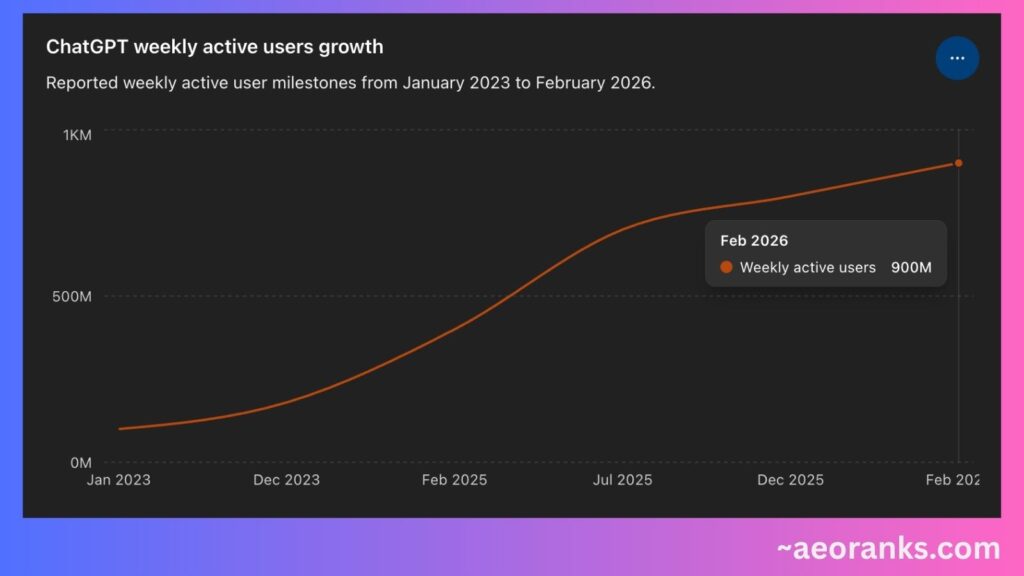
This article will walk you through an effective AI Content Strategy that grows organic traffic, revenue pipeline and authority over time: How to use AI for scale production, structuring content for topical authority, optimising it for traditional SEO and answer engines, and measuring your brand’s true visibility across both search and AI-generated results.
The goal of an AI content strategy is not just to produce more content. It’s to become the source AI systems trust enough to cite when your buyers are asking questions.
◆ TL;DR – What You’ll Learn
- How to use AI to accelerate research, ideation, and content production without losing quality or brand voice
- How to structure content into pillar clusters that build topical authority over time
- How to optimise for SEO and for AI answer engines (AEO and GEO) simultaneously
- How to measure your brand’s share of voice in AI-generated answers and close the gap
Is Your Content Visible in AI Search?
Most brands are creating more content than ever, but few know whether ChatGPT, Gemini, Perplexity, or Google’s AI Overviews can actually discover, understand, and cite their content.
Book a free 30-minute strategy session with Pradeep Kumar to identify AI visibility gaps, uncover content opportunities, and improve your SEO, AEO, and GEO performance.
What Is an AI Content Strategy and Why Does It Go Beyond Writing Faster?
An AI content strategy integrates AI technologies into research, ideation, creation, and distribution workflows to scale production while saving time. AI handles drafting, analyzing, and repurposing. Humans focus on fact-checking, expertise, and authentic brand voice.
The 10-20-70 rule captures how effort breaks down in practice. About 10% goes toward algorithms, 20% toward technology, and 70% toward people. AI without human oversight produces generic, sometimes inaccurate content that damages trust rather than building it.
Think of it this way: traditional content strategy asks, ‘How do we rank for this keyword?’ An AI content strategy asks ‘How do we become the source AI cites when someone asks this question?’ Those goals overlap significantly, but they require different structural thinking – particularly around content depth, format, entity clarity, and topical coverage.
Neither approach is wrong – they serve different eras of search. The most effective approach layers AI capabilities on top of proven SEO fundamentals. Quality content, technical health, and authoritative backlinks/citations still matter deeply.
How to Build an AI Content Strategy in 8 Steps
Audit existing content and search visibility: Before building forward, understand where you stand. Audit your existing content inventory for gaps, outdated information, and topical coverage relative to competitors. Then run your brand through key AI engines: ask ChatGPT, Perplexity, and Google AI Overviews the questions your buyers ask. Are you appearing? Are competitors? This baseline is your starting point for measurement.
Define your audience and search intent: Create detailed ideal customer profiles that include not just demographics but the specific questions your audience asks at each stage of their journey – awareness, consideration, decision. Document these and feed them into your AI tools as the foundation for all subsequent content generation. The quality of this step determines the relevance of everything that follows.
Map Your Content Pillars and Topical Cluster: Use AI to generate a topical map: three to five core pillar topics your brand should own, and ten to twenty cluster articles beneath each one. Prioritise pillars where you have genuine expertise or data to contribute – AI engines reward demonstrated knowledge, not just keyword coverage. Plot this as a content calendar with pillar pages given production priority, since cluster articles derive authority from the pillar’s strength.
Build Brand Voice Guidelines and Prompt Templates: Document your brand’s tone, vocabulary, phrases to avoid, and the kind of examples and data you prefer to cite. Turn these into reusable prompt templates that any team member can use to generate on-brand drafts. This is the guardrail that prevents AI output from sounding generic – and generic content is the quickest way to be ignored by both readers and AI engines.
Generate AI-Assisted Briefs, Drafts, and Structure: Use AI to produce content briefs that include the target question, intent classification, suggested headings, competitor coverage gaps, and recommended schema type. From each brief, generate a first draft structured around the answer-first principle. Every section should open with a direct response, then expand with evidence, examples, and context.
Human Review: Fact-Check, Add Expertise, Refine Voice: Every AI-generated draft must pass through human review before publication. This is non-negotiable. Note what human review is not: running the draft through a humanizer tool. Those tools rewrite sentence rhythm, not substance, and detector scores are not a signal Google or any answer engine actually uses — we break down why in our guide to AI detectors and humanizers. Review means checking facts, adding expertise the model doesn’t have, and cutting what isn’t true.
Publish with Full AEO/GEO Optimisation: Before publishing, apply schema markup appropriate to the content type (FAQPage, HowTo, Article), ensure author bylines with genuine credentials are visible, add a clear datePublished and dateModified, and verify the page is crawlable. Structure internal links so the article connects to the relevant pillar page and two or three related cluster articles. This creates the semantic web of content that reinforces topical authority.
Measure, Refresh, and Compound: Track traditional metrics (rankings, organic traffic, conversions) alongside AI-specific metrics (citations in AI answers, brand mentions in AI-generated responses, share of voice for target queries). Set a cadence for content refreshes – at minimum, revisit any article more than six months old that covers rapidly evolving topics. Freshness matters for both traditional and AI search visibility.
Book A Free Strategy Call ›Benefits of AI Content Strategy – Why to do it?
A solid AI Content strategy can help brands build scalable web architecture with high-value content, strategically internally linked to form topical authority. This has resulted in significant growth in AI visibility and organic traffic.
Scaled Content Production
Teams using structured AI workflows commonly cut first-draft time in half. That freed capacity goes toward deeper research, expert editing, and strategic distribution – the activities that actually differentiate content in a crowded market. The efficiency gain is real, but only valuable if the quality floor stays high. A hundred mediocre articles will not outperform ten genuinely authoritative ones in either traditional search or AI citations. Read our article –> Role of AI Citation in AEO Success.
Topical Authority
AI engines – both Google’s and LLM-based ones – evaluate authority at the topic level, not just the page level. When your site consistently covers a subject in depth, from foundational concepts through advanced application, the AI systems that crawl your content begin to recognise you as a trusted source on that topic. This is why the pillar-and-cluster model is so central to an AI content strategy: it creates the semantic density that authority requires.
AI Search Visibility
Appearing in AI-generated answers is becoming a distinct business metric. Brands cited in ChatGPT or Perplexity responses get exposure at the moment of decision – often before a buyer ever visits a website. Early data suggests traffic from AI-generated answers converts at significantly higher rates than traditional organic traffic, because the buyer is already mid-research and primed.
Organic Brand Growth
When your content is routinely cited across AI platforms, traditional search, industry publications, and social channels, the compounding effect on brand recognition is substantial. Each citation in an AI answer is effectively a recommendation. Collectively, these build the kind of ambient brand awareness that shortens sales cycles and increases inbound quality.
Best AI Tools for Each Stage of Your Content Strategy
Research and Ideation Tools:
Use ChatGPT or Gemini to turn broad topics into content clusters, buyer questions, and prompt-based search ideas. Pair those insights with keyword research tools to validate demand, uncover related entities, and map the questions your audience is already asking. The goal is not just more ideas, but better topic coverage that supports topical authority.
Writing and Editing Tools
Use Jasper, Claude, or ChatGPT to create first drafts, outlines, and content variations faster. Then refine everything with Grammarly or Hemingway-style editing to improve clarity, flow, and readability. AI can accelerate production, but human editing is what keeps the content accurate, credible, and on-brand. One category worth understanding before you add it to your stack: humanizer tools. They promise to make AI drafts read naturally, and independent comparisons of what these tools actually do are worth reading before you budget for one — rewriting cadence is not the same as adding expertise.
SEO, AEO, and GEO Optimization Tools
Use tools like Surfer or Clearscope to align pages with search intent, structure headings, and improve on-page relevance. For AI visibility, go a step further: add schema, strengthen entity signals, and track whether your content is extractable and citation-worthy. AI engines increasingly favor content that is well structured, factually clear, and easy to retrieve in chunks.
Workflow and Distribution Tools
Use StoryChief, HubSpot, or similar platforms to manage calendars, approvals, and distribution. The best systems do not stop at publishing; they repurpose one strong article into social posts, email, sales collateral, and video scripts so the same idea compounds across channels. That wider footprint also supports generative visibility beyond your site.
Analytics and Measurement Tools
Measure three layers separately: traditional search performance, answer-engine visibility, and AI citation presence. Rankings and traffic still matter, but AI-driven discovery now requires additional tracking around citations, share of voice, and whether your brand is actually being surfaced in AI-generated answers.
How to Optimize Content for AI Search and Answer Engines
Structure content for AI extraction and citation
AI systems do not reward dense, rambling copy. They work better with clean headings, short answer blocks, bullets, tables, and direct definitions that can be lifted cleanly into summaries. Start each section with the answer first, then add context, examples, and nuance underneath. That format makes the page easier for both humans and answer engines to understand.
A good rule: put the core answer in the first 40 to 60 words of the section, then expand. This helps with AI extraction and makes the article easier to scan. HubSpot’s AEO/GEO coverage leans heavily into answer-first structuring for exactly this reason.
Strengthen entities and schema markup
AI systems need to understand who you are, what you do, and how your topics connect. Use consistent entity language across the page, your schema, your author bio, and your site structure. Add Article, FAQPage, Organization, and relevant schema types so the page is easier to interpret and reuse in AI-generated answers.
Build E-E-A-T signals AI engines trust
Experience, expertise, authoritativeness, and trustworthiness still matter. Strong author bios, original insights, citations, reviewed facts, and visible brand proof all increase the chance that your content will be treated as a reliable source. For GEO in particular, off-site mentions and editorial credibility help generative engines decide who to cite.
Think in sections, not just pages
AI search often retrieves passages, not whole pages. That means every major section should stand alone as a useful answer. Use one idea per section, keep the wording precise, and make each block usable on its own in a summary or citation. This is one of the clearest differences between traditional blog writing and AI-ready content.
How to Measure the ROI of an AI Content Strategy
The right question is not simply “Did content get published?” but “Did content create visibility, trust, and pipeline?” The most successful AI content programs measure performance across efficiency, visibility, and business impact.
Efficiency
- Time saved per article
- Faster publishing cycles
- Lower production costs
- Higher content output
Visibility
- Keyword rankings
- AI Overview inclusion
- Answer engine citations
- Brand mentions
Business Impact
- Qualified traffic
- Lead generation
- Conversion growth
- Pipeline influence
Measure Two Discovery Surfaces, Not One
Traditional Search
Keyword Rankings Organic Traffic ConversionsAI Search Visibility
AI Citations Answer Engine Presence Brand MentionsRun one content strategy, but measure two discovery surfaces: traditional search and AI answer engines.
Common Mistakes to Avoid With AI Content
- Publishing AI output without human review.
- Writing in generic brand voice that sounds like everyone else.
- Optimizing only for Google and ignoring AI answers.
- Skipping fact-checking and source validation.
- Automating too much and losing expert perspective.
- Using unstructured content that is hard to extract or cite.
The biggest mistake is treating AI content as a volume play only. The pages that win in AI search are usually the pages that are most structured, most credible, and most useful at the sentence level.
Do AI Detectors and Humanizers Belong in Your Workflow?
Short answer: detectors are a diagnostic at best, and humanizers solve a problem that does not affect your visibility.
Many teams building an AI content workflow add a detect-and-humanize step, assuming a low AI score protects their rankings. It does not. Google’s stated position is that AI assistance is not itself a violation — the criterion is whether the content is useful, original, and demonstrably expert. Answer engines apply a similar test when deciding what to cite.
What these tools do is narrower than the marketing suggests. Detectors measure surface features like sentence rhythm and word predictability, which is why they produce false positives on human writing. Humanizers alter those same surface features. Hands-on testing of how much a humanizer really changes a draft shows the edits are largely cosmetic — the underlying claims, structure, and gaps stay exactly as the model left them.
For a view of the current landscape, this roundup of detector and humanizer tools covers what is available. But treat the category as optional tooling, not a quality gate. The step that protects your visibility is the one in Step 6: a human who knows the subject, checking what is true and adding what the model could not.
Turn AI Content Visibility Into Pipeline
Building an AI content strategy is only step one. The real goal is turning discoverability into qualified demand, and that means making your content easy to find, easy to understand, and easy to trust across search engines and AI systems.
AEORanks helps brands connect SEO, AEO, and GEO into one growth system: stronger topical authority, better answer visibility, and more brand citations in AI-generated results. That is what turns content into compounding organic growth. Book A Strategy Call with US –>