Google AI Overviews are AI-generated answers that appear at the top of Google search results for some queries. The AI Overview section is designed to answer complex questions instantly. Instead of showing only a list of blue links, Google uses AI to understand your query, collect useful information from different web pages, and create a short summary directly on the search results page.
By default, the AI Overviews search feature appears at the top of the page, “zero position” in SERP. Along with the answer, this section also includes website citations and an option to dive directly into AI mode for the query. Normal search results can be seen after this section.
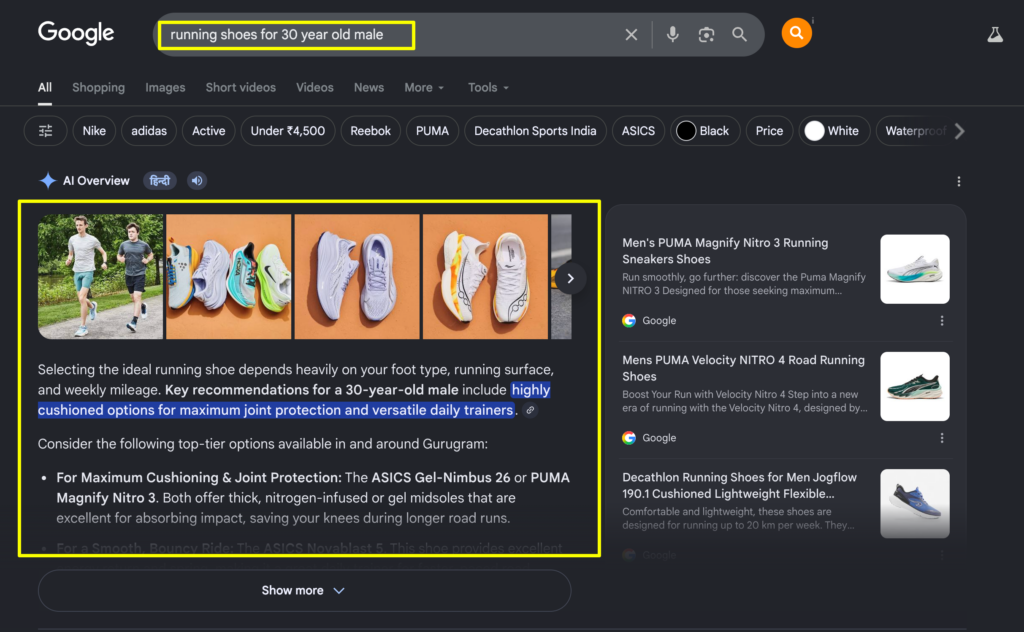
This change in Search behaviour has made a significant dent in organic rankings and traffic – brands are not getting traffic even after ranking in the No. 1 spot in organic results. This makes AI Overviews the prime place for any brand to be visible, but how?
By Answer engine optimization (AEO) is the process of optimizing your content so AI search engines and answer boxes can easily understand, extract, and show it as a direct response. It helps your brand appear in featured snippets, AI Overviews, and other question-based search results.
Rank Across AI Search Platforms
Grow visibility across ChatGPT, Claude, Gemini & Perplexity with AI-first SEO strategies.
Book Free Strategy Call ChatGPT
 Claude
 Gemini
 Perplexity
 Grok
Grok
For example, if someone searches “what is Google AI Overview”, Google may show a quick AI-written explanation at the top, along with links to the sources it used. This helps users get a faster answer without opening multiple websites.
Google AI Overviews are Google’s AI-powered summaries that answer search queries directly on the SERP, usually above traditional organic results.
Google’s AI Overviews now appear on an estimated 65% of queries. ChatGPT processes over 5.7 billion monthly visits. Perplexity is becoming millions of users’ default research tool. The result? A growing share of your audience never scrolls to the organic results. They read the AI answer, form an opinion about your brand (or don’t), and move on – all before clicking a single link.
This guide breaks down exactly what it takes to show up in AI Overviews, get cited by ChatGPT and Perplexity, and build a presence in the AI-driven search ecosystem – whether you’re an SEO professional, a marketer just getting started with AEO & GEO (Generative Engine Optimization), or someone trying to understand why AI search matters at all. Before optimizing for AI search, you need to understand what’s happening under the hood.
How Do AI Overviews Get Generated?
AI search engines don’t rank a single page and show it. Instead, they retrieve, evaluate, and synthesize information from multiple sources to generate a direct answer.
Crawl & Index Content
AI systems discover webpages, documentation, articles, FAQs, and other content across the web.
Break Into Chunks
Content is split into smaller sections that can be individually understood and retrieved.
Convert To Embeddings
Each content chunk is transformed into vectors so AI can understand meaning and context.
Retrieve Relevant Content
When a user asks a question, AI retrieves the most relevant content fragments based on semantic similarity.
Generate Answer
The LLM combines retrieved information into a single response and cites trusted sources when appropriate.
Want Your Brand To Be Cited In AI Search?
Let’s identify the gaps preventing your content from being discovered, trusted, and referenced across ChatGPT, Gemini, Perplexity, and Google AI Overviews.
Book Free Strategy CallWhen you type a question into Google today, Gemini – Google’s large language model – doesn’t just rank pages. It reads multiple sources, synthesizes the most relevant information, and generates a single answer at the top of the results page, with citations. This is Google’s AI Overview (AIO).
ChatGPT Search, Bing Copilot, and Perplexity work similarly, using a technique called Retrieval-Augmented Generation (RAG). Here’s the short version: your page gets broken into small “chunks” of text, those chunks get converted into numerical vectors (embeddings), and when a user asks a question, the AI retrieves the most semantically relevant chunks and builds an answer from them.
Three key technologies power this process:
- NLP (understanding conversational language),
- Semantic search/embeddings (matching meaning, not just keywords), and
- the LLM itself (to write the answer).
The stakes are real. AI search visitors convert at 14.2% compared to 2.8% from traditional organic search – a 5x differential. Brands cited in AI Overviews also see 35% higher organic CTR and 91% higher paid CTR compared to those not cited. Visibility in AI search isn’t just a vanity metric. It directly compounds your performance across every channel.
How AI Search Engines Decide Which Brands to Recommend
AI search platforms don’t evaluate content the same way traditional search engines do. Instead of focusing primarily on keywords and backlinks, they look for signals that indicate trust, authority, expertise, and real-world recognition. Understanding these five signals can help your business increase its visibility, earn more AI citations, and improve its chances of being recommended in platforms like ChatGPT, Gemini, Perplexity, Claude, and Google AI Overviews.
1. Brand Mention Volume (The New Authority Signal)
In traditional SEO, authority was largely built through backlinks. In AI search, authority is increasingly shaped by how often your brand is mentioned, discussed, reviewed, and referenced across the web.
AI systems don’t simply count links. They learn from vast amounts of content across websites, forums, communities, reviews, and publications to determine which brands are trusted within a topic or industry. As a result, brands with a strong digital footprint are more likely to be cited and recommended in AI-generated answers.
Research shows that brand mentions have a significantly stronger correlation with AI citations than backlinks. This means AI platforms are paying closer attention to overall brand visibility and reputation rather than link volume alone.
Think about where your brand appears:
- Industry publications
- Reddit discussions
- Review platforms
- Niche communities
- Podcasts and webinars
- Expert roundups
- Social media conversations
The more frequently your brand is referenced in trusted contexts, the more confidence AI systems have in recommending it.
How to improve this signal:
- Invest in digital PR and earned media
- Encourage reviews and customer testimonials
- Participate in industry communities and forums
- Build founder and executive thought leadership
- Publish original research and expert insights
The shift is clear: successful AI visibility strategies focus less on link building and more on building a recognizable, trusted brand across the web.
2. Content Freshness
76.4% of ChatGPT’s most-cited pages were updated within the last 30 days. AI algorithms apply time decay – content that hasn’t been touched in months slowly gets deprioritized as competing, fresher sources emerge.
This doesn’t mean writing new content constantly. It means systematically refreshing your most important pages: updating statistics, replacing outdated examples, adding new perspectives, and changing the dateModified timestamp in your schema.
What to do: Set a quarterly content refresh schedule. Prioritize pages targeting your highest-value queries and make meaningful updates — not just minor edits to game freshness signals.
3. Structured Content Format
Listicles are cited in AI Overviews at a 25% rate. General blog posts achieve 11%. The difference isn’t quality – it’s extractability. AI systems favor content they can cleanly parse and repackage into an answer. Unbroken walls of text, even brilliant ones, get skipped.
61% of AI Overviews include unordered lists. Comparison tables, step-by-step processes, and FAQ sections dominate AI-generated answers because they match the format the AI needs to synthesize a useful response.
What to do: Restructure your most important pages around lists, tables, clear H2/H3 headings, and short paragraphs (2–4 sentences max). Think “extraction-friendly,” not just “readable.”
4. Schema Markup and Structured Data
Schema markup improves source citation rates by 30%. JSON-LD structured data gives AI engines explicit context: this is a FAQ, this is a HowTo guide, this is an Article written by this author with this publication date.
Without schema, the AI has to infer all of this. With schema, you’re handing it a labeled roadmap.
FAQ sections are among the most-cited content types in AI Overviews. But a single FAQ block at the bottom of a 3,000-word article is a missed opportunity.
Embed FAQ modules within relevant sections, each with 2–4 tightly written Q&A pairs that address follow-up questions naturally. Each pair becomes an independent extraction target. Mark them up with FAQ schema. Keep answers under 60 words where possible – concise responses are consistently favored over longer explanations in AI-generated summaries.
Types of Schema to add for AI overviews Optimization
- Use Google’s Rich Results Test to validate your structured data
- Implement Article schema with
author,datePublished,dateModified - Add FAQ schema to every question-answer section
- Use Organization schema with
sameAslinks to your social profiles and knowledge panel
What to do: At minimum, implement FAQ schema, Article schema, and – where relevant – HowTo, Product, and Organization schemas. Add datePublished and dateModified, author Person schema with sameAs links to professional profiles, and canonical tags to prevent signal dilution.
5. Traditional SEO Foundation
In order to rank in AI Overviews, we don’t have to do something differently. Your website should have a strong SEO foundation, and then build an AEO layer on top of it. To get featured in answers, your website should be technically sound, have trust signals, structured content and schema markup implemented.
AI doesn’t discover content that the traditional algorithm misses. It amplifies what’s already surfacing. If your page isn’t crawlable, fast, mobile-friendly, and earning at least some organic traction, the AI will cite a competitor who is.
What to do: Core Web Vitals, mobile optimization, HTTPS, clean crawl paths, and no blocked AI crawlers (check your robots.txt for GPTBot, PerplexityBot, and other AI user agents). These are table stakes, not optional extras.
Content Structure: The Architecture of a Page AI Wants to Cite
Most pages that struggle with AI visibility have the same problem: they’re written for human readers who read start to finish, not for AI systems that extract fragments.
Here’s what changes when you write for AI discoverability:
Lead With the Answer, Then Explain
Every major section should open with a direct, self-contained answer to the implied question — within the first 1–2 sentences. Supporting context, nuance, and examples come after.
Instead of this: “When we consider the landscape of enterprise resource planning, there are many factors that organizations must weigh carefully before making a decision…”
Write this: “ERP systems for construction companies should prioritize job costing, project management integration, and field-to-office data sync. Here’s why each matters…”
The AI extracts the first sentence. Your reader reads the full section. Both get what they need.
How Google AI Overviews Actually Choose Sources
Google AI Overviews cites a website or webpage if it’s highly relevant, has direct answers, a structured format, and satisfies multiple intents behind the searched query. One of the biggest misconceptions about Google AI Overviews is that they simply pull information from the highest-ranking pages.
In reality, Google’s AI systems evaluate multiple signals before deciding which sources to reference, summarize, or cite in an AI-generated answer. A page can rank well organically and still fail to appear in AI Overviews, while another page with stronger topical relevance or clearer answers may be selected instead.
Think of AI Overviews as a two-step process:
- Find the most relevant information
- Find the most trustworthy source for that information
To do this, Google’s AI systems retrieve content from multiple pages, analyze specific passages, compare sources, and generate a synthesized answer. The pages that provide the clearest, most useful, and most credible information are more likely to be cited.
1. Relevance to the User’s Question
Google looks for content that directly answers the query.
Pages that clearly define concepts, answer questions, and address user intent are more likely to be selected than pages filled with generic information or unnecessary introductions.
For example, if someone searches: “How do I rank in Google AI Overviews?”
A page with a clear framework, actionable steps, and direct answers will typically have a higher chance of being cited than a broad SEO article that only briefly mentions AI Overviews.
2. Topical Authority
Google wants confidence that the source genuinely understands the topic. Websites that consistently publish content around AI search, SEO, AEO, GEO, and related subjects often build stronger topical authority than sites covering dozens of unrelated topics.
This is why content clusters, pillar pages, and strong internal linking structures have become increasingly important for AI visibility.
3. Passage-Level Quality
AI Overviews don’t always evaluate an entire page. They often retrieve and analyze specific sections or passages. A well-structured paragraph that clearly explains a concept can be cited even if it sits within a larger article. This makes content formatting critical:
- Clear headings
- Concise explanations
- Bullet points
- Tables
- Definitions
- Step-by-step instructions
The easier your content is to extract and understand, the easier it becomes for AI systems to reuse it.
4. E-E-A-T and Trust Signals
Google continues to prioritize Experience, Expertise, Authoritativeness, and Trustworthiness (E-E-A-T). AI systems are more likely to surface content that demonstrates:
- First-hand experience
- Expert authorship
- Credible references
- Accurate information
- Strong brand reputation
Author profiles, citations, original research, and transparent sourcing all help strengthen trust signals.
5. Entity Recognition and Brand Authority
Google increasingly evaluates entities – not just webpages. An entity can be:
- A company
- A person
- A product
- A concept
- A brand
When Google clearly understands who you are, what you specialize in, and how you’re connected to a topic, your content becomes easier to trust and cite.
This is one reason why brand mentions, digital PR, author authority, and consistent entity optimization play a growing role in AI visibility.
6. Build Topic Clusters, Not Isolated Pages
A single excellent article rarely gets AI traction. What AI platforms look for is topical authority — evidence that your domain deeply covers a subject from multiple angles.
A pillar page on “AI search optimization” supported by specific articles on schema markup, brand mention building, content freshness strategies, and technical crawler access signals topical depth. The AI cites brands that own topics, not brands that have one good article.
The practical model: One comprehensive pillar page + 4–8 supporting articles covering subtopics → interlinked with descriptive anchor text → creating a “knowledge cluster” the AI recognizes as authoritative.
Building Brand Authority for AI Discovery
This is where AI search strategy diverges most sharply from traditional SEO – and where most brands underinvest.
LLMs learn from the full web corpus. They “know” your brand based on how it’s described across every mention, review, forum post, news article, and community discussion. Your on-site content is only one input.
The brands dominating AI citations tend to share common off-page characteristics: they’re discussed in industry publications, they appear in forum threads where people ask for recommendations, they have consistent Knowledge Panel information, and their executives or team members have recognizable professional profiles.
Practical authority-building moves:
- Digital PR: Target placements in publications that AI platforms frequently cite. Earned coverage in industry media creates lasting brand mention signals.
- Community participation: Engage meaningfully on Reddit, LinkedIn, and niche forums where your target audience asks questions. AI systems draw heavily from these sources – Reddit and LinkedIn are in the top-cited domains across all major AI platforms.
- Wikipedia presence: If your company or category is notable enough, a well-maintained Wikipedia page (or being mentioned on relevant Wikipedia pages) signals legitimacy to AI systems trained on the full web.
- Consistent entity signals: Ensure your brand name, description, and category are consistent across your website, Google Business Profile, Crunchbase, LinkedIn, industry directories, and anywhere else you appear. AI systems use these signals to resolve your “entity” – the more consistent the picture, the clearer your authority.
Measuring AI Search Visibility: The Metrics That Actually Matter
Traditional ranking reports miss most of AI search’s impact. When AI Overviews are present, Google Search’s CTR drops by 34.5%. For Google’s AI Mode, the zero-click rate reaches 93%. Ranking #1 in organic results while being invisible in AI Overviews means significantly less traffic than it used to.
Metrics to track:
| Metric | What It Tells You |
|---|---|
| AI Overview Impressions | How often your content surfaces in AIO triggers (Google Search Console) |
| Citation Frequency | How often your domain is cited across AI platforms per query set |
| Share of Voice | Your citation rate vs. competitors on target topics |
| Brand Mention Volume | Third-party web mentions – the leading indicator of citation growth |
| AI-Referred Engagement | Time on page, conversion rate, and scroll depth from AI-sourced sessions |
Tools to consider: Profound, Peec AI, Semrush AI Toolkit, Ahrefs Brand Radar, SE Ranking’s AIO tracking, and ZipTie each offer different angles on AI visibility. Google Search Console provides impression data for queries triggering Overviews, though granular AIO-specific data is still limited.
Set a baseline now. The brands tracking AI visibility today will have the competitive data advantage six months from now.
What’s the difference between traditional SEO and AI search optimization?
Traditional SEO optimizes for Google’s ranking algorithm – backlinks, keywords, page authority, and technical factors. AI search optimization (also called GEO / AEO) focuses on citation-worthiness: how likely an AI system is to extract and reference your content when answering a related query. The key differences are that brand mentions matter more than backlinks, content structure affects extractability directly, freshness is weighted more heavily, and third-party presence influences visibility more than on-site content alone. Critically, they aren’t competing strategies, 76.1% of AI-cited URLs also rank in the top 10 organically. Traditional SEO is still the foundation; AI optimization adds a layer on top.
Why is my content not showing up in AI Overviews even though I rank well organically?
The most common causes are: your key content is JavaScript-rendered (not visible in raw HTML source), AI crawlers are blocked in your robots.txt, your content isn’t structured for extraction (dense paragraphs without lists or direct answers), or you lack the off-page brand mention signals that AI systems use to assess authority. Run this diagnostic: view your page source and confirm content is visible; check robots.txt for blocked AI bots; compare your brand mention volume to competitors who are being cited; then assess whether your content leads with direct answers or buries them after long preambles.
How important is schema markup for AI search visibility?
Very important. Schema markup improves citation rates by approximately 30% because it gives AI systems explicit, structured context about your content – what type of content it is, who authored it, when it was published, and what specific questions it answers. Without schema, the AI has to infer all of this from unstructured text. At minimum, implement FAQ schema on every Q&A section, Article schema with author and date information, and HowTo schema for step-by-step content. JSON-LD format is the recommended implementation method.
Does content length matter for AI Overviews?
Length matters less than structure and relevance. High-ranking pages average around 1,447 words, but comprehensiveness and extractability matter more than hitting a word count. A 800-word page that’s perfectly structured with direct answers, clear headings, FAQ schema, and strong brand authority will outperform a 3,000-word article that buries its insights in dense narrative paragraphs. Focus on covering your topic thoroughly and formatting each section so it can stand alone as an extracted answer.
How do I build brand authority for AI search if I’m a smaller brand?
Start with consistency – ensure your brand name, description, and category information are identical across your website, Google Business Profile, LinkedIn, Crunchbase, and any directories in your industry. Then focus on community-level presence: participate genuinely in relevant Reddit threads, LinkedIn discussions, and industry forums where your target audience asks questions. These communities are heavily indexed by AI systems. Pursue 2–3 targeted PR placements in credible industry publications rather than mass outreach. Each earned mention in a trusted source trains AI systems to recognize your brand as a legitimate authority in your space.
How do I track whether my content is being cited in AI Overviews?
Google Search Console shows impression data for queries that trigger AI Overviews, though it doesn’t yet offer granular per-page AIO data. For deeper tracking, tools like SE Ranking’s AIO Toolkit show which AI Overviews mention your brand or link to your pages. Ahrefs Brand Radar and Semrush’s AI Toolkit track citations across multiple AI platforms. Manual checking – searching your target queries directly and noting which sources appear in the AI Overview – is still valuable for qualitative pattern recognition. Track citation frequency, share of voice against competitors, and brand mention volume as your core AI visibility KPIs.