You don’t rank in Perplexity. You get cited — or you don’t. There’s no position three, no blue links to climb. Perplexity retrieves sources, synthesises one answer, and lists the handful it used. You’re either in that list or you’re invisible.
Which sounds like a small semantic point until you realise it changes what you optimise for. Everything below follows from it.
Key takeaways
- Perplexity runs an entity reranker that can discard an entire result set if too few sources clear its quality bar. Weak topical authority doesn’t rank lower — it drops you out.
- It carries manual lists of authoritative domains — Amazon, GitHub, LinkedIn, Coursera among them. Being referenced on those carries an inherent boost.
- Topic matters. Tech, AI and science get boosted. Sports and entertainment get suppressed.
- Reddit is roughly 46% of Perplexity’s citations. No other platform comes close.
- Freshness is weighted heavily — time decay is explicit, and content outside a rough 12-month window struggles.
- Early engagement compounds. Clicks in the first days shape long-term visibility.
First, how Perplexity actually works
Perplexity doesn’t have an index it sorts and shows you. It does something closer to what a researcher does under time pressure: takes your question, breaks it into sub-questions, runs searches, grabs the passages that look useful, and writes an answer from them.
Three things follow.
It cites a small number of sources. Not ten. Usually a handful. The shortlist you’re competing for is much shorter than a page of search results.
It reads passages, not pages. Your page isn’t evaluated as a whole. Individual chunks are pulled out and assessed on whether they answer the question on their own. A brilliant page where no single paragraph stands alone can lose to a mediocre one with a clean, liftable answer.
It’s probabilistic. Ask the same question twice, get different sources. That’s not a bug — the model re-retrieves each time. It also means “do we show up?” is the wrong question. The right one is “how often, across how many runs?”
If that mental model is new, our guide to answer engine optimization covers the fundamentals before you go further here.
What the research found about Perplexity’s ranking logic
Here’s where most guides on this topic stop short. They’ll tell you to write answer-first and add schema — fine advice, and the same advice as everywhere else. What almost nobody covers is what’s been reverse-engineered about Perplexity’s actual systems.
Independent researcher Metehan Yesilyurt analysed browser-level interactions with Perplexity’s infrastructure and documented what he describes as 59 ranking patterns. Search Engine Land covered the findings in 2025.
Important caveat, and I’d rather say it than bury it: this research is unverified. Perplexity hasn’t confirmed any of it. Treat it as the best available reverse-engineering, not gospel. That said, it’s considerably more specific than anything else published on this topic, and the patterns line up with observable behaviour.
Three findings matter most.
1. The entity reranker can throw out your whole result set
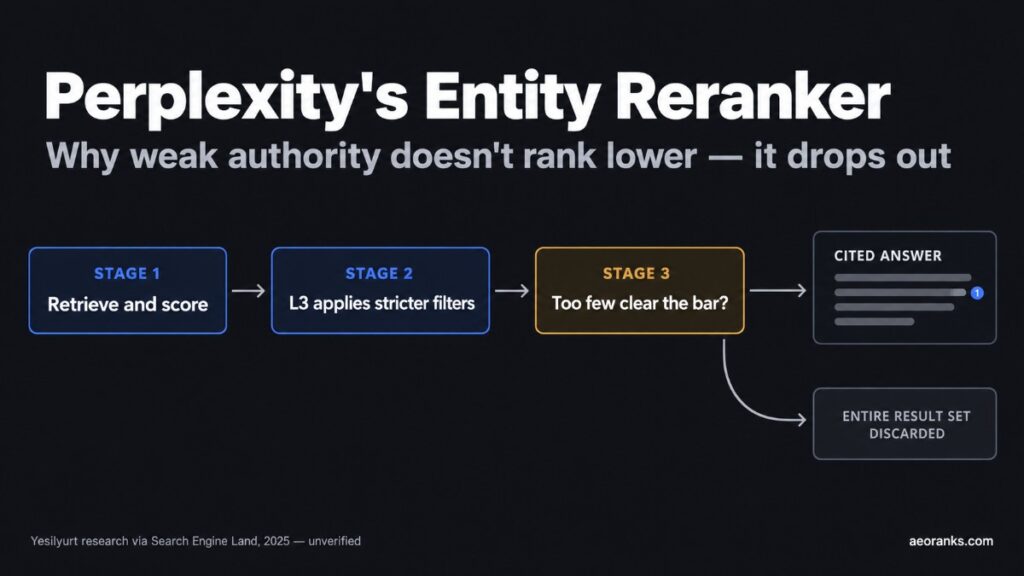
Perplexity runs a three-layer machine learning reranker — called L3 — on entity searches. That’s queries about people, companies, topics and concepts, which is to say most commercial queries you care about.
The sequence: results get retrieved and scored normally. Then L3 applies stricter filters. And if too few results clear the threshold, the entire set gets scrapped.
Sit with that for a second. It’s not a ranking penalty. It’s exclusion. If your content doesn’t clear the quality and authority bar, you don’t appear further down — you don’t appear.
The practical read: keyword optimisation won’t save you here. Topical depth and genuine authority are what get you past L3. This is the mechanism behind every piece of advice you’ve read about building topical authority — now you know why it matters specifically.
2. Some domains carry a manual authority boost
The research turned up manually curated lists of authoritative domains — Amazon, GitHub, LinkedIn and Coursera were among those identified.
Content on or referenced by those platforms inherits an authority advantage. Which is a slightly uncomfortable finding, because it means some of your visibility isn’t about your site at all. It’s about where else you exist.
Practically: an active, substantive LinkedIn presence isn’t a social media nicety for Perplexity visibility. If you’re in developer tooling, GitHub matters. If you publish courses or training, Coursera does.
3. Perplexity has topic preferences
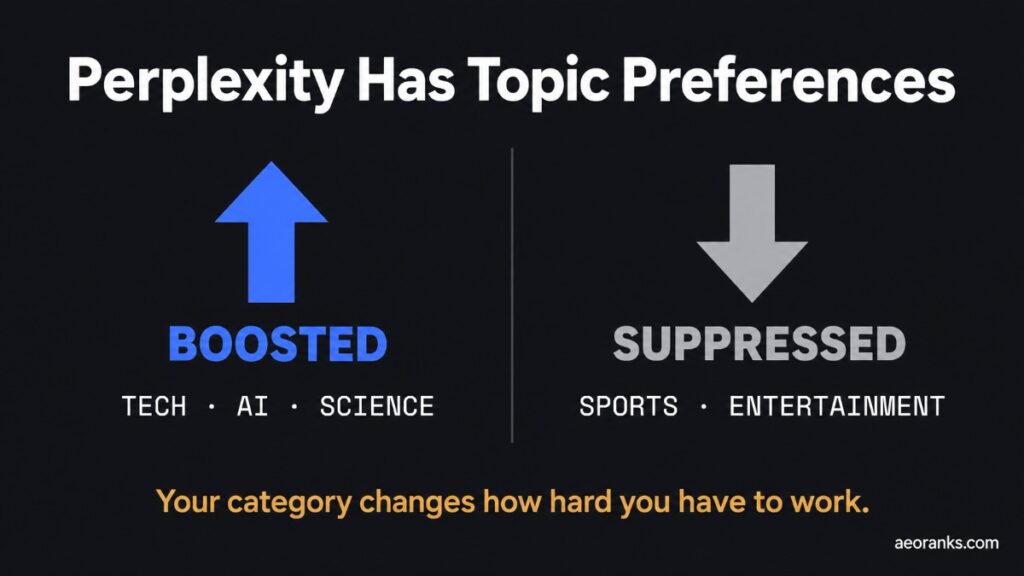
This one surprised me. The documented factors include topic classification — tech, AI and science get boosted; sports and entertainment get suppressed.
If you’re in B2B software or technology, you’re working with a tailwind. If you’re in lifestyle, entertainment or sport, you’re pushing against a built-in bias, and you’ll need to work proportionally harder on the other signals.
Nobody else writing about Perplexity seems to mention this, and it changes how you’d set expectations with a client.
The rest of the documented factors
| Factor | What it means for you |
|---|---|
| New post performance | Early clicks shape long-term visibility. The first few days matter disproportionately. |
| Time decay | Visibility drops as content ages. Publishing and refreshing on a cadence isn’t optional. |
| Semantic relevance | Content needs to be genuinely comprehensive, not keyword-matched. |
| User engagement | Clicks and historic engagement feed performance models. |
| Memory networks | Interlinked content clusters rank better together than isolated pages do. |
| Negative signals | User feedback and redundancy checks can bury content that adds nothing new. |
That “memory networks” line is worth a second read. Interlinked clusters outperform standalone pages — which is the strongest argument I’ve seen for building topic clusters rather than chasing individual keywords.
Where Perplexity actually gets its sources
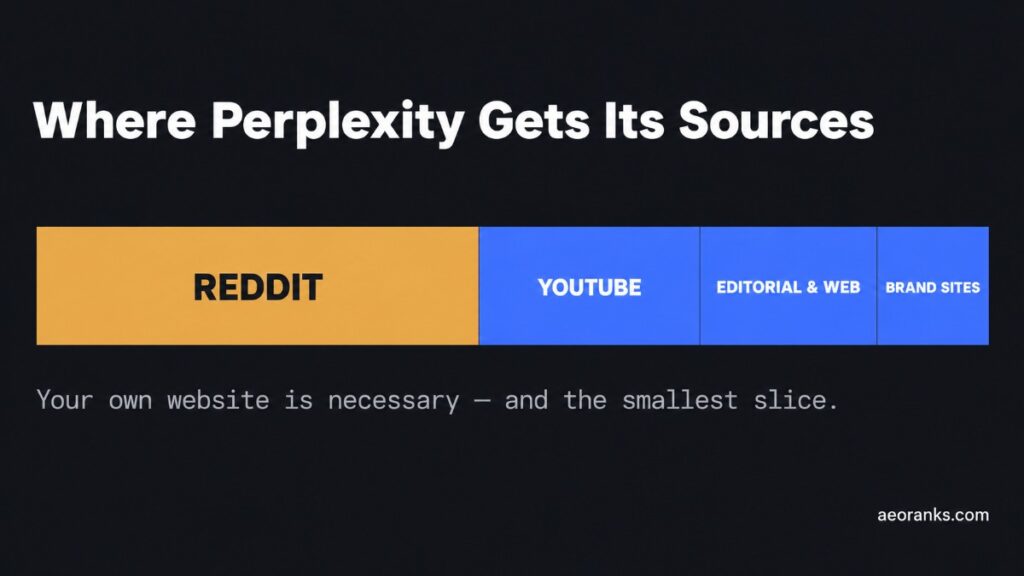
Reddit is the single largest source of Perplexity citations — around 46% by one analysis. Nothing else is close.
That number tends to annoy people, because you can’t buy your way onto Reddit and promotional posts get shredded. But it’s the reality of the platform, and ignoring it means ignoring nearly half of where Perplexity looks.
What actually works there: genuinely answering questions in the subreddits where your buyers hang out, over months, without pitching. Slow, unglamorous, and effective.
YouTube is the other big one — and there’s a specific finding worth knowing. The research suggests YouTube titles that closely match trending Perplexity queries see boosted visibility on both platforms, which points to some cross-platform validation. Moving fast on emerging topics seems to be rewarded.
Then there’s your own site, which is where most of your effort goes but a smaller share of citations come from. That’s the uncomfortable arithmetic of AI visibility: your website is necessary but not sufficient. We break down why in why AI finds content but doesn’t cite it.
9 things to Rank in Perplexity Answers
1. Answer in the first 40–60 words
Lead every page and every section with the direct answer, then expand. Perplexity lifts passages — if your answer arrives in paragraph four, it may never be found.
Test for it: can you copy any single paragraph, paste it somewhere with no context, and have it still make sense? If not, it’s not extractable.
2. Make headings the questions people ask
“How much does X cost?” beats “Pricing considerations.” Perplexity matches retrieved passages to question intent, and a heading phrased as the question is doing half that work for it.
3. Build clusters, not orphans
Given the memory networks finding, a single excellent page on a topic underperforms six connected ones. Internal linking isn’t housekeeping here — it’s a ranking input.
4. Publish and refresh on a cadence
Time decay is explicit in the documented factors, and Perplexity’s recency preference is the most consistently reported thing about it across every source I’ve read. Set a quarterly refresh on your important pages. Update stats, add recent examples, change the date honestly.
5. Put real numbers in
Specific, sourced data gets cited. Vague claims get skipped. “Conversion improved significantly” is unusable. “Conversion rose 34% over 90 days (internal data, n=127)” is a quotable fact.
6. Get on Reddit properly
Find the two or three subreddits where your buyers actually ask questions. Answer them. Don’t link to yourself for the first month. This is a six-month play, not a campaign.
7. Build presence on the boosted domains
LinkedIn long-form, GitHub if you’re technical, Coursera if you teach. Given the manual authority lists, presence on those platforms carries weight your own domain can’t replicate.
8. Use Perplexity Pages
Perplexity lets you publish Pages that can themselves appear as cited sources. Barely anyone uses this. It’s the one direct lever the platform actually hands you, and it costs nothing but time.
9. Fix the boring technical stuff
Make sure PerplexityBot isn’t blocked in robots.txt. Add Article and FAQPage schema. Keep the site fast and crawlable. None of this wins you citations on its own — all of it can quietly prevent them. Our technical SEO consulting covers the audit if you’d rather not do it yourself.
What doesn’t work
Keyword stuffing. The founding GEO research found it performed worse than no optimisation on a live engine. Perplexity’s semantic relevance factor explicitly rewards comprehensiveness over matching.
llms.txt. Still being sold as a Perplexity tactic. In controlled testing, AI bots didn’t request the file at all over three months, and 97% of published llms.txt files were never requested by anyone. We covered the evidence in what is llms.txt.
“Parasite SEO” shortcuts. The YouTube results ranking for this query are full of them. Posting on someone else’s high-authority domain to borrow their trust works until the host platform cleans up, and you’ve built nothing you own.
Checking once and declaring victory. Perplexity is probabilistic. One query proves nothing in either direction.
How to measure whether it’s working
Build a fixed set of 20–30 questions your buyers genuinely ask. Run them on Perplexity weekly. Record three things each time: whether you appear, which competitors appear, and which sources got cited.
Three numbers come out of that — appearance rate, share of voice against competitors, and prominence (named early and clearly, or buried). Track the trend, not the snapshot.
The full setup is in our guide to tracking AI share of voice.
Not sure where you stand on Perplexity right now? Book a free AI visibility audit. We’ll run your priority questions across Perplexity, ChatGPT, Gemini and AI Overviews, show you which competitors are cited instead of you, and tell you which gap is worth closing first.
How do I rank number one in Perplexity?
There’s no number one. Perplexity synthesises an answer from a handful of sources and lists them — the goal is being included and named early, not holding a position. Appearance rate across repeated runs is the closest equivalent to a ranking.
Does Perplexity use Google rankings?
Not directly. Perplexity runs its own retrieval and reranking, and research suggests it applies manual authority lists and entity-level filters Google doesn’t use. Strong SEO helps you get discovered, but it doesn’t decide whether Perplexity cites you.
How long does it take to get cited by Perplexity?
Structural changes to pages that already get traffic often show movement within four to eight weeks — Perplexity responds faster than most engines because it weights freshness heavily. Authority and community presence take three to six months.
Why does Perplexity cite Reddit so much?
Around 46% of its citations come from Reddit, which reflects a preference for authentic, community-validated discussion over brand-published material. Genuine participation in relevant subreddits is one of the highest-leverage activities for Perplexity specifically.
Does llms.txt help with Perplexity?
No evidence it does. Controlled testing found AI bots didn’t request the file across three months, and 97% of published llms.txt files received zero requests. Implement it if it’s cheap; don’t build a strategy on it.
What content format does Perplexity prefer?
Answer-first passages that stand alone, question-shaped headings, comparison tables, specific sourced statistics, and FAQ blocks. The common thread is extractability — can a single chunk be lifted out and used without the surrounding context?
Is Perplexity worth optimising for if it’s smaller than Google?
For B2B and technical categories, usually yes. Perplexity users click cited sources at higher rates than typical AI referral traffic, and the documented topic bias favours tech, AI and science — so the audience quality tends to offset the volume difference