Topical authority is how completely and credibly your site covers one subject. Not one page about it — the whole subject. Definitions, comparisons, costs, objections, edge cases, the lot. When a site covers a topic that thoroughly and connects it all together, search engines and AI systems start treating it as a go-to source rather than one more result.
One thing to get straight before we go further: there’s no topical authority score. Google has never published one. It isn’t a metric you can look up like Domain Rating. It’s an operating model — a way of organising how you cover a subject — and the sooner you treat it that way, the less time you’ll waste hunting for a number that doesn’t exist.
Key takeaways
- Topical authority is about coverage and coherence, not word count or publishing volume.
- It’s not a Google ranking factor with a published score. It’s a model that makes relevance easier to establish.
- A small site can beat a big one on a narrow topic — this is the main reason to care.
- For AI search it matters more than for Google, because of how retrieval filtering works.
- You measure it by tracking observable signals — intent coverage, internal graph health, query spread, evidence — not a single number.
What topical authority actually means
Here’s the way I find easiest to explain it.
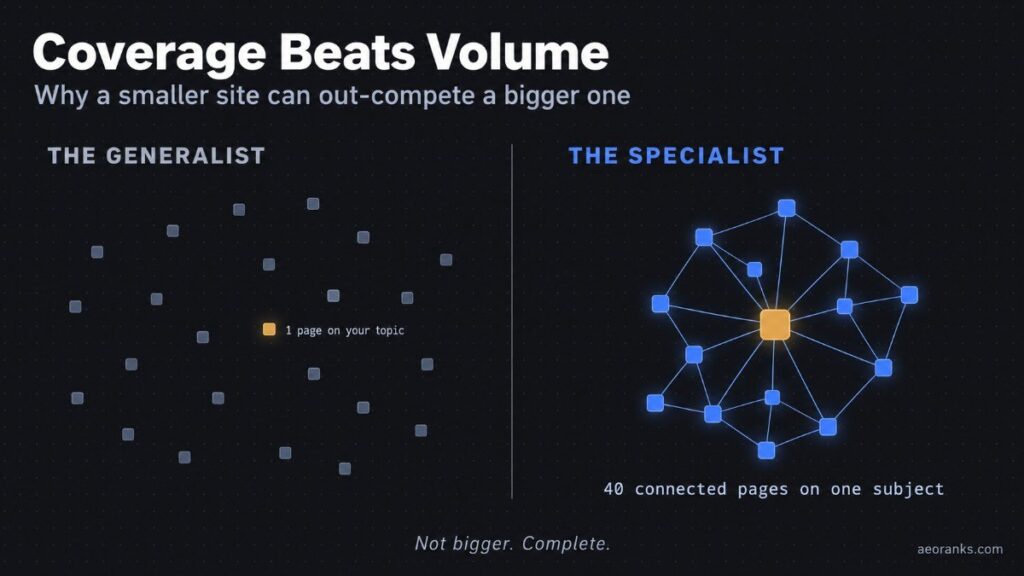
Imagine you need serious advice about commercial lease negotiation. Two options. One is a general business blog that’s published 400 posts about everything from hiring to accounting, including one piece on leases. The other is a site with forty connected articles about commercial property — lease structures, rent review clauses, dilapidations, break options, what happens when you want out early.
You’d pick the second one. So would a search engine. Not because it’s bigger, but because it’s complete on the thing you asked about.
That’s topical authority. Depth over one subject, with the pieces connected to each other so the relationship between them is obvious.
Why keywords stopped being the unit
The old model was one page, one keyword. Write “best CRM software,” rank for “best CRM software,” repeat.
Search systems don’t work that way anymore. They understand that “CRM,” “customer relationship management,” “pipeline software” and “sales tracking tool” all point at the same underlying thing — an entity, not a string of text. Once systems reason about entities and relationships, the question stops being “does this page match the query” and becomes “does this site actually know this subject.”
A single page can’t answer that. A connected set of pages can. That’s the whole shift, and everything else in this guide follows from it.
If some of this vocabulary is new, our AEO glossary covers entities, clusters and the rest in plain English.
Topical authority vs domain authority
These get confused constantly, and they’re measuring completely different things.
| Topical authority | Domain authority (DA/DR/AS) | |
|---|---|---|
| What it describes | How well you cover one subject | Overall strength of your backlink profile |
| Who defines it | Nobody — it’s a model, not a metric | Moz, Ahrefs, Semrush — third-party scores |
| Scope | One topic at a time | The whole domain, all subjects |
| How you build it | Complete coverage, clusters, internal links, evidence | Earning links from other sites |
| Is it a Google metric? | No | No — these are vendor scores |
The practical difference that matters: domain authority is general, topical authority is specific. A DR 80 generalist might have three thin pages on pharmacy inventory software. A DR 25 specialist with thirty connected pages on exactly that can out-compete them for those queries.
That’s not a guarantee — links still count, and so does technical health and intent match. But it’s the realistic path for a smaller site, and it’s why this concept gets so much attention. You can’t out-link Forbes. You can out-cover them on a narrow subject.
Worth saying plainly though: coverage doesn’t cancel links. You still need external validation to compete at the top of commercial terms. The two work as separate layers, not as substitutes.
Why it matters more for AI search than for Google
This is the part most guides on this topic treat as an afterthought, and it’s actually where the strongest argument lives.
In Google, weak topical coverage means you rank lower. In AI search, it can mean you don’t appear at all.
Research into Perplexity’s infrastructure — reverse-engineered rather than confirmed by the company, so treat it as directional — documented a machine-learning reranker applied to entity searches. Queries about companies, products, topics, concepts. The sequence: results get retrieved and scored, then stricter filters are applied. If too few results clear the quality threshold, the entire result set is discarded.
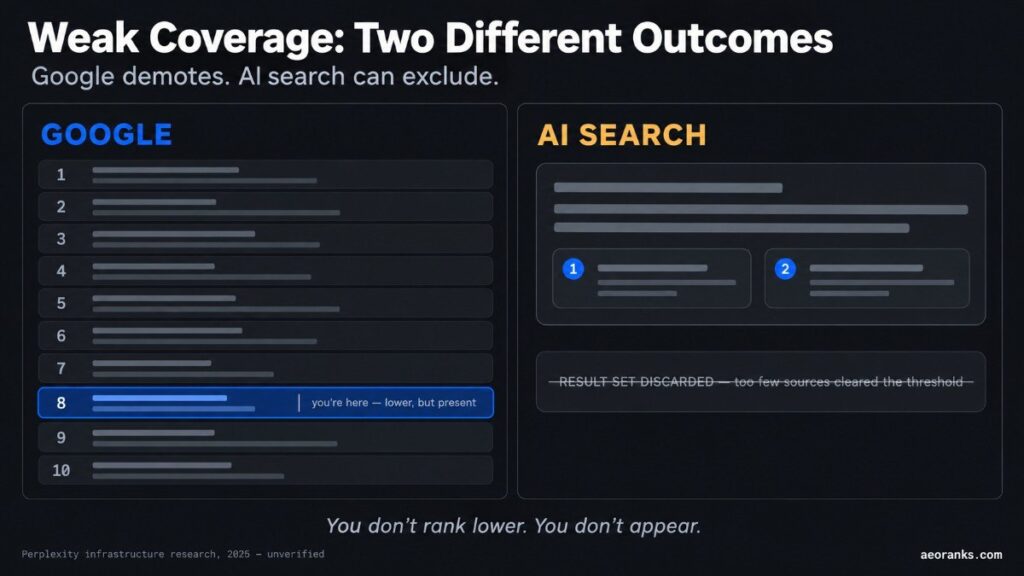
Read that again, because it’s the difference between a ranking penalty and exclusion. You don’t appear further down. You don’t appear.
The same research documented something it called memory networks — the finding that interlinked content clusters perform better together than isolated pages do. Which is exactly what every guide tells you to build, except now there’s a mechanism behind the advice rather than just an assertion.
There’s a second reason this matters more now. AI answers tend to settle on category owners, and that ownership turns out to be durable — once a brand leads mentions in a category, it tends to keep leading. We covered that research, and what to do about it, in topical authority for AI search. If AI visibility is your main concern, read that one next — this guide covers the foundations underneath it.
How to build topical authority: six steps
1. Pick a subject narrow enough to finish
The most common mistake is scope. “SEO” isn’t a topic you can own. “Technical SEO for Shopify stores with large filtered catalogues” is.
Write one sentence naming the audience, the problem, and what’s explicitly out of scope. If you can’t, the subject is still too broad.
2. Map intents, not keywords
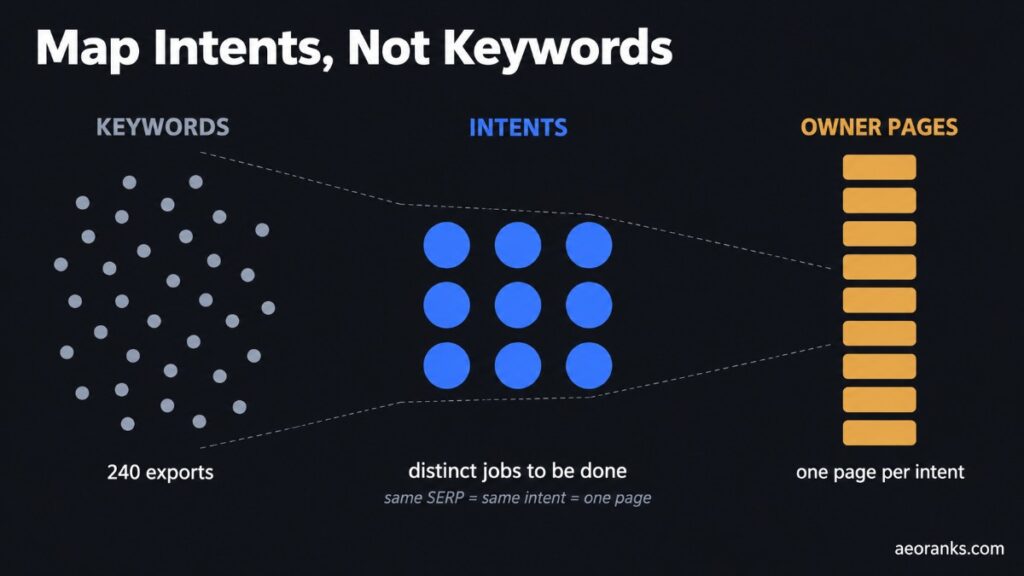
Export your keyword list, then throw away the duplicates — and by duplicates I mean anything where the search results are basically the same. “Best onboarding tools” and “top software for new hires” are one intent wearing two outfits. They need one page, not two.
What you’re building is a map of distinct jobs a reader needs done: what is it, how does it work, what does it cost, what are the alternatives, how do I implement it, what goes wrong, which should I buy.
Mine People Also Ask boxes three or four layers deep. They show you how questions relate to each other, which is closer to what you need than a volume column.
3. Assign one owner page per intent
Every distinct intent gets exactly one page that owns it. Two pages chasing the same job isn’t twice the coverage — it’s cannibalisation, and it weakens both.
On an existing site, do this before you publish anything new. Merge the overlaps, redirect the losers, reposition the near-misses. Most sites find they have more pages than intents.
4. Connect them properly
A cluster that isn’t linked isn’t a cluster, it’s a folder.
The pattern: pillar links out to each supporting page, supporting pages link back to the pillar, and adjacent pages link to each other where the reader’s next question naturally leads there. Use descriptive anchors — “how to calculate lease dilapidations,” not “click here.”
This is the step teams skip most often, and it’s the one that converts a pile of articles into something a crawler can read as a subject.
5. Put in evidence nobody else has
Coverage without substance gets you a complete map of pages nobody has a reason to cite.
Original data, a documented test, a real client outcome with numbers, a screenshot of something actually happening, an honest comparison that names the trade-offs. Anything that didn’t exist on the internet before you published it.
This is also what separates a page that gets cited by AI from one that gets read and ignored — a failure mode we break down in why AI finds content but doesn’t cite it.
6. Maintain it
Facts age. Prices change. Competitors publish. Links break.
Set a quarterly review on the pages that carry decision-critical information and actually re-check the evidence — don’t just bump the date. Stale content erodes authority faster than missing content, because it actively misleads.
How to measure topical authority
Since there’s no score, you measure the layers that are observable. Here’s the framework I’d use.
| Signal | What you measure | What it tells you |
|---|---|---|
| Intent coverage | Owner pages ÷ mapped intents | How much of the subject you actually cover |
| Graph health | Orphan pages, click depth, internal links per page | Whether the cluster is connected enough to read as one |
| Query distribution | Ranking URLs and queries per cluster, from Search Console | Whether pages own distinct jobs or fight each other |
| Evidence density | Original data, tests, cases, named sources per page | Whether you’re citable or just comprehensive |
| External validation | Topic-relevant referring domains and mentions | Whether anyone outside your site agrees |
| Freshness | Age of facts that can actually change | Decay risk |
Two notes on using this.
Don’t collapse it into one number. A single 0–100 score hides which layer is broken, which is the only useful thing the exercise tells you. Score each separately.
Add the AI layer if that’s your goal. The six signals above are all site-side. For AI visibility you also need citation rate and share of voice across engines, measured on repeated runs — which is a different exercise entirely, and one we cover in tracking AI share of voice.
A quick version
If you want a rough read in twenty minutes: export your Search Console data by page and query for one cluster. Then look for three things. Is one URL ranking weakly for everything in the cluster? That’s thin coverage. Are several URLs swapping positions for the same query? That’s cannibalisation. Are your commercial pages only picking up definition-level queries? That’s an intent mismatch.
None of that needs a tool you don’t already have.
Four ways this goes wrong
Publishing volume instead of coverage. Forty articles across six unrelated subjects builds authority in none of them. Focus beats output.
Clusters that aren’t linked. Writing the pages and never connecting them is the most common half-finished version of this strategy.
Chasing the easy pages first. Teams write the fifty definition pages because they’re simple, and never get to the ten comparison pages that actually convert. Build bottom-of-funnel first — it funds the rest.
Treating it as a one-off project. Clusters decay. If nobody owns maintenance, you’re rebuilding this in eighteen months.
Not sure which subject you can realistically own? Book a free strategy call with AEORanks. We’ll map your current coverage, show you where the gaps and overlaps are, and tell you honestly which category is winnable — and which one isn’t worth the fight.
What is topical authority in SEO?
Topical authority is how completely and credibly a site covers one subject. It’s built through distinct pages for each real search intent, strong internal links connecting them, original evidence, and relevant external validation. It isn’t a published Google score — it’s an operating model for organising coverage.
Is topical authority a ranking factor?
Google has never named topical authority as a standalone ranking factor, and there’s no public score for it. It’s a model that makes relevance easier for search systems to establish. It doesn’t replace page quality, intent match, links or technical health.
What’s the difference between topical authority and domain authority?
Domain authority (Moz DA, Ahrefs DR, Semrush Authority Score) are third-party metrics describing overall backlink strength across your whole site. Topical authority describes how well you cover one specific subject. A lower-authority specialist can out-compete a high-authority generalist on a narrow topic.
How do you measure topical authority?
There’s no single score. Track six observable signals separately: intent coverage, internal graph health, query distribution, evidence density, topic-relevant external validation, and freshness. Scoring them separately shows which layer is actually broken.
How long does it take to build topical authority?
Months, not weeks. A focused cluster can be published in a quarter and start showing movement, but external validation accumulates slowly. Competitive categories take longer. Anyone promising a fixed timeline is guessing.
Can you build topical authority for more than one topic?
Yes, but sequentially. Pick one subject, cover it properly, then expand to an adjacent one. Teams that chase three at once usually end up owning none.
How do I build topical authority for AI search specifically?
The foundations are the same — complete coverage, connected clusters, original evidence — but AI search adds entity consistency and off-site corroboration as decisive factors. We cover the AI-specific playbook in topical authority for AI search