For twenty years, “getting found online” meant one thing: rank on page one of Google, earn the click, convert the visitor. That funnel still exists. But a second, parallel funnel has opened up next to it, and it works on completely different rules.
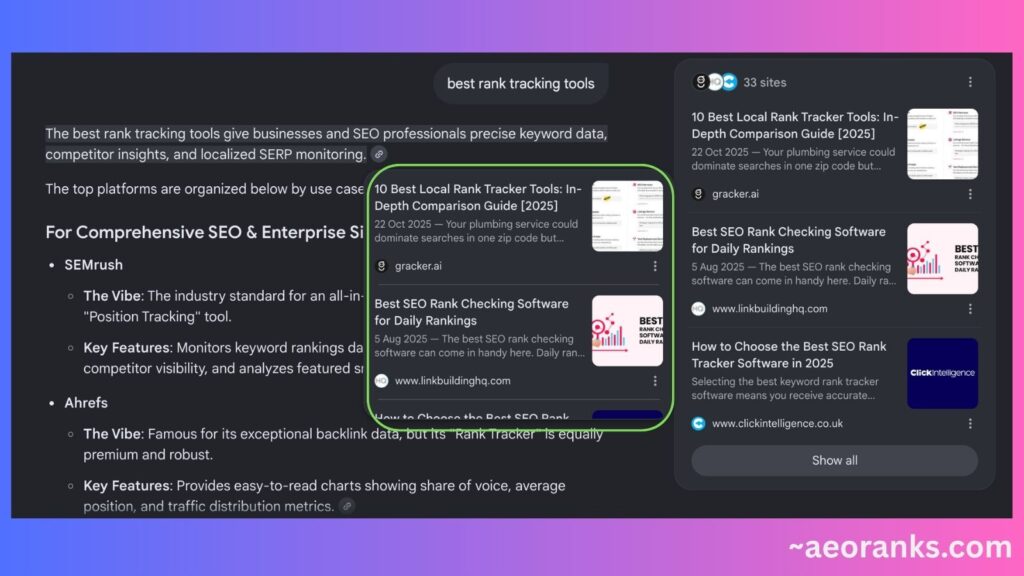
Today, a growing share of your audience never touches a results page at all. They ask ChatGPT to compare vendors. They ask Perplexity to summarize a category. They ask Google’s AI Overview a question and get a synthesized answer with a handful of citations – sometimes yours, usually not. Google itself confirms that its AI features lean on retrieval-augmented generation (RAG) – grounding answers in pages pulled from its core Search index – and query fan-out, where a single question spins off multiple related searches behind the scenes before the model writes its answer.
Key Takeaways:
- AEO/GEO is still SEO: Google confirms that AI-driven features still rely on core search ranking signals. Focus on valuable content, clear structure, and site health first.
- Answer-First Content: Lead with direct answers (in the first 40–60 words) and use structured layouts (headings, lists, FAQs) to help AI models extract information.
- Authority & Trust: Demonstrate Expertise-Experience-Authority-Trust (E-E-A-T) through expert authorship, original data, and reputable citations. Build consistency across channels – social, PR, forums – so AI systems “see” your brand everywhere.
- Schema & Rich Snippets: Use schema markup for FAQs, HowTo guides, products, etc., not as a gimmick, but to clarify content intent. Google says special AI markup (like llms.txt) isn’t needed, but continue normal schema for rich results.
- Tracking & Metrics: Traditional clicks and rankings don’t tell the full story. Measure AI visibility with tools and new channels: e.g. GA4 now tags “AI Assistant” referrals from ChatGPT/Gemini/Claude. Track AI Share of Voice (brand mentions in AI answers), citation frequency, AI-driven traffic and conversions.
- Iterate & Update: AI models change fast. Treat content optimization as an ongoing loop: research, write, optimize (technical and on-page), monitor across AI engines, and refresh content regularly. Early adopters gain compounding visibility, as AI systems reinforce known authoritative sources.
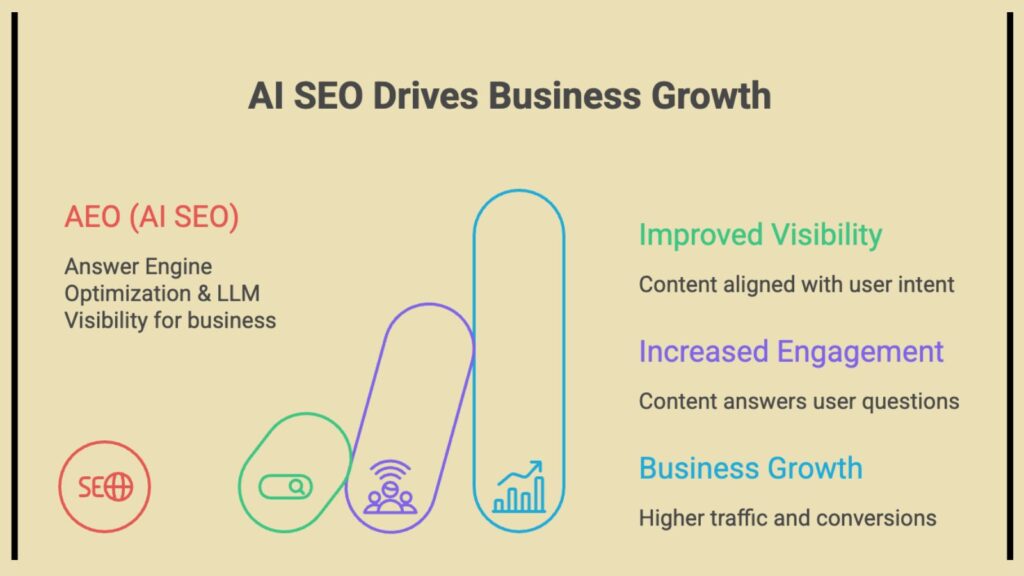
AEO (Answer Engine Optimization) and GEO (Generative Engine Optimization) are extensions of SEO focused on surfacing your content in AI-driven search. To succeed, follow solid SEO fundamentals – create unique, helpful content, maintain a clean technical setup, and earn trust signals – while also structuring content for AI (answer-first paragraphs, clear headings, FAQs, schema, etc.). Track your progress with new metrics like AI mentions and referrals (e.g. GA4’s new “AI Assistant” channel) and adapt your strategy across platforms.
Rank Across AI Search Platforms
Grow visibility across ChatGPT, Claude, Gemini & Perplexity with AI-first SEO strategies.
Book Free Strategy Call ChatGPT
 Claude
 Gemini
 Perplexity
 Grok
Grok
What AEO and GEO Actually Mean
Two terms get used almost interchangeably, but they describe two different jobs an AI system does:
- Answer Engine Optimization (AEO) is about winning direct, extractable answers – featured snippets, voice results, AI Overviews. It’s the “can this model pull a clean answer out of my page” problem.
- Generative Engine Optimization (GEO) is about being cited or mentioned when an AI system synthesizes an original response from multiple sources – ChatGPT, Perplexity, Claude, Gemini. It’s the “does this model trust me enough to reference me” problem.
In practice, the tactics overlap heavily, and Google’s own guidance treats both as facets of one thing: optimizing for the search experience. If you want the deeper mechanics of how these differ from classic SEO, we’ve broken that down separately in what AEO actually is and in our GEO explainer.
| Aspect | Traditional SEO | AEO | GEO |
|---|---|---|---|
| Primary goal | Rank high, earn the click | Win featured snippets, direct answers | Get cited inside AI-generated responses |
| Target surfaces | Google, Bing SERPs | Featured snippets, voice, AI Overviews | ChatGPT, Perplexity, Claude, Gemini |
| Content style | Keyword-optimized, comprehensive | Extractable, snippet-ready | Comprehensive, evidence-backed, citable |
| Success metric | Rankings, organic traffic | Snippet wins, position zero | Brand mentions, citation frequency |
| Core mechanism | Crawling + ranking algorithms | Passage extraction | Retrieval-augmented generation (RAG) |
This means AEO/GEO efforts focus on earning citations and mentions in AI-generated answers rather than just chasing top SERP ranks. As Core dna notes, the goal shifts from “rank high” to “be cited in AI-generated answers,” with metrics like mentions and brand visibility replacing pure clicks. Brands that adapt early have an advantage: AI systems tend to favor sources they already trust, so achieving visibility now can compound future authority.
AEO & GEO Best Practices for AI Visibility
As Google’s guide reminds us, skip the gimmicks and double down on what works: high-value content, clean structure, and accessibility. To improve your AI visibility, brands have to follow an iterative loop of research → write → optimize → monitor → update.
By doing this, build topical authority, have more answers on subject/topic/industry, build trust & expertise, help users to take actions and most importantly, build a distribution channel.
| AEO & GEO Practices | What You Should Do |
|---|---|
| 📋 Audit & Structure | Identify the most important questions your audience is asking. Update existing pages by placing the direct answer in the first 100 words, followed by detailed explanations. Organize content using descriptive headings, short paragraphs, bullet points, and comparison tables. |
| 🔍 Keyword & Prompt Research | Go beyond traditional keyword research. Use AI tools like ChatGPT, Gemini, Claude, and Perplexity to discover real conversational questions users ask. Turn these questions into H2s, FAQs, and supporting content throughout your article. |
| ✍️ On-Page Optimization | Write clear SEO titles and meta descriptions that immediately communicate the answer. Use FAQ, HowTo, Product, Organization, and Article Schema where appropriate. Back important claims with reliable sources and statistics. |
| 🏆 Build Trust (E-E-A-T) | Show who wrote the content and why readers should trust them. Add author bios, credentials, case studies, original research, customer testimonials, and references. Keep your Google Business Profile, LinkedIn Company Page, and other business profiles updated. |
| ⚙️ Technical SEO | Ensure your website is crawlable, fast, mobile-friendly, and indexable. Fix broken links, improve Core Web Vitals, optimize images, enable caching, and verify important pages are indexed in Google Search Console. |
| 📅 Content Freshness | Publish consistently and refresh older articles with new statistics, examples, screenshots, AI features, and industry updates. AI search engines tend to favour content that stays current and continues improving over time. |
| 📈 Monitor AI Visibility | Every week, test important prompts in ChatGPT, Gemini, Claude, Perplexity, Copilot, and Google AI Overviews. Track: Brand mentions Citation frequency AI Share of Voice Competitor visibility Referral traffic in GA4 (AI Assistant Channel) Leads and conversions from AI platforms Use tools like Profound, Peec AI, Otterly AI, Ahrefs Brand Radar, Semrush AI Toolkit, Brand24, and Google Alerts. |
| 🌍 Build Brand Presence | Don’t rely only on your website. Distribute your expertise across LinkedIn, Reddit, Quora, industry communities, YouTube Shorts, podcasts, webinars, newsletters, and guest posts. Encourage reviews, comparisons, and third-party mentions because AI systems build confidence when they find your brand consistently across multiple trusted sources. |
Apply SEO Fundamentals: Content and Technical Best Practices
Unique, high-quality content is still king.
Google explicitly urges creators to “focus on what your visitors would enjoy, find helpful, and feel satisfied with”. This echoes through all guidance: avoid generic “safe” content. Rather, provide a unique perspective, original data or case studies, and first-hand analysis that set you apart. As Frase sums it up, Google calls this “valuable, non-commodity content” – content that goes beyond common knowledge.
Keep it clear and structured.
Google explicitly urges creators to “focus on what your visitors would enjoy, find helpful, and feel satisfied with”. This echoes through all guidance: avoid generic “safe” content. Rather, provide a unique perspective, original data or case studies, and first-hand analysis that set you apart. As Frase sums it up, Google calls this “valuable, non-commodity content” – content that goes beyond common knowledge.
Optimize user experience.
AI systems pull content by chunks. The opening paragraph (“answer-first”) is prime real estate. Aim to answer the main query within the first 40–60 words, then provide details below. Use headings, subheadings, and bullet lists liberally. Headings that read like questions can trigger AI to extract them as Q&A. Core dna’s analysis shows AI treats headings, lists and FAQs as signals of content structure. FAQ sections are especially powerful since they mirror AI’s question-answer format (and can be marked up with schema, see below).
Use clear language and authority signals.
Write with clarity and authority. Avoid jargon and explain terms for a general audience. Provide evidence by citing reputable sources (studies, official stats) and linking out to them. Jasper recommends descriptive anchor text and linking to both external authorities and relevant internal pages. These links help AI (and humans) verify your claims, boosting trust. Demonstrate E-E-A-T (Experience, Expertise, Authority, Trustworthiness) through author bios, credentials, and transparent sourcing. Lumar emphasizes E-E-A-T as a checklist item – for example, expert authorship and original data signal trust.
Structuring Content for AI Discoverability
Building content that AI loves is often about giving it exactly what it needs to extract. The Lumar “Content GEO checklist” offers a concise summary: write clear, factual, answer-first content and structure it into retrievable “chunks”. In practice:
Content Techniques That Get You Cited
Four formatting patterns that make it easy for AI engines to identify, extract, and reuse your content in generated answers.
| Technique | How It Works |
|---|---|
1Answer-First Opening |
Begin with a strong, concise answer to the user’s question. For example, if the query is “How to optimize for AEO?”, the first sentence might be a direct answer or definition. This ensures the AI picks up your answer without wading through fluff. |
2Chunking with Headings |
Break your page into logical sections (H2s/H3s) that group related points. Each section should have a descriptive heading — ideally question-like, e.g. “What is AEO?” — followed by a succinct answer or explanation. Clear sections make it easy for AI to identify and extract relevant text. |
3FAQs and Q&A |
Include a section of frequently asked questions. Mark them up with FAQ schema to directly signal answers to common queries. AI systems often treat “Question/Answer” pairs as ready-made content to cite. |
4Lists and Tables |
Where appropriate, use bullet points or numbered lists to present information. AI can parse lists more easily than paragraphs, often using them in generated answers. Listicles and comparison tables appear frequently in AI answers. |
Importantly, don’t “game” the system with tricks. Google specifically warns against artificial tactics: you do not need special files like llms.txt, nor do you need to split content into tiny chunks for AI. The AI is smart enough to understand context. Instead, focus on natural, audience-first writing that happens to be AI-friendly. As Frase notes, AI still rewards genuine quality: “The fundamentals Google endorses (useful content, clear structure, accessibility)… are the things that travel well across every engine.”
Schema Markup and Entity Signals
Schema markup remains useful for helping both AI and traditional search understand your content. Google’s guide says schema isn’t required for AI search, but it “helps with being eligible for rich results”. In other words, add schema primarily for SEO/Rich Snippets, with the side benefit of clarity. Key schema types for AEO/GEO visibility include:
- FAQPage and QAPage: Mark up your FAQ and Q&A sections. This clearly tags each question and answer for machines.
- Article/BlogPosting: For general pages, basic article schema helps AI recognize your content type.
- HowTo: Use on instructional pages with step-by-step guides.
- Organization/Person: Specify your brand or author as an entity, building trust.
- Product/Service: On product pages, use Product schema (incl. reviews, price) so AI knows your offerings.
- LocalBusiness: If location is relevant, keep your Google Business Profile data fresh (Google notes current business data helps AI surface local info).
Remember: schema should match visible content. Don’t insert irrelevant schema hoping for favoritism; Google calls that out as a misuse. Instead, use schema to “remove ambiguity,” helping AI parse your page structure. The richer and more precise your markup, the more confidently AI can cite your content (for example, a HowTo schema makes it obvious you’re answering a how-to query).
Building Authority and Trust
Just as in SEO, authority is crucial for AEO/GEO success. AI systems aggregate signals from across the web to determine trust. To boost your authority:
- Brand Consistency: Align messaging and data about your brand everywhere (website, social profiles, industry listings). AI engines often look for consensus: if multiple credible sources say the same thing about you, the AI gains confidence in your brand.
- Earn Mentions and Citations: High-quality content can earn organic mentions on authoritative sites. These third-party citations act like votes of confidence. Participate in industry discussions on forums, answer questions on Reddit/Quora, or publish guest posts – but focus on giving value, not promotional links. (Google filters spammy mentions, so authenticity matters.)
- Thought Leadership: Publish unique research, case studies, or long-form guides. Original insights are more likely to be cited by AI than generic “top 10 tips.” They also bolster your E-E-A-T.
- User Engagement: Encourage reviews, testimonials, and social proof. While an AI model doesn’t “feel” user sentiment, more engagement (and positive sentiment) correlates with higher brand interest. Monitor brand mentions with tools (Brand24, Mention, etc.) to catch feedback and new opportunities.
- Update Frequently: AI search favors fresh content. Even if your facts remain accurate, rewrite or add to articles every 1–2 months to signal relevance. Google’s recent guidance highlights that updated info helps AI feel confident citing your page.
Over time, these efforts make your site a known, trusted source. Lumar’s checklist emphasizes demonstrating E-E-A-T through expert authorship and transparent sourcing. Core dna explicitly lists E-E-A-T as a must-not-ignore factor. Ensure entity and topic alignment so AI systems recognize your authority across formats.
Measuring AEO & GEO Success
Traditional SEO metrics (ranks, impressions, clicks) don’t fully track AEO & GEO visibility. Instead, focus on brand-centric KPIs: AI Mention Rate, Share of Voice in AI answers, Citation Rate (how often AI models cite you), AI Referral Traffic, and conversions from AI referrals. AEORanks, for example, tracks an “AI Visibility Score” combining such metrics to summarize performance.
Key measurement strategies include:
- Brand Mentions in AI: Use monitoring tools or queries to see if generative AI mentions your brand/URL for relevant questions. For example, periodically ask ChatGPT or Gemini: “What are the best AI marketing agencies for B2B SaaS?” and check if your brand appears. (Tools like Frase’s AI Visibility Checker or Profound’s AI Ranking tracker can automate part of this.)
- Citation Tracking: Specialized platforms (e.g. Lumar’s AI Visibility tools, Peec AI, etc.) scan AI answers for citations. They can report how often and where your site is cited by ChatGPT, Gemini, etc. These tools often simulate many queries to collect data.
- GA4 AI Assistant Channel: Google now classifies ChatGPT/Gemini/Claude traffic under AI Assistant. In GA4, look at the Channel Group “AI Assistant” (Medium: ai-assistant) to see how much referral traffic these bots drive. Compare that to organic traffic to gauge AI’s impact on your site.
- Conversion Tracking: Tag AI-driven conversions (e.g. form fills, sign-ups) in your analytics. Early data suggests AI-referred visitors convert at higher rates, so quality over quantity is the goal. Use multi-touch attribution to give credit to AI touchpoints.
- Sentiment & Engagement: Track sentiment of AI mentions (positive/negative context). Also monitor on-page engagement (time on page, bounce rate) for AI-landing pages – improvements here indicate better relevance.
This holistic view answers questions like: “Is ChatGPT getting more clicks through us or our competitors? Is our brand share in AI answers growing?” If data shows declining AI mentions, revisit content and distribution (see below). AEORanks often builds custom dashboards (Looker Studio) to combine these signals weekly/monthly.
Content Distribution & Brand Presence
Visibility isn’t achieved by on-site optimization alone. Distribute your expertise everywhere your audience lives:
- Communities & Forums: Share insights on relevant Reddit subs, LinkedIn groups, and Quora. For instance, answer questions on platforms like StackExchange or specialized forums. This builds backlinks and authority, and AI may crawl these contexts too.
- Social & Professional: Post key findings or infographics on LinkedIn, Twitter, or Facebook. Bite-sized LinkedIn posts or tweets can highlight main points of your content, driving traffic and brand mentions.
- Video/Audio: Convert your content into a YouTube short or podcast snippet. AI models ingest multi-format content (especially if transcripts are provided). If your video answers a question, it might even rank in AI responses that surface videos.
- Guest Expert Panels: Appear on podcasts, webinars, or industry roundups. Quote widgets (e.g. PR Newswire or forums) and press releases ensure your insights are published on high-authority domains, reinforcing consensus.
- Influencer and Peer Shares: Encourage industry peers to share your content (e.g. round-ups of the best AEO resources). This boosts visibility and signals to AI that multiple sources endorse your message.
The goal is a “cross-platform ecosystem” of content. Lumar’s Jon Clark notes: “Treat content as a cross-platform ecosystem. Make videos, images, and audio AI-friendly… Ensure entity and topic alignment so AI systems recognize your authority, no matter the format.”. In practice, maintaining a consistent brand voice and message across all channels makes it more likely an AI will find agreement and cite you.
How AEORanks Can Help
Optimizing for AEO/GEO is complex and evolving. At AEORanks, we specialize in helping brands measure and boost their AI visibility. Our data-driven approach tracks AI Share of Voice, monitors citations across platforms, and refines content accordingly. If you’re a SaaS company or enterprise looking to understand your AI presence and build a custom visibility dashboard, book a free AI discovery call with our team. We can benchmark your performance and outline a strategy to increase your mentions in ChatGPT, Gemini, Claude, and Google AI Overviews.