AI detectors and AI humanizers have no direct effect on how you rank in Google or whether AI search engines cite you.
Google evaluates content on usefulness, originality and demonstrated expertise. It does not run a detector over your page. AI answer engines select passages on relevance, clarity and trustworthiness — not on how “human” the prose reads.
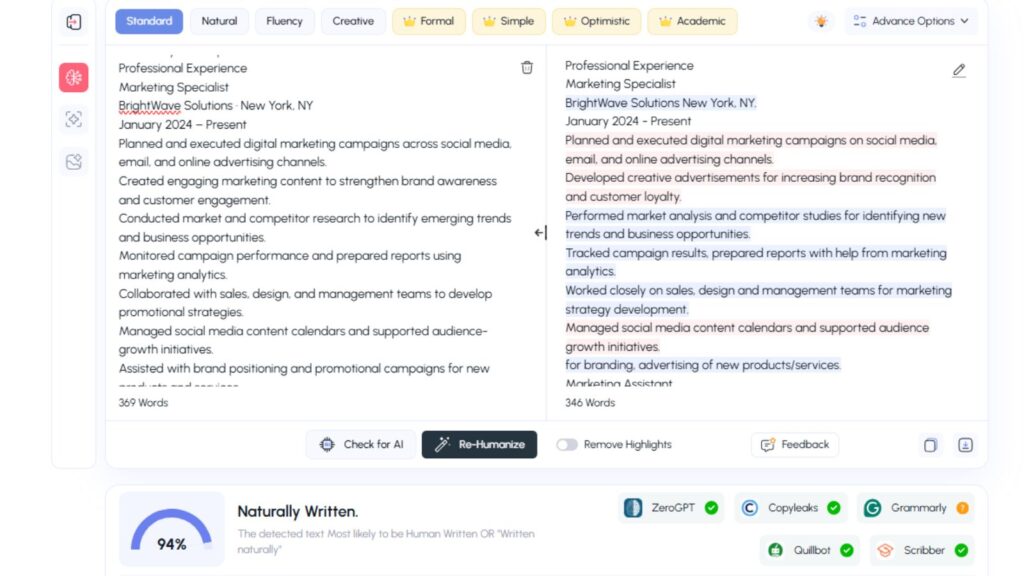
So: detection is the wrong problem. Pushing a detector score from, say, 82% down to 4% optimises a number no search or AI system consults. It is a metric with no consumer.
AI-assisted content does carry a real risk — thin, unoriginal work at scale. A humanizer does nothing about that, and can make it worse by suggesting the problem is solved.
Key takeaways
- No. A detector score is not a Google ranking factor, and a humanizer pass does not make ChatGPT, Perplexity or Gemini cite you.
- Google’s test is whether content helps people, not how it was produced. Its spam policies target scaled content abuse — mass-producing low-value pages to manipulate rankings.
- Detectors are probabilistic, not evidential. OpenAI retired its own classifier in July 2023, citing “its low rate of accuracy.”
- False positives follow a pattern. Research found widely used detectors consistently misclassified non-native English writing as AI-generated.
- Humanizers change sentence texture. They cannot add data, expertise, or a reason to quote you.
- Optimise for citation, not detection — originality, verifiable claims, entity clarity, extractable structure.
What Google actually says about AI-generated content
It is worth reading Google’s position precisely, rather than through the filter of tools that profit from anxiety about it.
In February 2023, Google Search Central published guidance on “how AI-generated content fits into our long-standing approach to show helpful content to people on Search.” The position has not changed: the criterion is quality and helpfulness, not origin.
Google’s helpful content documentation asks whether content “provide[s] original information, reporting, research, or analysis,” and whether it is “written or reviewed by an expert or enthusiast who demonstrably knows the topic well.” Notice what is absent: any question about which tool typed the words.
Where Google does draw a line is in its spam policies, under scaled content abuse — “when many pages are generated for the primary purpose of manipulating search rankings and not helping users.” The policy names “using generative AI tools or other similar tools to generate many pages without adding value for users.”
The violation is without adding value for users. AI is named as a means, not as the offence. One AI-assisted article backed by original data is not scaled content abuse. Four hundred templated pages from a keyword list are — whether a model or a freelancer produced them.
Google even frames disclosure as a trust signal, asking whether “the use of automation, including AI-generation, [is] self-evident to visitors” — close to the opposite of an instruction to hide your process. For the wider picture, see AI and SEO and AI content strategy for organic growth.
How AI detectors actually work
The mechanism explains why the scores are shaky. Detectors do not identify AI writing — they measure two statistical properties and infer from them.
Perplexity — how surprising each word is, given the words before it. Models pick likely words, so their output is less surprising than human writing. Low perplexity pushes a score toward “AI.”
Burstiness — how much sentence length and rhythm vary. Human writing lurches: a long, winding sentence, then a short one. Model output is more even. Low burstiness pushes the score toward “AI” too.
These are proxies, not proof. Nothing in a text records its origin — the detector guesses from surface patterns that appear in plenty of writing no model ever touched. Hence the predictable failure modes:
- Clear, plain, well-edited prose scores as AI. Simplicity lowers perplexity. Technical, legal and instructional writing all read as “too regular.”
- Formulaic human writing scores as AI. Press releases, policy documents, templated reports.
- Lightly edited AI writing scores as human. Vary a few sentence lengths and the signal degrades.
Why detector scores shouldn’t drive content decisions
Two pieces of evidence do most of the work here.
1. OpenAI retired its own classifier. In July 2023, OpenAI discontinued its AI Text Classifier, stating it was withdrawn “due to its low rate of accuracy.” At launch, OpenAI reported it correctly identified only 26% of AI-written text as “likely AI-written,” while incorrectly flagging human-written text 9% of the time.
The organisation with the deepest access to how these models generate text built a detector, measured it, and pulled it. Third-party detectors work with less information and rarely publish audited accuracy figures.
2. The false positives are not randomly distributed. In research published in Patterns (Cell Press) in July 2023, Liang, Yuksekgonul, Mao, Wu and Zou evaluated several widely used GPT detectors against native and non-native English writing. The detectors “consistently misclassify non-native English writing samples as AI-generated,” while native samples were correctly identified. The authors warned against deploying them in evaluative settings.
Same perplexity problem: non-native writers often use a more constrained vocabulary, which reads as model-like. That matters commercially — if your team or your subject-matter experts write in English as a second language, a detector will systematically mislabel your best expert-authored work.
A number that is unreliable in one direction and biased in another is not one to edit your content against.
What detectors measure vs. what actually affects visibility
| AI detectors measure | Google and AI answer engines respond to | |
|---|---|---|
| Signal | Perplexity and burstiness in the text | Usefulness, originality, demonstrated expertise |
| Unit of analysis | The passage in isolation | The page, the site, the entity behind it |
| Evidence used | Statistical patterns only | Content, links, structure, corroboration, track record |
| Reliability | Probabilistic; documented false positives | Directly documented in Google’s guidelines |
| Who reads the score | You and your client | Nobody — no ranking or retrieval system consumes it |
| What improving it does | Changes sentence texture | Nothing, unless substance changed too |
What humanizers actually change and what they can’t fix
Humanizers are rewriting tools. They work on the same two variables detectors measure, because that is the only lever available: less predictable synonyms, varied sentence length, broken-up parallel structures, added hedges and idiom, shuffled clause order.
That is the whole mechanism, which tells you exactly what it cannot touch.
| Humanizers can change | Humanizers cannot add |
|---|---|
| Sentence length variation | Original research or proprietary data |
| Word choice and synonyms | First-hand experience or testing |
| Rhythm and cadence | A named, credible author with real expertise |
| Contractions, idiom, hedging | A point of view competitors don’t already have |
| Paragraph and clause order | Accurate, verifiable, citable claims |
| A detector score | Any reason for an AI system to quote you |
There is also a cost. Aggressive rewriting shifts technical meaning and strips out the precise terminology that makes a passage quotable. If a humanizer turns “answer engine optimisation” into “reply-system enhancement,” you have improved a score and damaged your semantic relevance.
Note the incentives, too: most articles ranking for “does Google penalise AI content” are published by companies selling humanizers — a reason to check who benefits from the conclusion before acting on it.
The question that actually matters: will AI systems cite you?
Ranking is no longer the only outcome. A growing share of queries are answered inside AI Overviews, ChatGPT, Perplexity, Gemini and Claude, where the visibility that counts is being cited in the answer — named, quoted, linked. Being crawled is not enough: plenty of well-optimised pages get read and never referenced, a failure mode we break down in why AI finds content but doesn’t cite it.
A detector score is irrelevant to that outcome. What isn’t:
1. Originality. AI systems synthesise from many sources. If your page restates what twenty others say, there is no reason to pick yours. If it holds a claim, number, framework or example that exists nowhere else, you become the only available source for it.
2. First-hand data and experience. Original benchmarks, survey results, customer data, teardowns, tested workflows. The strongest differentiator — and the one thing no rewriting tool can manufacture.
3. Entity clarity. AI systems need to know who you are and why you’re credible: consistent naming, a named author with verifiable credentials, an About page stating expertise plainly, corroboration across the web, structured data. Our AI citations guide covers this.
4. Extractable structure. Answer-first paragraphs, question-shaped headings, passages that survive being lifted out of context, tables for comparisons, one-sentence definitions.
5. Citable, checkable claims. Attribute precisely, date your evidence, link primary sources. Content that cites well tends to get cited — it signals verifiability and lets a model corroborate you against sources it already trusts.
None of these five are affected by a humanizer. All are affected by how you research and structure the work. Our AEO and GEO best practices guide goes deeper.
A practical workflow: replace the detector step
If your process ends with “run it through a detector, humanize until green,” replace that step with these. Same effort, applied to something that moves.
1. Establish the differentiator first. What will this page contain that no competing page does? If you can’t answer, the page isn’t ready – and no rewriting will rescue it.
2. Bring in a real expert. Have someone who has actually done the thing supply the specifics, then credit them by name with a bio. Google puts trust first among Experience, Expertise, Authoritativeness and Trustworthiness.
3. Draft with AI if it helps – then do the work AI can’t. Use it for structure and clarity. Add what it cannot know: your data, your clients, your results, your judgement.
4. Edit for accuracy, not texture. Verify every claim against a primary source. Fix hallucinated statistics, misattributed quotes and confident vagueness – the failure modes that damage trust.
5. Structure for extraction. Lead each section with the answer. Match headings to real questions. Keep paragraphs short. Add a table wherever you compare things.
6. Add citations and dates. Link primary sources; say when the evidence is from.
7. Measure the outcome that matters. Track whether AI systems mention and cite you – share of voice in AI answers, not detector scores.
Where tooling fits in this workflow
No rewriting tool adds originality, expertise, or verifiable claims. That work belongs to the writer, which leaves the practical question of what to do with an AI-assisted draft.
Grammarly is an AI writing assistance platform built to support that revision step. Its Authenticity Suite covers the checking side: Citation Finder helps writers identify and credit sources, Plagiarism Checker reviews originality, AI Detector offers a signal about how a passage may be perceived, and Authorship shows how a document came together. Humanizer handles the revision itself, helping writers rework a draft so it reads clearly and sounds like their own voice, with a custom voice option that learns from a sample of their writing.
The goal is not to disguise the process. It is to put the writer’s thinking, evidence, and voice into the final piece.
When a detector score does matter
A detector score has real consequences in three contexts:
- Client contracts that specify a detector threshold as an acceptance condition.
- Academic settings, where policies may reference detection — precisely where the research above warns against relying on it.
- Internal editorial screening, where a high score prompts a review rather than delivering a verdict.
That last use is the defensible one: treat a flagged draft as a prompt to ask “is this actually saying anything?” – then fix the substance. The score was never the problem it pointed at.
The bottom line
AI detectors don’t affect your rankings. Humanizers don’t improve your AI visibility. Both operate on a variable, the statistical texture of your sentences – that no ranking or retrieval system evaluates.
Google’s criterion is helpfulness. Its enforcement target is scaled, low-value content. AI answer engines cite on originality, credibility and extractability. Optimise for those, and the score takes care of itself.
Not sure whether your content is actually being cited? A detector score won’t tell you – but testing your priority questions across ChatGPT, Perplexity, Gemini and Google AI Overviews will. Book a GEO visibility consultation and we’ll show you where you’re cited, where competitors are cited instead, and what’s causing the gap.
Does Google penalise AI-generated content?
No. Google rewards helpful, high-quality content regardless of how it was produced. Its spam policies target scaled content abuse — generating many pages primarily to manipulate rankings without adding value for users.
Do AI detectors affect SEO rankings?
No. Detector scores are not a ranking signal. Google does not run third-party detectors over web pages, and no detector output feeds into ranking systems — the score exists only for the person who ran the tool.
Are AI content detectors accurate?
Unreliable enough that OpenAI withdrew its own AI Text Classifier in July 2023, citing “its low rate of accuracy.” At launch it correctly identified only 26% of AI-written text, while flagging 9% of human-written text as AI.
Why do AI detectors flag human writing as AI?
They measure statistical proxies, not origin: perplexity (how predictable the word choices are) and burstiness (how much sentence rhythm varies). Clear, plain, well-edited or formulaic human writing scores low on both, so it reads as AI-generated.
Are AI detectors biased against non-native English writers?
Yes, according to peer-reviewed research. A 2023 study in Patterns by Liang, Yuksekgonul, Mao, Wu and Zou found widely used GPT detectors consistently misclassified non-native English writing as AI-generated while correctly classifying native writing.
What does an AI humanizer actually change?
Surface features of the text: word choice, sentence length variation, rhythm, idiom and clause order — the same variables detectors measure, which is why the score moves. It does not add original research, first-hand experience, expert judgement or a credible author.
Will humanizing my content improve AI visibility?
No. AI systems decide what to cite on originality, verifiable claims, entity clarity and how easily a passage can be extracted. Rewriting for texture affects none of these, and aggressive rewriting can hurt by replacing precise terminology with vaguer synonyms.