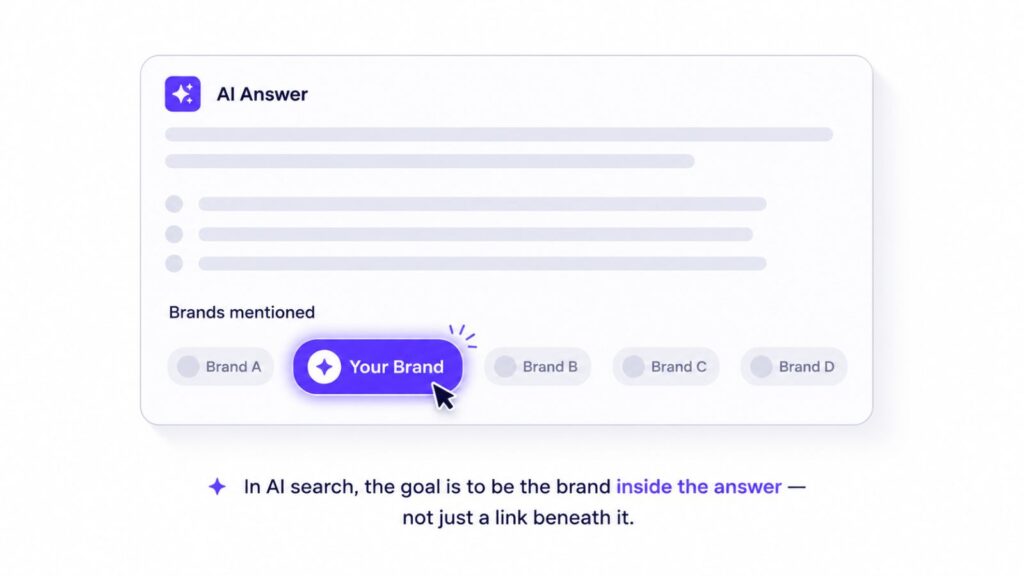
To track AI search mentions of your brand, build a list of 15–20 real customer questions, run them on a fixed schedule (weekly or biweekly) across ChatGPT, Perplexity, Gemini, and Google AI Overviews, and record three things each time: whether your brand appears, what source it was cited from, and how it’s positioned against competitors. Because the same prompt can return a different answer next time, you’re measuring a trend across repeated runs, not a single snapshot.
Key takeaways
- AI answers are becoming a primary discovery channel — you can rank #1 on Google and still be invisible in AI recommendations.
- Track prompts, not keywords, and separate mentions from citations — they’re different signals.
- Measure with three core metrics: Mention Rate, Citation Rate, and AI Share of Voice.
- Run the same prompt set on a schedule and watch the trend, because AI responses vary run to run.
- Fewer clicks doesn’t mean less value — AI visibility drives downstream branded search and trust.
If your customers are asking ChatGPT, Gemini, Perplexity, or Google AI Overviews which brands they should consider, traditional Google rankings no longer tell you the whole story.
Your brand could rank well for important keywords and still be missing from AI-generated recommendations. Or an AI platform might describe your company confidently even when the user never clicks a single search result. Both situations are invisible in a normal rank tracker — which is why marketers now track AI search mentions alongside rankings, traffic, and conversions.
The good news: you don’t need an expensive platform to start. You can build a reliable tracking process manually with a consistent set of prompts, platforms, competitors, and metrics. As your prompt list grows, dedicated AI-visibility tools automate the repetitive work.
What is an AI search mention?
An AI search mention happens when an AI-generated answer names your company, product, service, or brand in response to a relevant question.
For example, someone asks: “What are the best project management tools for a remote marketing team?” If the AI recommends your software, that’s a brand mention.
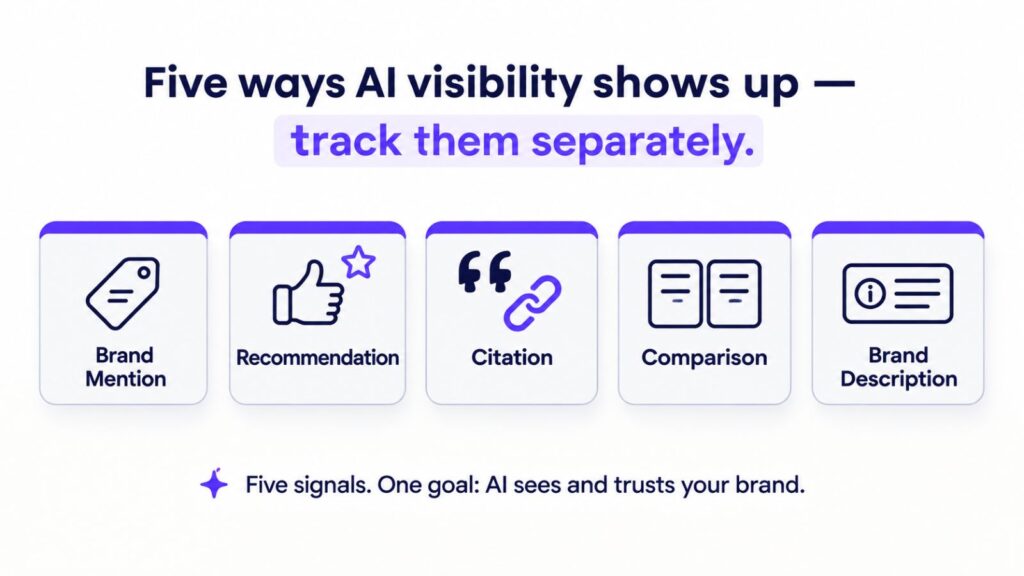
AI visibility shows up in five distinct ways, and it helps to track them separately:
| Signal | What it means |
|---|---|
| Brand mention | Your company or product is named in the answer. |
| Recommendation | The AI actively suggests your brand for the user’s specific need. |
| Citation | The AI links to your website (or another page) as a source. |
| Comparison | Your brand appears alongside competitors in a shortlist. |
| Brand description | The AI explains what you do, who you serve, and what you’re known for. |
These are related but not identical. A brand can be mentioned without a citation, and a page can be cited without the brand being recommended. If you only track “did we get a link?”, you’ll miss most of the picture. (For the difference between earning a link and earning a recommendation, see our guide on AI citations for AEO visibility.)
Why AI Mentions matters in AEO
Traditional rank tracking answers “where does my page sit on the results page?” AI tracking has to answer a different question: “did the model bring us up at all — and how did it describe us?”
The shift is already measurable:
- Around 80% of search users now rely on AI-generated summaries at least part of the time, according to Bain & Company.
- 71% of people say they use AI platforms like ChatGPT to search the web (Search Engine Land).
- When a Google AI Overview appears, it can reduce clicks to organic results by about 34.5% (Ahrefs).
- Roughly 60% of Google searches ended in zero clicks back in 2024 — and AI answers accelerate that trend.
Google itself describes AI Overviews as AI-generated snapshots with links for users who want to explore further, and says AI Overviews and AI Mode may use different models — so responses and links vary by surface. Perplexity describes itself as an answer engine that searches the web, identifies sources, and synthesizes them into an answer.
The takeaway: your brand is now competing for a place inside the answer, not just for a blue link beneath it.
Fewer clicks doesn’t mean less value
This is the reframe most teams miss. AI visibility often pays off downstream rather than as an immediate click.
Samsung attributed 28% of its direct brand searches to increased zero-click exposure, and Better.com reported a 41% lift in brand recall after optimizing for AI search. In other words, being cited in an AI answer builds awareness and trust that shows up later as branded search, direct visits, and conversions — none of which a last-click report captures cleanly. So don’t judge AI visibility by referral clicks alone.
AI search visibility vs. traditional SEO
AI search monitoring complements SEO — it doesn’t replace it.
| Traditional SEO | AI search visibility |
|---|---|
| Tracks rankings | Tracks brand inclusion |
| Focuses on keywords | Focuses on prompts and topics |
| Measures clicks and impressions | Measures mentions and citations |
| Evaluates SERP position | Evaluates presence and prominence |
| Tracks backlinks | Tracks cited sources |
| Measures organic traffic | Also measures AI referral traffic |
| Compares ranking positions | Compares AI share of voice |
Strong SEO still helps: authoritative content and trusted sources feed the models. But an AI answer is not a SERP with different formatting — it’s a synthesized recommendation, and it has to be measured on its own terms. (More on how the two fit together in AI and SEO.)
The step-by-step process for tracking brand mentions in AI search
A useful tracking system has six parts:
- Choose the AI platforms to monitor.
- Build a prompt library based on real customer intent.
- Include brand variations and competitors.
- Run the same prompts on a fixed schedule.
- Measure the right AI visibility metrics.
- Turn visibility gaps into content and authority.
Let’s walk through each.
1. Choose which AI platforms to monitor
Start with the platforms your audience actually uses. Depending on your market, that may include ChatGPT, Google AI Overviews, Google AI Mode, Gemini, Perplexity, Claude, and Microsoft Copilot.
Don’t assume visibility on one platform means visibility everywhere. These systems use different models, retrieval methods, and sources — Google itself notes AI Overviews and AI Mode may return different responses and links. So report visibility per platform, never as one blended number.
2. Build a prompt library from real customer intent
This is the most important step. Don’t just convert SEO keywords into prompts — think about the questions a real person asks an assistant before buying, comparing, or choosing.
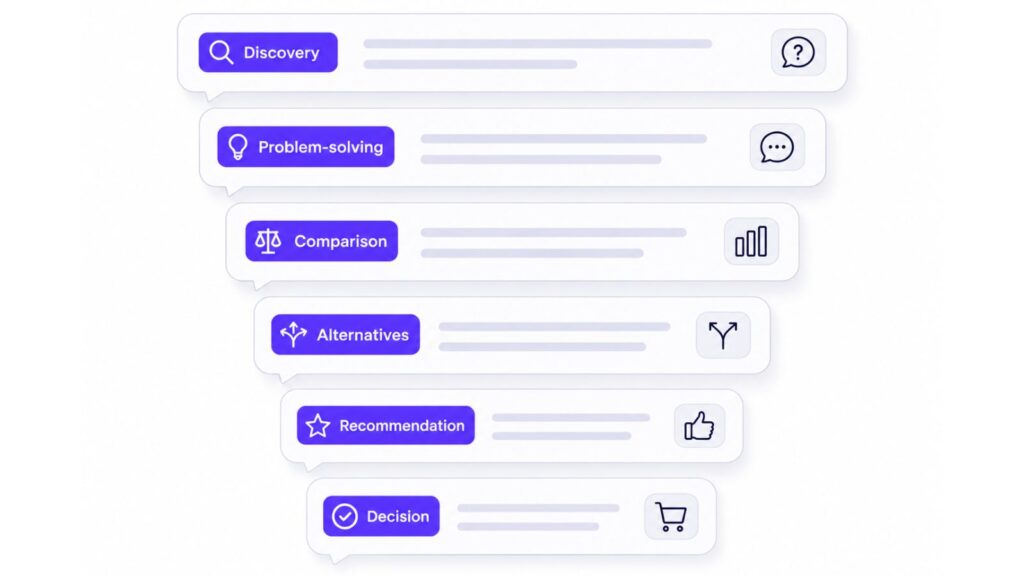
Cover several stages of the journey:
| Prompt type | Example |
|---|---|
| Discovery | “Best [product category] for [use case]” |
| Problem-solving | “How can a [type of business] solve [problem]?” |
| Comparison | “[Brand] vs [Competitor]: which is better for [use case]?” |
| Alternatives | “What are the best alternatives to [Competitor]?” |
| Recommendation | “Which [product] would you recommend for [situation]?” |
| Decision-stage | “What should I consider before choosing a [product category]?” |
A project-management SaaS, for example, might track: “best project management tools for remote teams,” “alternatives to [Competitor],” “which PM tools integrate with Slack,” and “what should a 50-person company look for in PM software?”
Start with 10–20 high-value prompts. Larger teams expand into dozens or hundreds, grouped by product, segment, and intent.
3. Include brand variations and competitors
Track more than your exact company name:
- Official brand name, product names, and service names
- Common abbreviations, former names, and frequent misspellings
- Key executives (where relevant)
- Main competitors and their product names
This surfaces the most actionable insight of all: cases where the AI understands your category but doesn’t associate your brand with it. If an answer to “best CRM for small businesses” names five competitors and not you, that gap is far more useful than simply knowing you were mentioned somewhere.
4. Run the same prompts on a fixed schedule
Create a repeatable log. For each run, record: Track your brand mentions, competitors named, cited or not, sentiment on each AI platform. Do this activity for few weeks while executing AEO strategies on your content and distribution. This will give you a good idea of how your brand is performing in its niche and amongst top cited or seen brands.
Run the set weekly or biweekly when starting out; a monthly cycle works for broader trend reporting.
Never rely on a single answer. AI responses are dynamic — ask the same question twice and you may get different brands, ordering, or sources. The 2026 SparkToro and Gumshoe experiment tested 12 prompts across ChatGPT, Claude, and Google’s AI search with 600 volunteers producing 2,961 runs, and found the exact same brand list was highly unlikely to repeat — yet repeated appearances across many runs still revealed real visibility patterns. The lesson: track patterns over time, not one screenshot.
5. Measure the right AI visibility metrics
Go beyond “mentioned or not.” Three core metrics give you a baseline:
| Metric | What it tells you | Formula | Example |
|---|---|---|---|
| Mention Rate | How often you’re named in tracked answers | Brand mentions ÷ total prompts × 100 | 30 of 100 prompts → 30% |
| Citation Rate | How often AI links to your site as a source | Answers citing you ÷ relevant answers × 100 | 20 of 100 → 20% |
| AI Share of Voice | Your visibility vs. competitors | Your mentions ÷ all brand mentions in the category × 100 | 20 of 100 total → 20% |
A quick worked example. Say you run 50 prompts across four platforms (200 answers). Your brand appears in 60 → 30% Mention Rate. It’s cited as a source in 24 → 12% Citation Rate. Across the category there were 300 total brand mentions and 60 were yours → 20% AI Share of Voice. Next month you re-run the identical set and Mention Rate moves to 36%. That delta — not any single answer — is your signal.
Some teams now call the competitive version of this “Share of Model” — how often you show up as the recommended answer across models. Whatever you call it, the principle is the same: measure consensus across many runs. (We break the calculation down further in how to track AEO/GEO and measure AI share of voice.)
6. Track visibility over time
Don’t build one report and forget it. Create a baseline and compare month over month:
| Metric | August | September | October |
|---|---|---|---|
| Mention Rate | 24% | 29% | 36% |
| Citation Rate | 11% | 15% | 18% |
| AI Share of Voice | 8% | 11% | 14% |
| Competitor A SoV | 31% | 29% | 27% |
| Positive mentions | 72% | 76% | 81% |
Then line those changes up against what you shipped: new content, major refreshes, digital PR, product launches, positioning changes, or technical fixes. That’s how tracking becomes a feedback loop instead of a vanity dashboard.
Common AI visibility tracking mistakes
Most teams get weak data for the same handful of reasons. Avoid these:
- Tracking too few prompts. Five prompts is noise. Start with at least 15–20.
- Testing once. A single run tells you almost nothing given how variable answers are.
- Using generic prompts. “What is a CRM?” won’t reveal buying-intent visibility. Mirror real customer questions.
- Ignoring competitors. Without a benchmark you can’t tell 20% Share of Voice from good or bad.
- Tracking mentions but not citations (or vice versa) — you need both.
- Blending platforms into one number and hiding where you’re actually weak.
When should you use AI visibility tools?
Manual tracking is perfect for an initial audit, but it gets hard to maintain as your prompt list grows. Dedicated AI-visibility platforms automate prompt monitoring, mention and citation tracking, competitor comparisons, sentiment analysis, share-of-voice measurement, and historical trends — turning a pile of screenshots into a comparable view over time.
Whichever route you take, judge a tool on four questions:
- Does it cover the platforms your buyers actually use?
- Does it track prompts, not just keywords?
- Does it separate mentions from citations?
- Does it let you benchmark against named competitors over time?
How to turn AI mention data into SEO & GEO opportunities
Tracking only matters if you act on it. Suppose your data shows competitors dominate “best accounting software for small businesses” and you’re absent.
Don’t immediately publish another generic “Best Accounting Software” post. First, investigate why competitors are surfaced:
- Which sources and competitor pages are being cited?
- What questions do those pages answer, and what evidence do they show?
- Which third-party sites, comparison pages, or publications mention them?
- Does your own site clearly explain your product’s use case and proof?
Then build a stronger information ecosystem around the topic in three moves:
- Create content that answers the real question — with specifics, data, and examples the model can extract. (See AI content strategy for organic growth.)
- Strengthen third-party signals — earn mentions and reviews on the sources AI already trusts in your category.
- Keep brand information consistent everywhere, so the model forms one clear, confident picture of who you are.
If you’re finding that AI can reach your content but still won’t cite it, that’s a specific, fixable problem — we cover it in why AI finds your content but doesn’t cite it.
Want a head start? Grab a free starter list of 20 high-intent prompts tailored to your category — talk to AEORanks and we’ll map where you stand today.
How to measure AI referral traffic
AI visibility and AI referral traffic are two different things. A mention or citation can influence a buyer without an immediate click. And when an AI platform does link to your site, the visit may show up as referral traffic — or be hard to attribute cleanly, depending on the platform and your analytics setup.
So don’t judge AI visibility on referral traffic alone. Read it as a chain:
AI visibility → mentions → citations → referral traffic → branded search → conversions
The early signals measure visibility and influence; the later ones show downstream business impact. Track both ends so a rise in branded search doesn’t get mistakenly credited to the wrong channel.
Can I track AI mentions of my brand for free?
Yes. Start with a spreadsheet and a fixed set of prompts, run them across the platforms your audience uses, and log mentions, citations, competitors, sentiment, and source URLs. Dedicated tools become worth it when you need larger prompt sets, automation, competitor benchmarking, and historical reporting.
Which AI platforms should I track?
Start where your customers are — typically some mix of ChatGPT, Google AI Overviews, Google AI Mode, Gemini, Perplexity, Claude, and Copilot. Don’t assume visibility on one represents all of them.
How many prompts should I track?
For a first audit, 10–20 high-value prompts. As you mature, expand across intents, products, use cases, and competitor comparisons. Prompt quality and consistency matter more than raw volume.
Is AI visibility the same as SEO ranking?
No. SEO rankings measure where your pages appear in traditional results. AI visibility measures whether and how your brand appears inside AI-generated answers. They overlap — strong content and authority help both — but an AI answer isn’t a reformatted SERP.
What’s the most important AI visibility metric?
There isn’t a single universal one. Start with Mention Rate, Citation Rate, AI Share of Voice, competitor visibility, and sentiment — then connect them to referral traffic, branded search, and conversions.
Why does my brand appear in AI answers sometimes but not others?
Because AI responses are dynamic — different runs produce different answers and sources. Research from SparkToro and Gumshoe shows how variable recommendations can be, which is exactly why repeated testing and trend analysis beat any single response.
Ready to see where you stand? AEORanks builds AI-visibility tracking and content programs specifically for B2B teams. Get a tailored prompt list for your industry and a benchmark of your current AI share of voice — get in touch.