Almost every marketing team is experimenting with AI right now. Some use ChatGPT for blog writing. Others automate keyword research. Some generate social posts, landing pages, or ad copy at a pace that would have seemed impossible three years ago.
The problem isn’t a lack of AI adoption. It’s that most teams are adding AI into old workflows instead of redesigning how marketing works.
The result is predictable: more content, more tools, more prompts — but not more qualified traffic, not more AI citations, and not more revenue.
The companies winning in AI search aren’t publishing faster. They’ve built an AI-native operating model that turns every workflow into an engine for SEO, AEO, GEO, and qualified organic growth. This article shows you how — and where your team sits on the maturity curve today.
Why Most AI Marketing Strategies Fail
Too many companies treat AI as a tactical add-on, rather than rethinking how marketing works. The result is predictable: a burst of initial gains (more content, faster output) followed by a plateau or decline in results.
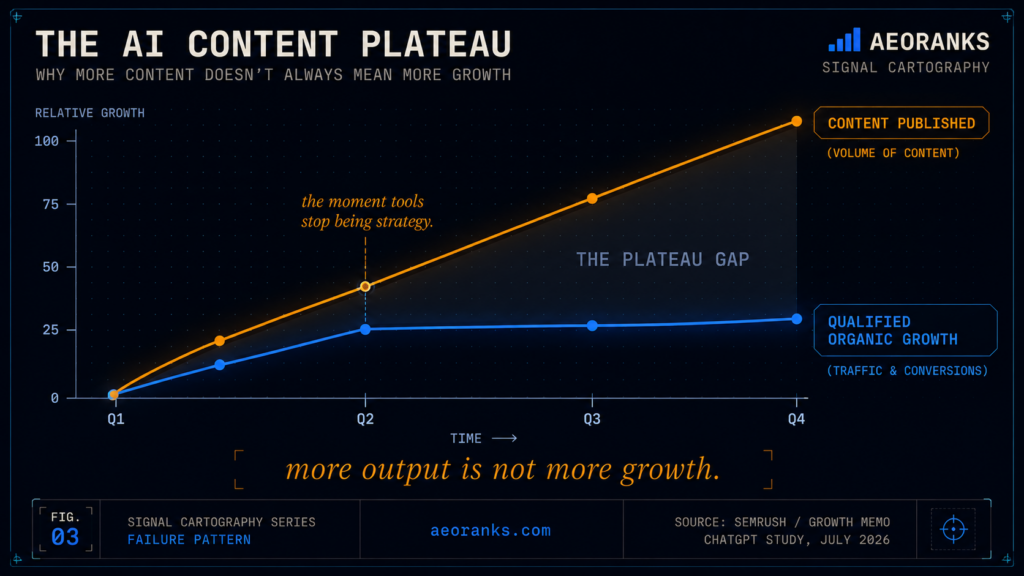
Typical symptoms include:
- Decentralized experimentation: Content, analytics, and ad teams each try AI on their own, using different tools and data. Without a shared strategy for data, prompts, and KPIs, these efforts don’t combine into a cohesive plan.
- Tool obsession: Teams rush to buy every new AI tool, expecting instant lift. But tools alone don’t solve the core problem of strategy. As one marketer put it, “AI is for velocity, not final quality” – churned-out content floods in, but without direction.
- Lack of governance: There are no shared guidelines or taxonomies. One team’s AI prompts and data sources might not match another’s, so content overlaps or gaps arise.
- No content strategy: Many companies use AI to crank out more generic articles (traffic content), rather than to address higher-value topics. Google’s 2024 algorithm updates have heavily penalized “mass-produced” or low-value content. ChatGPT and Perplexity also favor insightful, factual answers – so generic posts often don’t attract AI citations or clicks.
- Missing entity focus: Brands neglect to structure their data as searchable “entities.” As one AI strategist notes, if a company isn’t set up as a verified entity, it’s “losing distribution” to AI answer engines. In other words, an SEO without an entity/knowledge-graph strategy is invisible to AI bots.
- No AI metrics: Many teams still measure only classic SEO KPIs (rankings, clicks) and ignore AI-specific signals. They never track if ChatGPT or Google’s AI Overviews cite their content, or if their answers appear as recommended solutions. Without those metrics, it’s impossible to know what’s working.
In short, everyone is experimenting, but nobody is building the needed systems. The more teams throw AI at problems, the more fragmented the effort becomes. One company found that after Google rolled out AI answer panels, their traffic didn’t just dip – it flatlined. They only recovered by pivoting to brand-centric and community-led tactics. This is a clear sign that simply increasing output (blogs, ads, keywords) doesn’t overcome the underlying strategy gap.
The Three Stages of AI Maturity in Marketing
Marketing organizations typically move through three stages as they adopt AI. Understanding these can help you diagnose where you stand:
Stage 1: AI Curiosity. Teams ask “What can AI do for me?”
This is where nearly everyone starts. The team generates blogs, drafts ads, summarizes meetings, rewrites emails. It feels like magic for about a quarter.
What it looks like: random experimentation, no documentation, no ownership.
The outcome: higher content velocity, little business impact. The content is fluent, generic, and identical to what every competitor’s AI produces from the same prompts.
Stage 2: AI Fluency. After initial testing, teams start building AI-aware workflows. They create shared prompt libraries, integrate AI features into tools (e.g. generating content briefs or keyword reports), and standardize some processes. Content templates, schema suggestions, or batch audits may become routine. The result is greater efficiency and consistency: more optimized content, faster research, etc. However, differentiation is still limited – AI is mostly amplifying existing tactics. Many systems still treat AI as a late-stage step, not a fundamental part of planning.
Stage 3: AI Instinct. Marketing becomes AI-native at its core. The team’s mindset shifts to, “How do we build this with AI in mind from the start?” Every content planning session and campaign kickoff begins by asking where AI can automate or enhance tasks. Workflows are designed so that AI handles repetitive or data-heavy work (e.g. entity extraction, draft creation, schema generation) and feeds insights back to humans. Humans then focus on what machines can’t: creative strategy, brand positioning, original insight. As StartSmart Global warns, in this stage you stop simply “writing blogs” – you “architect the technical data infrastructure” so that AI models see your brand as the only logical answer. AI Instinct means no one has to remind the team to use AI – it is the default first step, not an afterthought.
Across all stages, a crucial lesson emerges: AI itself is not the competitive moat – your operating model is. Anyone can download GPT-4 or integrate an AI API. What matters is how quickly you turn AI-generated data into proprietary insight and human-led action. Think of it this way: AI provides tools; humans and systems create advantage.
“Why AI Alone Doesn’t Create Organic Growth” — restructure for answer-first depth
AI creates content, but engines reward trust — and trust can’t be generated. Google evaluates AI content by the same E-E-A-T bar as human content. ChatGPT cites sources that demonstrate expertise. No engine gives a boost for volume.
- Google ranks authority — experience, expertise, and a track record on the topic.
- ChatGPT cites expertise — precise answers corroborated elsewhere.
- Perplexity rewards structured knowledge — clean, extractable, well-sourced pages.
- Claude values context — content showing real understanding, not keyword coverage.
- Gemini and AI Overviews trust brands — entities with consistent signals across the web.
The AI-Native Organic Growth Framework
Old model: Keyword → Blog. Pick a keyword, publish a post, hope it ranks. That model is dying because it optimizes for one engine (Google) and one format (the blog post).
The AI-native model runs every piece of content through a longer chain — and each link is a reason for engines to cite you:
Intent → Entities → Topical Cluster → Expert Insight → Original Data → Schema → Internal Links → AI-Ready Formatting → Distribution → AI Citations → Qualified Leads
Here’s what each step does, in plain language:
- Intent — start with the real question a buyer asks, not a keyword. AI conversations are questions, so your content map should be too.
- Entities — define the people, products, and concepts your brand should be known for, and name them consistently everywhere. Engines reason in entities, not keywords.
- Topical cluster — plan the full set of related pieces, not one post. Depth on one topic beats breadth across twenty.
- Expert insight — inject something only your team knows: a customer pattern, a contrarian take, a lesson from real work.
- Original data — first-party numbers, benchmarks, or research. This is the single most citable asset you can create; engines prefer sources over summaries.
- Schema — mark up the content (FAQ, Article, Organization) so machines parse it the way you intend.
- Internal links — connect the cluster so authority flows and engines see the topic relationship.
- AI-ready formatting — answer-first paragraphs, question headings, short blocks, tables. Make extraction effortless.
- Distribution — get the piece referenced in the third-party places AI trusts: communities, roundups, reviews. Citations are earned off-site as much as on-site.
- AI citations — the outcome: your brand named and linked inside AI answers.
- Qualified leads — buyers who arrive pre-sold, because the AI recommended you at the moment of decision.
AI accelerates almost every step of this chain. But notice which steps make the chain valuable: insight, data, distribution. Those are human.
What AI Should Do vs. What Humans Should Own
The most useful division of labor we’ve seen — validated by practitioners across industries — looks like this:
| AI handles | Humans own |
|---|---|
| Research at scale | Positioning |
| Keyword & prompt clustering | Strategy |
| Entity extraction | Brand voice |
| Content drafting | Opinion & point of view |
| FAQ generation | Lived experience |
| Schema markup | Customer interviews |
| Internal link suggestions | Product messaging |
| Repurposing across formats | Original frameworks |
| Optimization & quality checks | Final editorial judgment |
The pattern behind this table comes from how skilled professionals actually use AI well. The best description we’ve seen came from an experienced teacher using AI to assist with feedback: they treat AI as a peer — it drafts an assessment, they scan the original work themselves, keep what they agree with, cut what they don’t, and add what the AI missed. They agree with it about 95% of the time. The value isn’t the 95% — it’s that a human expert catches the 5%, and the reader gets judgment, not just output.
Three working rules fall out of that experience, and they transfer directly to marketing:
- AI is a second reader, never the only reader. Someone with real expertise reviews everything that ships. Practitioners who verify outputs “regularly catch mistakes” — including AI confidently asserting things that aren’t there. Your brand claims deserve the same scrutiny.
- Specificity determines quality. AI matched human experts only when given an extremely specific rubric. In marketing terms: vague prompts produce generic content; detailed standards — voice, structure, evidence requirements, banned claims — produce usable drafts. Your prompt library is your rubric.
- Stakes decide the workflow. Low-stakes work (internal summaries, first drafts, repurposing) can lean heavily on AI. High-stakes work (positioning pages, original research, anything a buyer decides on) gets full human ownership. Teams that apply one rule to everything either move too slow or ship embarrassments.
And one governance rule that too many teams skip: know what you’re feeding the machines. Practitioners across fields have learned the hard way that pasting sensitive material into AI tools without a data policy creates privacy and IP exposure. Decide upfront which tools are approved, what data may enter them, and who reviews the settings.
Why AI Visibility Is Becoming the New SEO KPI
In the AI search era, the old metric of “Did we rank #1?” is giving way to new questions: “Did AI answer engines cite our brand? Are we the chosen answer?”
Platforms like Google (with its AI Overviews), ChatGPT, Perplexity, Gemini and others are increasingly the first stop for users. Recent data shows that traditional click-through rates have plunged – when AI answer boxes appear, people click organic results far less. In one community discussion, users cited 35–60% declines in traffic from informational queries after AI summaries rolled out. The one bright spot: brand queries often see higher click-throughs (+18% in one report), implying that strong brands win in AI answers. Indeed, Reddit marketers now focus on brand mentions: one commenter noted that positive signals from “community surfaces” (like niche forums) help AI know your brand and protect you from traffic loss.
The bottom line: marketers must now track AI Visibility – how often AI bots “see” and cite your content. This means new KPIs:
- AI Citations: How often does ChatGPT or Google’s AI solution quote your site or answer? Tools like LLM Scout or specialized SEO platforms can report on AI answer inclusion.
- Entity Coverage: Are your key topics and products represented in knowledge graphs? Being a recognized “entity” increases the chance AI answers draw on your data.
- Answer Feature Share: What percentage of relevant AI answers (e.g. “AI Overviews” or “AI Answers”) include your brand?
- Brand Mentions & Context: Monitor if AI voice assistants (ChatGPT, Copilot, etc.) are recommending your brand by name. Does ChatGPT “talk about your brand” when users ask related questions? One marketer now routinely checks this, asking “Where does our brand rank in AI answers?”.
- User Engagement on AI: Track how many visits or conversions come indirectly from AI tools (for example, when AI sends a user directly to your site without a search click).
Some marketers even perform controlled tests: instead of zero-clicks and CTR, they measure brand lift and conversions. As one growth leader summarized, you need to “treat AI search as a new distribution layer”. That means expecting lots of no-click answers but focusing on lift in brand searches, direct traffic, and assisted conversions. In practice, teams set goals around branded search growth and incremental revenue from organic, rather than just raw clicks.
In short, AI Visibility = the new SEO metric. The key question is no longer “Did we get on page 1?” but “Did AI pick us as the answer?” Strong brands and data-driven content will be cited more. Weak players risk irrelevance as AI agents increasingly answer instead of links.
Building a Marketing Operating Model for AI Search
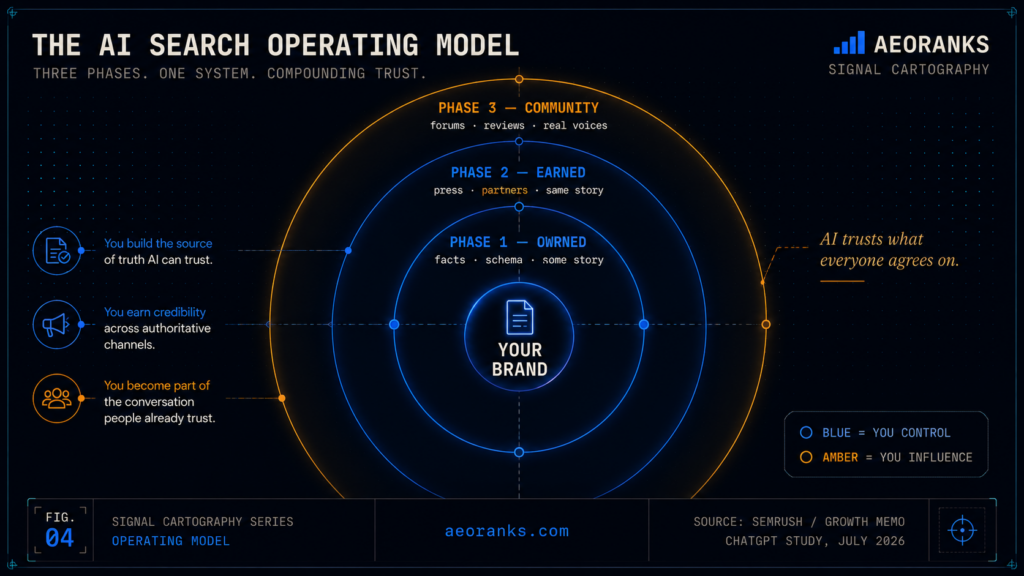
Shifting from AI tools to an AI-native strategy requires rewiring your marketing operations. This is not a one-off project but a phased transformation:
Phase 1 – Fortify Owned Content: Your website is your most controllable asset. Work with your development and content teams to make it a “source of truth.” Ensure every important fact (use cases, specs, pricing) is clearly written and marked up (schema, FAQs, definitions) so an AI can extract it easily. In practice, this means moving beyond making pages “human-readable” to making them bot-readable. For example, one SEO lead ensures that all product details on his site are so clear that “if the AI can’t find the facts on your site, it will hallucinate them from somewhere else”. This phase’s goal is to have no factual gaps; every critical query about your product can be answered from your own pages.
Phase 2 – Coordinate Earned Media: Next, expand into PR, partnerships, and social. Recognize that AI cares what others say about you almost more than your site. Work with PR and communications to build consistent narratives. Instead of one-off press releases, aim for an “always-on” strategy: every news piece, guest article, or influencer mention should reinforce the same key points and language. As Cornwell puts it, shift from chasing “backlinks” to chasing high-value citations – telling a story that other media sites will echo. The creative and brand teams should produce content (videos, infographics, stories) that can be syndicated in trade publications and social channels, each piece echoing your core message. The end goal: when an AI aggregates web content to answer a question, it finds the same facts on your site, in news articles, and in partner channels. This consensus-building ensures the AI is citing you as the authoritative source of truth.
Phase 3 – Shape Community & Social Signals: Finally, engage directly with customers and communities where LLMs “listen.” AI models crawl forums, reviews, Reddit, YouTube, and other user-generated sources for context. Your social/community team should identify where your audience naturally congregates (e.g. industry subreddits, LinkedIn groups) and participate meaningfully. This might mean answering questions on Q&A sites, sponsoring insightful discussions, or seeding useful content in relevant threads. The objective is to “optimize for community authority and sentiment”. In other words, make sure real people are saying positive things about you in the exact words an AI would pick up. Also coordinate with affiliates and review platforms so your product data and brand narrative extend even further. The more consistent your brand story is across community and social signals, the more confidently an AI can cite you in answers.
Throughout all phases, the SEO team acts as the “quarterback,” exchanging data and insights with every other team. For example, the content team provides deep topic expertise to SEO, and SEO provides keyword strategy and performance data. PR gives brand messaging input; in return SEO shares trending topics and authority targets. Technical teams offer site performance data; SEO delivers audit priorities. This constant feedback loop ensures that every content or PR effort is tuned for both human engagement and AI discoverability.
The Biggest Mistake Companies Make
The biggest mistake is thinking “AI will give me an edge.” In reality, everyone now has access to AI. Your competitors are playing the same tools. What will truly set you apart is how quickly and cleverly you use AI outputs to build something unique. AI is not your moat; your AI-driven operating model is.
Leading marketers frame it this way: “AI writes. Humans think. Systems scale. Authority wins.” In other words, AI can generate the draft, but humans must bring the insight, the creativity, the customer understanding. And you must have systems (processes, data governance, learning loops) to turn those outputs into consistent advantage. As StartSmart Global bluntly puts it, stop “decorating a sinking ship” by throwing blogs at the wall. Instead, build for consensus – only the brands that become the obvious answers in AI will truly win.
AI is here to stay, but it will only commoditize the basics. Yesterday’s “secret sauce” (like a clever SEO hack or proprietary algorithm) will soon be in every marketer’s toolkit. The durable competitive advantage comes from your capacity to continuously evolve: to absorb what AI commoditizes and push beyond it. Teams that stay curious, experiment deliberately, and always loop back with human expertise will keep creating new value. That is how AI-ready teams win at organic growth.
AI writes. Humans think. Systems scale. Authority wins.
What is an AI-native marketing operating model?
An AI-native operating model is a way of structuring your team, processes, and technology around AI from the ground up. Instead of tacking AI onto existing tasks, it weaves AI into planning, execution, and measurement. For example, it sets up cross-team governance (shared data taxonomies, prompt libraries), builds iterative workflows (content plans that include AI analysis each week), and tracks AI-specific KPIs (like AI answer citations). In practice, it looks like the phased approach above: SEO leads owned content, PR coordinates earned media, and social shapes community signals – all designed so AI powers the workflow, not just the end product.
What is the difference between AI SEO and traditional SEO?
Traditional SEO focuses on keywords, backlinks, and click-driven rankings in Google’s search results. “AI SEO” (or AEO/GEO) means optimizing for AI-driven discovery platforms. This involves focusing on entities and answering intent directly. For example, instead of just sprinkling keywords, you use clear schema markup and answer-first formats that LLMs can parse. You also pay attention to building brand authority in AI – ensuring AI chatbots and answer engines recognize your site as a trusted source. Essentially, AI SEO covers the same fundamentals (useful content and good UX) but adds new tactics like entity optimization, structured data, and monitoring of AI answer citations.
How does AI improve organic marketing?
AI accelerates many marketing tasks: it can generate content drafts, identify topic gaps, cluster keywords, and even optimize ad spend faster than manual methods. It aids personalization and analytics, uncovering trends that drive content strategy. In organic search, AI tools can speed up keyword research, suggest on-page optimizations, or automatically audit sites. This efficiency frees marketers to focus on strategy. However, the real power comes when AI is integrated into processes: using AI to analyze which blog posts users enjoy, then iterating, or using AI to draft an infographic outline that the team refines. Again, the value of AI is as an assistant – it improves productivity and insight, but it still requires human guidance.
What is AI Visibility?
AI Visibility is a measure of how often your brand and content appear in AI-powered search and answer tools. It goes beyond traditional rankings to include metrics like how often ChatGPT or Google’s AI Overviews cite your site, and how prominently your brand features in AI-generated answers. AI Visibility reflects your brand’s presence in the AI-driven discovery landscape. The higher your AI Visibility, the more likely AI assistants will recommend your content to users.
How do brands get cited in ChatGPT (or AI assistants)?
AI assistants like ChatGPT generate answers by summarizing information from web sources. To get cited, your content needs to be a primary source for the answer. This means being the most relevant, authoritative, and clear source for a given question. Brands can improve this by creating comprehensive, factual content (think unique data and definitive answers) and by using structured markup (so bots can identify content easily). Also, focusing on long-tail and conversational queries can help. Some companies use tools to submit their content to AI knowledge graphs. Over time, building general brand authority (so the AI “knows” you by name) leads to more citations.
What makes content AI-citation worthy?
To be AI-citation worthy, content should be original, authoritative, and easily extractable. That means: publishing unique research or insights, having a clear subject-matter expert voice, and organizing the page so facts stand out (headings, bullet lists, Q&As). For example, content that directly addresses a question (“How to do X?”) with step-by-step guidance or definitive answers is ideal. It should also use schema markup and answer-first formatting so AI bots can pick it up. As SEO experts note, generative engines reward factual, context-rich content. Avoid generic fluff – give AI assistants concrete data points to cite.
Will AI replace SEO professionals?
No. At least not fully. AI is changing the nature of SEO work, but skilled marketers are more essential than ever. AI can do grunt work, but it can’t replace deep domain knowledge or creativity. As many practitioners observe, the best results come from blending AI speed with human strategy. Humans understand nuances of brand voice, can interpret data in context, and make judgment calls. AI tools will evolve, but they will increase the demand for AI-literate SEO experts rather than eliminate them. In fact, the shift to AI means SEO roles are expanding to include data analysis, process orchestration, and cross-functional coordination – skills that are inherently human.