Topical authority is the degree to which search engines and AI systems recognize your brand as a trusted expert on a specific subject. In classic SEO, it helped you rank. In AI search, it decides something bigger: whether ChatGPT, Gemini, Claude, Perplexity, and Google AI Overviews name your brand when buyers ask questions in your category.
And here’s what most marketers haven’t internalized yet: AI search doesn’t just rank authorities — it crowns owners. Recent research analyzing 1,094 categories and 600,000+ citations in ChatGPT found that once a brand earns a clear lead in mentions for a category, it retains that lead in over 90% of month-over-month comparisons. Authority in AI search compounds. This guide explains how it works, and how to build it before your category settles.
What Is Topical Authority in AI Search?
In AI search, topical authority means an LLM has learned — from its training data and the sources it retrieves — that your brand is strongly and consistently associated with a topic. When that association is strong enough, the model doesn’t just cite your pages. It names your brand in its answers, includes you in comparisons, and recommends you when someone asks “which should I use?”
This is different from classic topical authority in one important way: it’s built on entities, not keywords. An entity is a distinct “thing” — your company, your product, your founders, the concepts you specialize in. LLMs represent knowledge as relationships between entities. Your job is to make the relationship between your brand entity and your topic entities so clear, consistent, and well-corroborated that the model treats it as a fact.
Think of it as the difference between ranking for “payroll software” and being known as a payroll software company — by the machines that now answer buyers’ questions.
Why Topical Authority Matters More in AI Search (The Data)
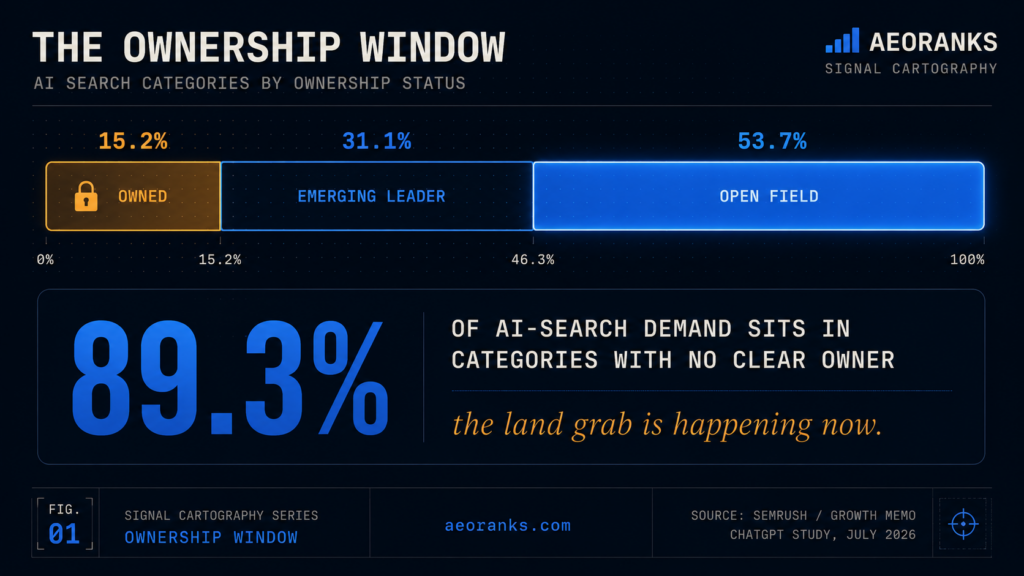
Because AI answers develop category owners — and ownership is durable. The July 2026 Semrush/Growth Memo study of ChatGPT answers across 1,094 US categories found:
- Only 15.2% of categories have a clear owner — a brand mentioned across almost all prompts with a wide lead. 53.7% are still open fields.
- 89.3% of AI-search demand sits in categories with no clear owner. The biggest categories are the least settled.
- But once ownership is established, it sticks: clear owners kept first place in 90.4% of month-over-month comparisons. Challengers only broke through where the lead was narrow.
- Category owners had higher brand search volume, organic traffic, and authority scores than runners-up — but none of those alone explained ownership. Topic-specific relevance did the heavy lifting.
The strategic read is simple: the land grab is happening now. Broad content spread across every semi-adjacent topic rarely reaches the mention share that makes a lead stick. Focused topical depth does — and the cost of picking your categories today is far lower than it will be in twelve months.
There’s a second data point every marketer should know. In user studies of AI-assisted buying, 74% of participants chose the brand ranked first in the AI’s answer, and 64% clicked nothing at all. In AI search, the mention is the shelf space. Authority isn’t a traffic play anymore — it’s a recommendation play.
How Do LLMs Decide Which Brands to Trust?
LLMs trust brands that are semantically close to a topic across many consistent, corroborated sources. In plain terms, four signals drive it:
- Entity consistency. Your brand is described the same way — same name, same category, same core claims — on your site, your profiles, directories, and third-party coverage. Contradictions weaken the association; consistency strengthens it.
- Topical depth. You’ve covered the topic completely: definitions, comparisons, use cases, alternatives, buying questions. Modern systems measure how densely your content maps to a topic’s full question space, not whether one page matches one keyword.
- Corroboration. Independent sources — reviews, communities, industry roundups, news — repeat the association. LLMs weigh agreement across sources heavily, which is why off-site signals often move AI mentions more than on-site tweaks. It’s also why AI sometimes finds your content but doesn’t cite it: the content is discoverable, but the trust isn’t there yet.
- Extractable structure. Clean headings, answer-first paragraphs, and schema markup make your pages easy to parse and safe to quote. Structure doesn’t create authority, but it removes the friction that stops authority from being used.
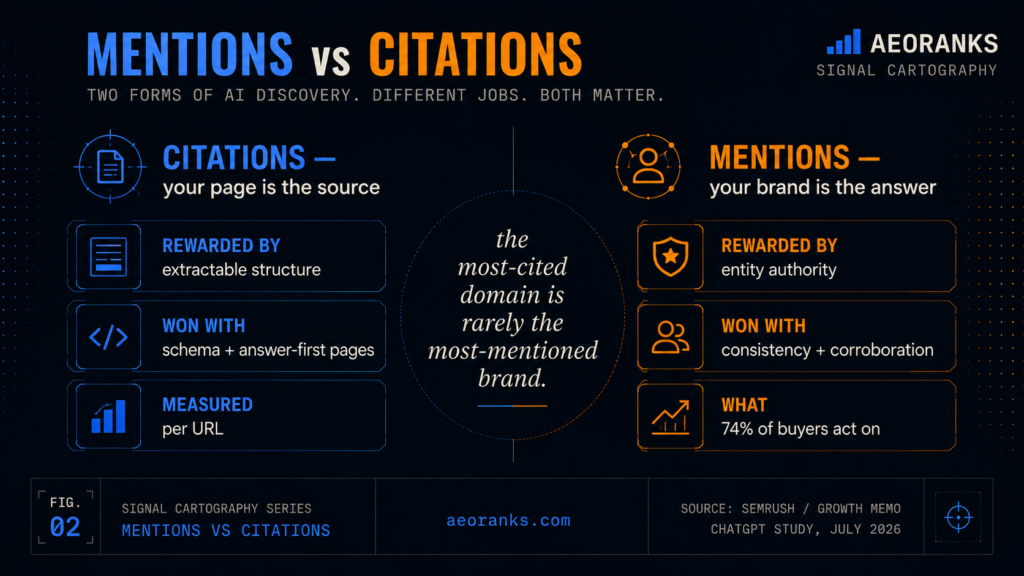
One more finding worth engraving on your strategy: in the ChatGPT study, the most-cited domain was the most-mentioned brand in only about 20% of categories. Citations and mentions are related but separate games. Citations reward extractable pages. Mentions reward entity authority. You want both — but if you must prioritize, remember what users act on: the name in the answer.
Rank Across AI Search Platforms
Grow visibility across ChatGPT, Claude, Gemini & Perplexity with AI-first SEO strategies.
Book Free Strategy Call ChatGPT
 Claude
 Gemini
 Perplexity
 Grok
Grok
How to Build Entity Authority LLMs Trust: A 6-Step Framework
Step 1: Pick the categories you can own
Don’t try to be an authority on everything. List 10–20 commercially important categories, then classify each: does it have a clear owner, an emerging leader, or no leader? Prioritize valuable categories with no owner or a narrow lead. Defend categories you already lead. Be selective about attacking one where an established brand appears in every prompt.
Step 2: Give your entity a home
Create one definitive page that states what your brand is, what category it belongs to, and what it’s known for. Support it with Organization schema, consistent naming everywhere your brand appears, and sameAs links connecting your site to your official profiles. This is the anchor LLMs use to resolve who you are.
Step 3: Cover the topic completely — as a cluster, not a page
For each category, build a pillar page plus supporting pieces that answer the five prompt types buyers actually ask AI: what is it, how does it compare, what are the alternatives, when do I use it, and which should I buy? Depth in one category beats breadth across ten. Interlink the cluster so engines see the topic relationship, and keep it current — stale facts erode trust fastest.
Step 4: Publish the page types AI actually cites
In the ChatGPT data, the most-cited page types were product and service landing pages, followed by editorial content. Homepages were cited just 4% of the time. Make your product pages answer real questions in plain language, and invest in editorial that contains something worth citing: original data, expert takes, honest comparisons.
Step 5: Earn corroboration off-site
Get your category association repeated where LLMs look: review platforms, community discussions, comparison articles, industry publications, podcasts. This is the slowest step and the most decisive one — AI citations are earned off-site as much as on-site.
Step 6: Measure mentions, citations, and business impact separately
Track brand mentions as your ownership metric, citations as your source-authority metric, and pipeline as your business metric — across the engines your buyers use, on repeated runs, weekly. Our guide to tracking AI share of voice covers the full setup.
Want to know if your category has an owner yet — and whether it’s you? Book a free AI strategy call with AEORanks. We’ll map how ChatGPT, Gemini, and AI Overviews currently see your brand and where your ownership window is still open.
Topical Authority vs. Entity Authority: What’s the Difference?
They’re two layers of the same asset:
| Topical authority | Entity authority | |
|---|---|---|
| What it is | Depth and completeness of your content on a subject | Strength of the association between your brand and that subject |
| Built by | Topic clusters, pillar pages, full question coverage | Consistent naming, schema, off-site corroboration, brand signals |
| Rewarded with | Rankings and citations | Brand mentions and recommendations |
| Classic SEO analogy | “This site covers payroll deeply” | “This brand is a payroll company” |
Topical authority makes your content citable. Entity authority makes your brand nameable. AI search rewards the combination – which is why a strategy built only on publishing content plateaus, and why answer engine optimization treats content, entities, and off-site trust as one system.
What is topical authority in AI search?
Topical authority in AI search is the degree to which LLMs like ChatGPT and Gemini associate your brand with a specific subject, based on the depth of your content, the consistency of your entity signals, and corroboration from independent sources. High topical authority leads to brand mentions and recommendations inside AI answers, not just rankings.
Does topical authority still matter for ChatGPT and AI Overviews?
Yes, July 2026 data across 1,094 categories shows AI answers develop durable category owners: brands with a clear mention lead kept it in 90.4% of month-over-month comparisons. Focused topical depth is how those leads are built and defended.
What is entity authority?
Entity authority is the strength of the connection between your brand (as a machine-readable u0022thingu0022) and the topics you want to be known for. It’s built through consistent naming, Organization schema, a definitive brand page, and repeated third-party corroboration – and it’s what makes LLMs name your brand rather than just cite your pages.
How long does it take to build topical authority for AI search?
Expect months, not weeks. Content clusters can be published in a quarter, but corroboration – the off-site signals LLMs weigh most – accumulates slowly. The encouraging part: because ownership is durable, authority built now compounds, and most categories are still unowned.
What content gets cited most by AI engines?
Product and service landing pages and substantive editorial content get cited most; homepages are cited only about 4% of the time. Pages that answer one question directly, contain original data or expert insight, and carry clean structure and schema are the most extractable – and the most cited.