AEO and GEO success isn’t measured with rankings or clicks – it’s measured with AI Share of Voice (your brand’s mentions divided by total brand mentions across a fixed set of prompts), citation rate, and downstream business impact like AI referral traffic and assisted conversions. You calculate AI Share of Voice by running a consistent prompt set across ChatGPT, Perplexity, Gemini, and Google AI Overviews, logging every brand named, and tracking your share against competitors over time.
Key Takeaways on AI Tracking
- Traditional SEO metrics (rankings, impressions, CTR) don’t capture AI visibility because AI engines synthesize answers instead of returning a ranked list of links.
- AI Share of Voice is the closest thing AEO/GEO has to a north-star metric – it tells you how much of the conversation about the category you actually own.
- Tracking requires four metric clusters: Visibility, Authority & Trust, Technical (crawlability), and Business Impact.
- You don’t need an enterprise platform to start. A spreadsheet, 20-30 prompts, and a monthly cadence will get you a real baseline in 30 days.
- GA4 already captures AI referral traffic – most teams just haven’t filtered for it yet.
What Is AI Share of Voice?
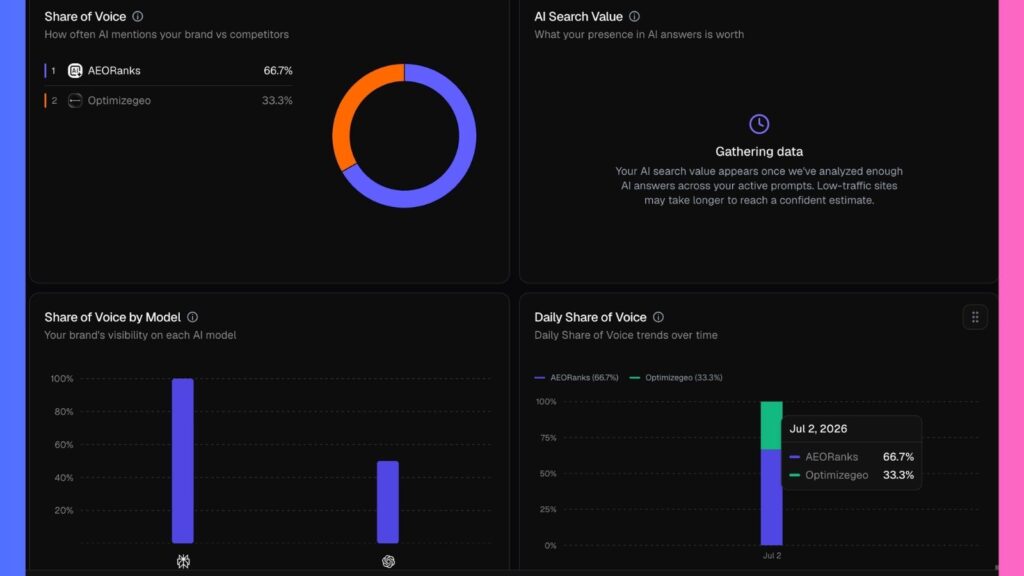
AI Share of Voice (AI SOV) is the percentage of total brand mentions, across a fixed set of AI-generated answers, that belong to you instead of your competitors.
It tells you how much space your brand owns inside AI conversations.
AI Share of Voice = (Your brand mentions ÷ Total competitor mentions in a prompt set) × 100That number matters because it shows how much AI search currently “sees” you in your category.
A simple way to think about it:
- GEO helps AI trust and recommend your brand.
- SEO helps people find your pages.
- AEO helps AI understand and extract your content.
| Area | Traditional SEO | AEO | GEO |
|---|
| Primary goal | Rank pages | Appear in answers | Be recommended as a brand |
| Main signal | Keyword position | Citations and answer extraction | Mentions, trust, and recommendations |
| What you track | Clicks, impressions, CTR | AI mentions, citations, retrieval | Share of voice, sentiment, recommendation rate |
| Main outcome | Traffic | Visibility in answers | Brand influence in AI discovery |
How to Track AEO Performance vs. GEO Performance
AEO and GEO get lumped together so often that most teams end up tracking them as one thing. They’re related, but they answer different questions – and separating them makes your reporting sharper.
How to Track AEO Performance
AEO performance is about whether your content gets pulled directly into an answer – a featured snippet, an AI Overview box, or a ChatGPT response that quotes or paraphrases your page. Track it through:
- Answer inclusion rate: the share of your target prompts where an AI engine surfaces your content as part of the direct answer, not just a passing mention.
- Citation rate / attribution quality: whether the AI links back to your page as the source, or just names you with no link (see the Authority & Trust cluster below).
- Content-level retrieval: which specific pages or sections get pulled into answers most often. This tells you which content format to double down on.
If you’re only checking whether your brand’s name shows up somewhere in a response, that’s GEO tracking, not AEO tracking. Tracking AEO performance means looking specifically at whether your content is doing the answering.
How to Track GEO Performance
GEO performance is broader: it’s whether your brand shows up, gets recommended, and is described accurately across the wider AI ecosystem – ChatGPT, Perplexity, Gemini, Claude – regardless of whether one specific page gets cited. Track it through:
- AI Share of Voice: your mentions relative to competitors across a fixed prompt set.
- Brand mention consistency: whether you show up reliably across variations of the same question, not just once.
- Sentiment and recommendation rate: how you’re framed when you do appear, and whether you’re the one actually being recommended.
In short: tracking AEO asks “did our content answer this?” Tracking GEO asks “did our brand get recommended?” Most teams need both – You can refer to our AEO & GEO best practices guide here.
Why Traditional SEO Dashboards Are Not Enough
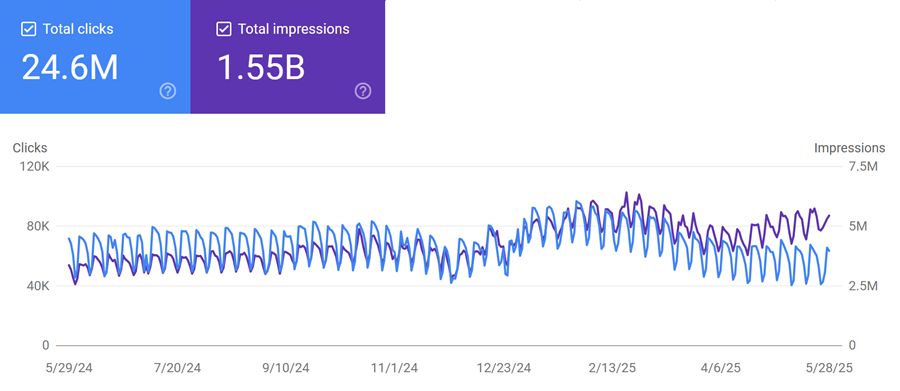
For years, marketers judged success through Google rankings, clicks, impressions, and CTR. That still matters, but it is no longer the full picture.
AI search changes the game. Instead of showing ten blue links and letting users choose, AI systems often give a direct answer. In many cases, the brand that gets mentioned or cited inside that answer wins attention before the click ever happens. Google AI Overviews can also cite pages that are not the highest-ranking organic results, which means a strong Google ranking does not automatically guarantee AI visibility.
That is why your dashboard needs a second layer:
Traditional SEO = visibility in search results
AEO/GEO = visibility inside the answer itself
If you only track rankings, you may miss the brands AI is actually recommending.
Gartner projects organic search traffic could decline by 25% or more as AI-generated answers absorb a growing share of queries, and separate research on AI Overviews found that 40–60% of the sources cited rotate every month. If you’re checking your AEO/GEO tracking once a quarter, you’re missing most of the actual movement. We recommend having a Weekly or Monthly analysis of AI visibility.
The 4 Metric Clusters That Make Up AEO & GEO Tracking
AI Share of Voice tells you how much of the conversation you own. But to actually act on it, you need to break the broader measurement problem into four clusters. We use this exact breakdown when auditing AI visibility for clients at AEORanks, because each cluster answers a different question.
1. Visibility metrics – “Are we even in the conversation?”
- AI Mention Rate (Brand Inclusion Rate): The percentage of your tracked prompts where your brand is named at all.
- AI Share of Voice: Covered above – your mentions relative to competitors across the same prompt set.
- Prompt-level visibility: Whether you appear consistently across variations of the same question (definition, comparison, how-to, follow-up), not just one phrasing.
2. Authority & trust metrics – “Are we being represented correctly, and do they trust us?”
- Citation rate / attribution quality: Whether the AI engine links back to your site as a source, versus just naming you with no link. A linked citation is worth meaningfully more – it drives both referral traffic and a stronger attribution signal.
- Recommendation rate: How often you’re surfaced specifically when a prompt asks for a recommendation (“best tool for…,” “top platforms for…”) rather than a general definition. This is the closest AEO equivalent to bottom-of-funnel intent.
- Brand / messaging accuracy: A simple correct / partially correct / incorrect rubric scoring whether the AI is describing your product, positioning, and differentiators accurately. Visibility with inaccurate framing can do more harm than no visibility at all.
- Sentiment accuracy: Neutral, positive, or comparatively unfavorable – how the AI frames you relative to alternatives.
3. Technical metrics – “Can AI systems even access and parse our content?”
- Retrieval success / crawl accessibility: Whether AI crawlers (GPTBot, ClaudeBot, PerplexityBot, Google-Extended) can actually reach and parse your pages. A blocked crawler silently kills every other metric downstream – this is the one most teams forget to check first.
- Schema and structured data coverage: Whether your content is marked up in a way that helps AI systems interpret it confidently.
4. Business impact metrics – “Is any of this translating into pipeline?”
Close rate by source: Whether AI-referred leads convert at a different rate than organic or paid traffic. In our experience, AI-referred leads tend to arrive pre-qualified, because the AI has already done a chunk of the evaluation work for them – which is exactly why they’re worth isolating in your CRM.
AI referral sessions: Real visits originating from chat.openai.com, perplexity.ai, gemini.google.com, copilot.microsoft.com, or claude.ai.
Assisted conversions: Deals where an AI touchpoint appeared somewhere in the journey, even if the final conversion happened through a direct inquiry or sales call.
Branded search lift: A rise in searches for your company or product name, which often tracks alongside growing AI mentions – useful as a second confirming signal when direct attribution is incomplete.
Curious how often AI engines actually recommend your brand? Let’s find out. In a free 30-minute AI Discovery Strategy Call, we’ll benchmark your visibility across ChatGPT, Gemini, Claude, Perplexity, and Google AI Overviews, identify the biggest gaps, and outline a practical roadmap to improve AI citations, authority, and demand generation. Book your free strategy call →
How to Calculate Your AI Share of Voice in 5 Steps
This is the part you can actually go do this week, with nothing more than a spreadsheet.
Step 1: Build a fixed prompt list. Pull 20–30 prompts that mirror how real buyers actually talk to AI engines – not keywords, full questions. Mix three types: category/definitional (“what is the best [category] for [use case]”), comparison (“[Competitor A] vs [Competitor B]”), and recommendation (“top tools for [job to be done]”). Lock this list for the quarter so your trend data stays comparable.
Step 2: Run the prompts across at least three engines. ChatGPT, Perplexity, Gemini, and Google AI Overviews behave differently enough that visibility on one doesn’t predict visibility on another. Run the full prompt set on each, on a fixed schedule (weekly is ideal, monthly is the minimum viable cadence).
Step 3: Log every brand named in every answer. For each prompt, record which brands appear – not just yours. This is the part teams skip, and it’s the part that actually makes Share of Voice possible to calculate, because you need the denominator (total brand mentions), not just your own numerator.
Step 4: Calculate the percentage. Your mentions ÷ total mentions across all brands named, for that prompt set, that week. Track it in a simple running spreadsheet – date, prompt, engine, brands mentioned, your mention (yes/no), competitor mentions.
Step 5: Track the trend, not the snapshot. A single week’s number is close to meaningless given how non-deterministic generative answers are. What matters is the direction over 8–12 weeks, and whether your share is growing relative to the same competitor set.
Once you’ve done this manually for a month, you’ll know exactly whether it’s worth automating with a dedicated tool – which brings us to the next section.
Top AI Visibility Tracking Tools for AEO & GEO
No single tool covers everything above. Most teams end up running a small stack: one AI visibility tracker, a technical crawler, and your existing analytics/CRM. Here’s how the best AEO & GEO tracking tools are available in the market:
| Tool | Category | What it actually tracks |
|---|---|---|
| Profound | AI visibility (enterprise) | Mention rate, Share of Voice, recommendation rate, sentiment, competitive benchmarking |
| AthenaHQ | AI visibility + revenue attribution | Mention rate, SOV, and revenue tied directly to AI citations |
| Peec AI | AI visibility (mid-tier) | Mention rate, prompt intent tagging (separating recommendation vs. informational prompts) |
| Otterly.AI | AI visibility (budget-friendly) | Link citation analysis — which URLs AI platforms reference and how often |
| Semrush AI Toolkit (AEO module) | AI visibility + core SEO | Cited pages, prompt-level visibility, unified SEO/AEO reporting |
| Ahrefs | Authority & content intelligence | Brand mention and backlink insights that help explain why content gets cited |
| AlsoAsked | Question discovery | Surfaces real follow-up questions people ask, useful for building your prompt list |
| Conductor | Enterprise reporting | Integrates AEO/GEO insight into broader content and search workflows at scale |
| Screaming Frog | Technical crawler | AI-bot accessibility checks (GPTBot, ClaudeBot, PerplexityBot) and schema validation |
| BrandMentions / Mention / Brand24 | Web-wide brand monitoring | Sentiment and unlinked mentions across the open web, including Reddit and forums |
| Google Analytics 4 (free) | Traffic analytics | AI referral sessions, engagement, and conversions by source |
| Google Search Console (free) | Search analytics | Branded query lift, long-tail queries that trigger AI Overviews |
What AEO & GEO Success Actually Looks Like
For context on where most brands stand today: independent audits across 850,000+ sites put the average AI-visibility score at just 34 out of 100 as of mid-2026. Most companies have enormous headroom here – which is exactly why building your baseline now compounds before the rest of the market catches up.
It won’t show up as a clean spike on a single dashboard the way a ranking jump used to. It shows up as your AI Share of Voice climbing steadily against the same competitor set, quarter over quarter. It shows up as branded search ticking upward even when your overall organic sessions stay flat. It shows up as AI-referred leads moving through your pipeline faster, because the AI already handled a chunk of the evaluation before they ever talked to you.
That’s the compounding case for treating AEO/GEO measurement as infrastructure, not an experiment – the brands building this baseline now will simply have better data to act on when the rest of the market catches up.
Don’t Just Measure AI Visibility.
Become the Brand AI Recommends.
Discover how visible your brand is across ChatGPT, Gemini, Claude, Perplexity and Google AI Overviews—and uncover the fastest opportunities to increase AI citations, visibility and qualified leads.
📅 Book Your Free AI Discovery Call →30-minute strategy session • No obligation • Actionable recommendations
How do I track AEO performance for my brand?
Track AEO performance by measuring whether your content is being pulled directly into AI answers – not just mentioned. Focus on answer inclusion rate (how often your content grounds a direct response), citation rate (whether the AI links back to you), and which specific pages get retrieved most often. Run this monthly against a fixed prompt set so you can see the trend, not just a single snapshot.
How do I track GEO performance across ChatGPT, Gemini, and Perplexity?
Track GEO performance by measuring AI Share of Voice (your brand’s mentions relative to competitors across a fixed prompt set), brand mention consistency across prompt variations, and sentiment/recommendation rate. Run the same prompt set across at least three engines weekly or monthly – visibility on one platform doesn’t predict visibility on another.
How do I track AEO success without an enterprise tool?
Start with a fixed list of 20–30 prompts your buyers would realistically ask, run them manually across ChatGPT, Perplexity, and Gemini on a weekly or monthly cadence, and log every brand mentioned in a spreadsheet. Pair that with free GA4 and Google Search Console tracking for referral traffic and branded search lift. This gets you a real baseline before you spend on a dedicated platform.
What are the best tools for tracking GEO performance?
There’s no single tool that covers everything. Most teams combine a dedicated AI visibility tracker (Profound, Peec AI, Otterly.AI, or AthenaHQ) with a technical crawler for crawlability and schema checks (Screaming Frog), plus GA4 and a CRM for business-impact attribution.
Can Google Analytics track AI traffic?
Yes – GA4’s Traffic Acquisition report already captures it. Switch the primary dimension to Session source / medium and filter for chatgpt, perplexity, gemini, copilot, or claude. Expect some under-counting, since AI platforms strip referrer data inconsistently, especially on mobile.
How often should I audit my AEO/GEO performance?
Run your prompt set weekly to catch citation drops early, roll the data into an AI Share of Voice trend monthly, and review business-impact metrics with leadership quarterly. Visibility loss can compound quickly as AI answers cache and propagate, so speed matters more than waiting for a complete monthly picture.
Does a high AI mention rate guarantee business impact?
No. Mention rate alone is a leading indicator, not a revenue metric. A brand can be mentioned frequently with neutral or even unfavorable framing. Pair mention rate with sentiment accuracy, citation quality, and downstream metrics like AI-referred close rate to know whether the visibility is actually working in your favor.