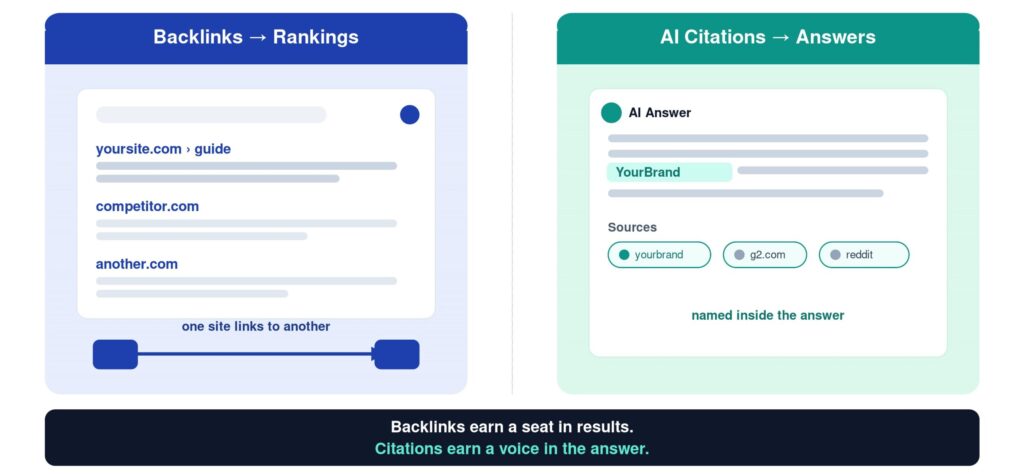
Backlinks and AI citations are two different games. Backlinks help you rank in Google’s blue links. AI citations get your brand named and quoted inside AI answers from ChatGPT, Gemini, Perplexity, and Google AI Overviews. A strong backlink profile does not guarantee AI citations, and neither one replaces the other. To stay visible in 2026, you need both – but you optimize for each differently.
If you only build links, you’re optimizing for one channel and going invisible in the one growing fastest.
Key takeaways
- Backlinks feed rankings. AI citations feed answers. They run on separate systems, so winning one doesn’t win the other.
- High Domain Rating ≠ AI visibility. In real-world tests, sites with strong link profiles get zero AI mentions while lower-authority competitors get cited constantly.
- What actually predicts citations: clear answers, verifiable claims, structured content, third-party mentions (Reddit, G2, forums), and a clean entity graph.
- AI reads at the passage level, not the page level. If your answer is buried under 400 words of intro, a clearer competitor gets cited instead.
- The winning move is one motion, not two. The same content traits that earn citations – original data, clear structure, sourced claims – also attract editorial backlinks.
What are backlinks?
A backlink is a link from one website to another. For over two decades, it’s been one of the strongest ranking signals in Google’s algorithm.
When a reputable site links to your page, search engines read it as a vote of trust. More high-quality, relevant links usually mean higher rankings, more referral traffic, and stronger domain authority. That mechanic hasn’t disappeared. In 2026, backlinks are still the foundation of traditional search.
An Ahrefs study of 14,000 keywords found pages in the top three Google positions had 3.8× more referring domains than pages ranked 4–10. No serious SEO strategy dismisses link building.
AEORanks offers –> SaaS Link Building Services helping brands distribute their product and services across their targeted audience. This not just builds trust but also makes you visible where the audience is. LLMs considers it as trust signal in Answer synthesis.
What are AI citations?
An AI citation is when an AI system references your content as a source inside a generated answer. It might be a footnote in Perplexity, a source chip in Google’s AI Overview, an inline attribution in Copilot, or your brand named directly by ChatGPT.
Unlike a backlink, a citation isn’t a hyperlink you earned on someone else’s page. It’s the AI choosing your content to build its answer. That distinction matters because it changes what visibility means: you’re no longer competing to be link number one in a list – you’re competing to be part of the answer itself, often before the user ever clicks.
There are a few types worth knowing:
- Named mentions — the AI recommends your brand or product directly.
- Source citations — your page appears in the “Sources” or “Learn more” panel.
- Quoted content — the AI quotes your exact words and credits you.
- Synthesized inclusions — your data or insight shapes the answer, even without a visible link.
For a deeper breakdown, see our guide on AI citations for AEO visibility.
AI citations vs backlinks: the key differences
Both backlinks and AI citations are important KPI signals, but they influence different discovery systems. Backlinks help search engines evaluate authority and improve traditional rankings, while AI citations help large language models (LLMs) choose your content when generating answers in ChatGPT, Google AI Overviews, Perplexity, and other AI search experiences. Modern SEO requires optimizing for both to maximize search visibility and AI discoverability.
| Factor | Backlinks | AI Citations |
|---|---|---|
| What it is | A hyperlink from another website pointing to your page. | A reference to your content or brand inside an AI-generated answer. |
| Core job | Helps pages rank higher in traditional search engines. | Helps your content get selected and cited by AI search engines. |
| What drives it | Authority passed from trusted external websites. | Clear answers, structured content, entity recognition, schema, and trustworthy information. |
| Where it shows up | Google search results and referral traffic. | Google AI Overviews, ChatGPT, Perplexity, Copilot, Gemini, Claude, and other LLMs. |
| Who controls it | Website owners, editors, publishers, and journalists. | The AI model’s retrieval, ranking, and response generation systems. |
| User behavior | Users click the link to visit your website. | Users often receive the answer directly without clicking through. |
| Speed of impact | Usually slower because authority compounds over time. | Can appear quickly once AI systems discover and trust your content. |
| How you earn it | Digital PR, outreach, partnerships, and link-worthy content. | Answer-first content, structured data, factual accuracy, schema markup, entity optimization, and topical authority. |
Why a strong backlink profile doesn’t guarantee AI citations
This is the part most teams get wrong. They assume that authority built for Google automatically carries into AI answers. It doesn’t.
Generative engines evaluate content at the passage level, not the page level. They run on retrieval-augmented generation (RAG): the model searches an index, pulls candidate passages, then selects which ones to cite based on relevance, specificity, and verifiability. A page that ranks #1 but buries its answer under 400 words of preamble can lose the citation to a clearer competitor with far fewer links.
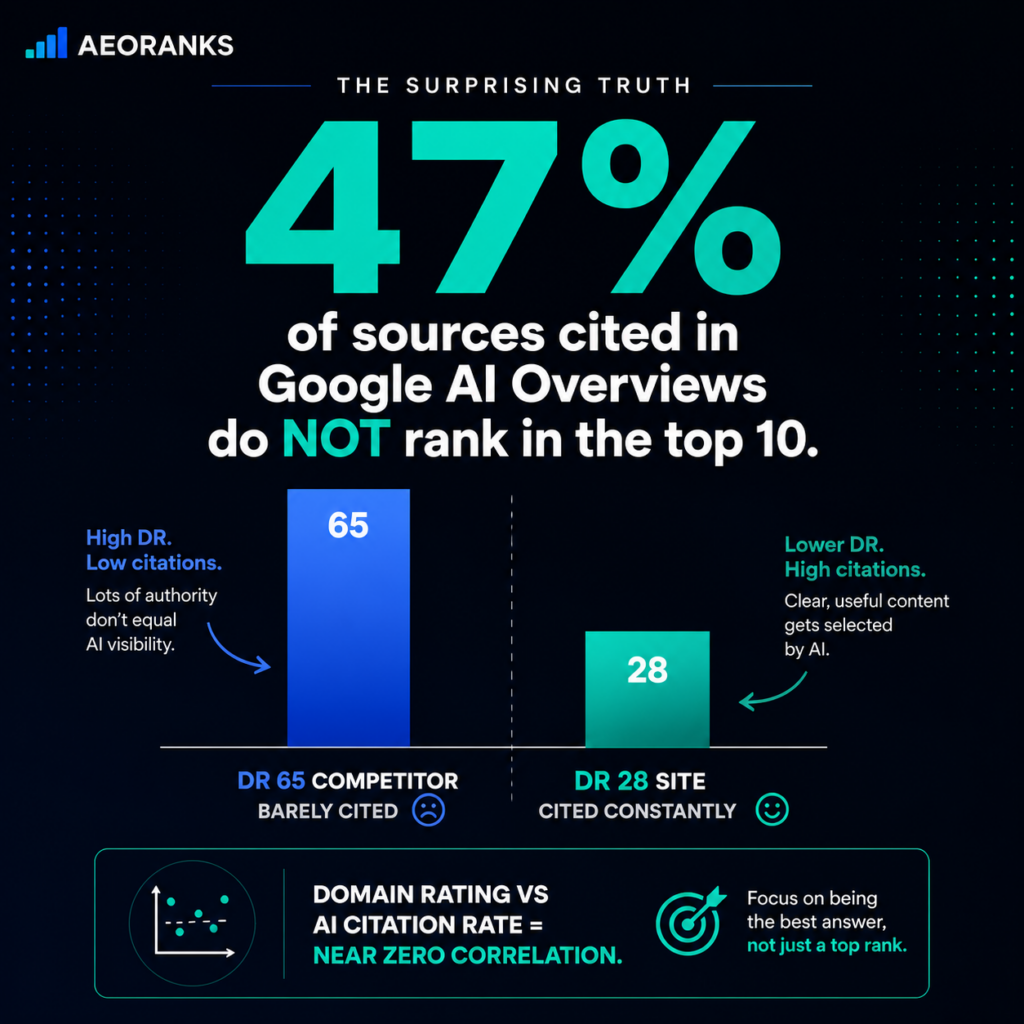
The data backs this up. A Semrush analysis found 47% of sources cited in Google AI Overviews did not hold a top-10 organic position for the same query. Authority alone isn’t the ticket in.
Field tests point the same way. In one widely shared teardown across nine sites, the correlation between Domain Rating and AI citation rate was effectively zero. A brand with DR 28 but 90+ G2 reviews and an active Reddit presence got recommended consistently; its DR 65 competitor with strong editorial links but no community footprint was barely mentioned. We dig into this failure mode in why AI finds your content but doesn’t cite it.
What actually makes AI cite you
Three things move the needle far more than raw link count:
1. Claim specificity. “Email open rates average 21.3% across industries (Mailchimp, 2024)” beats “email marketing has good engagement.” The Princeton GEO study (KDD 2024) measured a 37% visibility lift just from adding statistics, and up to 40% more visibility for content optimized with citations and authoritative structure.
2. Structural clarity. Concise headings mapped to real questions, short paragraphs, tables, and FAQ or HowTo schema make your passages easy to extract. Content with named sources earned around 30% more generative mentions than unsourced equivalents in the same study.
3. Entity clarity and third-party mentions. AI systems need to know who you are and whether others talk about you. A clean entity graph – a Crunchbase profile, a Wikidata entry, proper Organization schema with sameAs links – helps models disambiguate your brand. Mentions on Reddit, G2, Capterra, and niche forums (links optional – the mention in context is what counts) tell the model you’re a real, discussed entity worth citing.
This is the piece traditional link building misses entirely. It’s not more backlinks. It’s more presence in the places LLMs actually pull from.
Rank Across AI Search Platforms
Grow visibility across ChatGPT, Claude, Gemini & Perplexity with AI-first SEO strategies.
Book Free Strategy Call ChatGPT
 Claude
 Gemini
 Perplexity
 Grok
Grok
Do backlinks still matter in 2026?
Yes – completely. Backlinks remain the strongest off-page signal for traditional search, and Google still drives the majority of discovery. They also help indirectly with AI: sites with credible link profiles are often the same sites AI trusts as entities.
The mistake isn’t building links. The mistake is only building links and assuming that covers AI search. It doesn’t. Think of it this way: backlinks earn you a seat in the results page; AI citations earn you a voice inside the answer.
The winning strategy: optimize for both in one motion
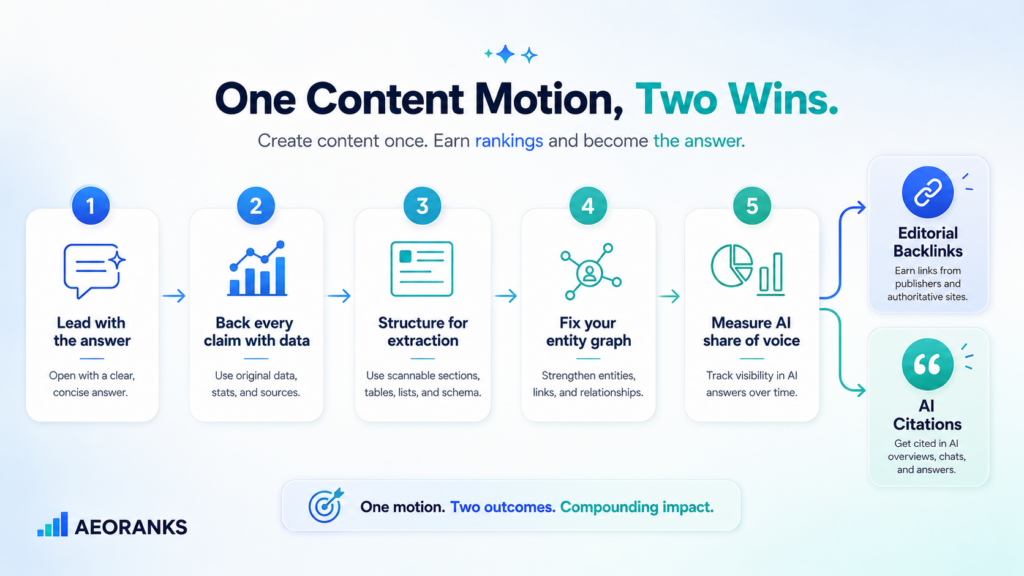
Treating citations and backlinks as competing priorities is a false trade-off. The content traits that earn AI citations – original data, clear structure, verifiable claims — are exactly what attracts editorial links too. Here’s the workflow we use at AEORanks:
- Lead with the answer. Put a one- to two-sentence direct answer right after each heading. This wins featured snippets and RAG retrieval at once.
- Back every claim with evidence. Replace vague statements with named data points and sources. Pre-justified claims are the path of least resistance for a model that has to cite everything.
- Structure for extraction. Use question-based headings, short paragraphs, comparison tables, and FAQ/HowTo schema.
- Fix your entity graph. Set up Organization schema with
sameAs, claim your Crunchbase and Wikidata entries, and keep your brand name consistent everywhere. - Build presence, not just links. Earn mentions on the review sites, subreddits, and forums your buyers actually read.
- Measure AI visibility separately. Track which pages get cited across ChatGPT, Perplexity, and AI Overviews – not just rankings. See how to track AEO/GEO and measure AI share of voice.
For the full framework, read our AEO and GEO best practices for AI visibility.
Backlinks and AI citations are not interchangeable, and neither is optional. Backlinks drive ranking authority. AI citations drive brand presence inside the answers that now sit above those rankings. The brands gaining ground in 2026 don’t pick one – they structure content so it earns links from editors and citations from models in a single pass.
Earlier, we used to ask “Do you rank?” The new one is “Are you the source AI chooses as answer?”
Start a conversation today ›Are AI citations replacing backlinks?
No. They run on separate systems. Backlinks still drive traditional rankings, while AI citations drive visibility inside AI-generated answers. You need both in 2026.
Can I get AI citations without backlinks?
Yes. Because AI evaluates content at the passage level, clear, well-structured, well-sourced pages can get cited even with a modest link profile. In tests, low-DR sites with strong community presence out-cited high-DR competitors.
Why does my competitor show up in ChatGPT and I don’t?
Usually because their content is answer-first and extractable, their entity graph is clean, and they have third-party mentions on sites like Reddit and G2 – not because they have more backlinks.
What content format earns the most AI citations?
Answer-first sections, comparison tables, definitions, statistics with named sources, and FAQ blocks. These map cleanly to how generative engines retrieve and quote content.
How do I measure AI citations?
Track how often your brand and pages appear across ChatGPT, Gemini, Perplexity, and Google AI Overviews, then compare that share of voice to competitors. Rankings alone won’t show it.