Search behaviour is shifting! People are now discovering brands, services and products in the form of synthesised answers by LLMs. In the same manner, Google has introduced AI Overview at the top of its search results.
AEO for B2B SaaS is the process of optimizing SaaS websites, content, entities, and brand signals so AI search engines like ChatGPT, Gemini, Perplexity, and Google AI Overviews can discover, understand, cite, and recommend your product in AI-generated answers.
Key Takeaways
- AEO for B2B SaaS is no longer just about rankings. Modern AI platforms like ChatGPT, Gemini, Perplexity, and Google AI Overviews are changing how buyers discover, compare, and trust SaaS products.
- AI visibility depends on more than website SEO. Strong positioning, structured content, reviews, Reddit discussions, founder branding, case studies, and third-party mentions all influence how AI systems recommend your brand.
- The best AEO strategies focus on clarity and buyer intent. SaaS companies that answer specific customer questions with structured, conversational, and experience-driven content are more likely to appear in AI-generated answers.
- Tracking AI visibility is becoming a critical growth metric. Brands should monitor AI citations, share of voice, AI referral traffic, recommendation accuracy, and AI-assisted conversions – not just traditional keyword rankings.
- AI citations and Google rankings are increasingly separate games. Up to 80% of what ChatGPT cites doesn’t rank in Google’s top 100 for the same query – winning one doesn’t guarantee the other, which is exactly why B2B SaaS AEO needs its own strategy.
Rank Across AI Search Platforms
Grow visibility across ChatGPT, Claude, Gemini & Perplexity with AI-first SEO strategies.
Book Free Strategy Call ChatGPT
 Claude
 Gemini
 Perplexity
 Grok
Grok
What is AEO and Why It Matters for SaaS
Answer Engine Optimization (AEO) is the practice of structuring your content so AI systems can easily interpret and cite it in answers. Put simply, it ensures your SaaS brand is visible when buyers ask AI, eg. “Which [category] tool solves my problem?”, “best marketing agency for b2b Saas” etc.
In today’s AI-driven world, SaaS buyers often start their research with chatbots like ChatGPT instead of traditional search. Forrester’s B2B buyer research has found that as much as 68% of the buying journey now completes before a prospect ever contacts a vendor – a growing share of that research happens inside AI tools, not on a results page.
The gap between SEO and AI visibility is wider than most teams assume, too. Ahrefs’ 2025 analysis found that 80% of the sources ChatGPT cites don’t rank in Google’s top 100 for the same query. A page can be invisible to Google and still be the answer AI recommends – or the reverse. That’s why B2B SaaS companies now need answer engine optimization for B2B alongside traditional SEO, placing their brands, products, and services as the answer to a buyer’s problem, not just a ranked link.
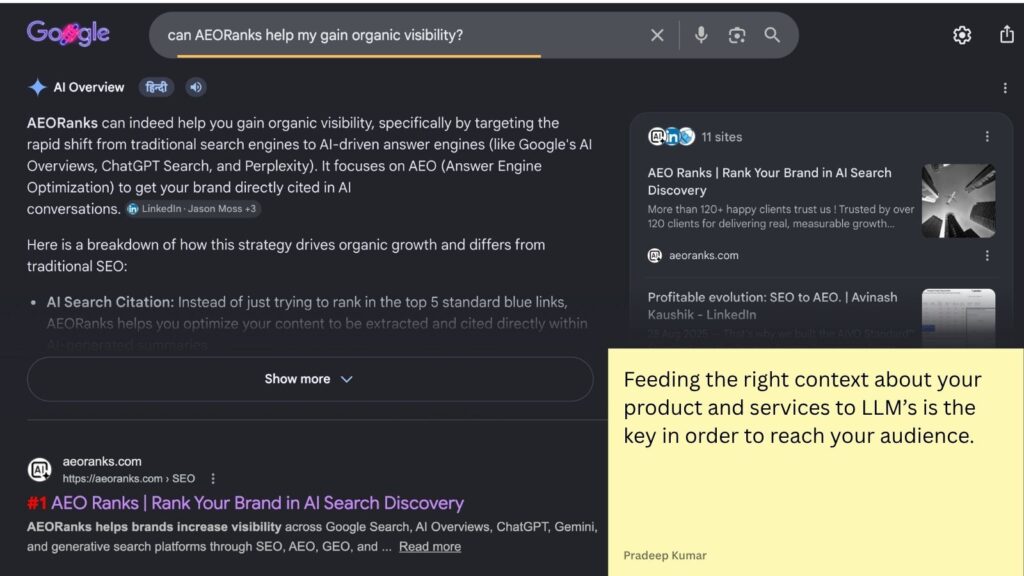
AI search is not just a ranking problem anymore. It is a brand perception problem. AEO for B2B SaaS is no longer just about being found by AI. It is about ensuring AI understands your brand the way you want buyers to understand it.
AEO Discovery Signals
If the market thinks one thing, the product says another, and LLMs summarize a third version, the brand loses control of discovery.
- Website messaging
- Product positioning
- Customer proof
- Founder voice
- Third-party mentions
- Support docs
- Case studies
- Reviews
Lead Quality for B2B
AI visibility can create bad leads if positioning is unclear. As one comment nails it: brands are being cited for problems they do not solve. AEO isn’t only about getting mentioned — it’s about getting mentioned correctly. For B2B SaaS, bad AI-driven discovery can lead to:
- Wrong-fit leads
- Higher churn risk
- More sales objections
- Reputation issues
- Confused prospects entering the funnel
AEO goes beyond traditional SEO (which targets web rankings). It’s about being the authoritative answer when an AI assistant responds. According to AEORanks, AEO means optimizing content so AI engines “can easily interpret, extract, and surface” your information. For SaaS companies, this is critical because discovery often happens via AI answers. Learn more about how to rank in AI Overviews here.
If your product isn’t cited by tools like ChatGPT or Google’s AI Overviews, it effectively “doesn’t exist” in that buyer’s consideration set. In short, AEO helps capture high-intent leads before they even click on a link.
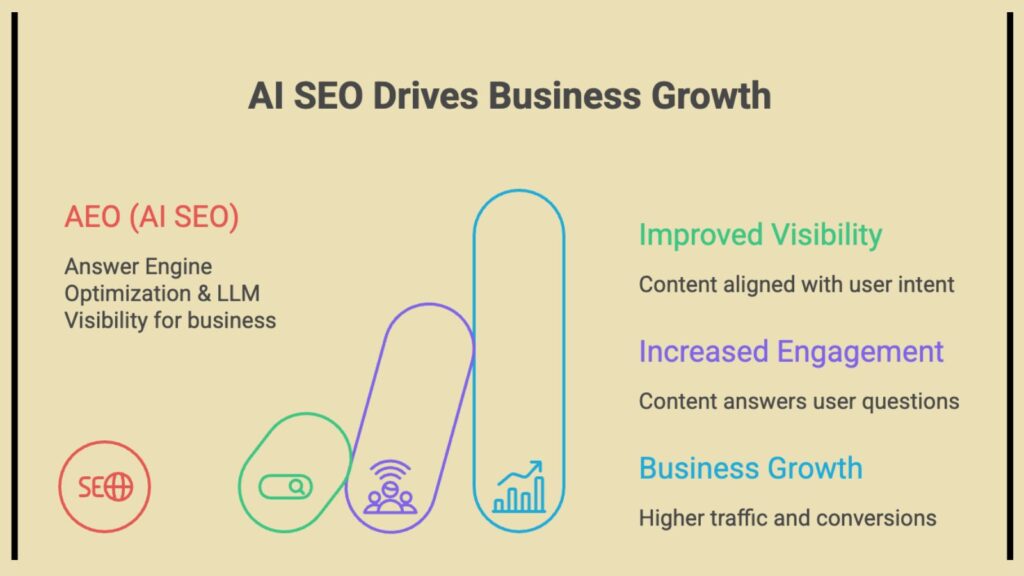
AEO / GEO vs. SEO: The New Search Landscape
While SEO (keywords, links, rankings) still matters, AEO adds an answer-first and machine-readable layer on top of traditional SEO. AI answer systems don’t just show web listings, they generate direct answers from content. These “answer engines” use your page as a source within a generated response. So content must be answer-first: start with a clear answer to a query, then back it up.
“Traditional SEO remains important, but AEO is an essential additional layer”
SEO vs. AEO vs. GEO
Three disciplines, three goals. Here’s how traditional search, answer engines, and generative discovery differ across what they optimize, how success is measured, and what they focus on.
| SEO | AEO | GEO |
|---|---|---|
| RankingsFocuses on ranking pages in traditional search engines. | AnswersOptimizes content to become part of AI-generated answers. | AI DiscoveryImproves visibility across AI search and recommendation systems. |
| ClicksSuccess is measured through website traffic and CTR. | CitationsMeasures how often AI tools mention and reference your brand. | RecommendationsFocuses on becoming a trusted AI-recommended solution. |
| KeywordsRelies heavily on keyword targeting and optimization. | EntitiesHelps AI understand products, companies, people, and topics. | Brand PerceptionShapes how AI systems describe and position your brand. |
Importantly, brands should not abandon SEO – the two strategies complement each other. In practice, optimizing for both Google and AI means crafting content that ranks well and also meets AI’s criteria (clarity, structure, authority).
Core AEO Strategies for SaaS Business
- Conversational Product Pages: Write product descriptions as if answering a question.
For example, turn features into Q&A: “What problem does [Your SaaS] solve?” and answer in plain language. Front-load the answer in the first 40 – 60 words. This means focusing on user pain points and benefits, not just buzzwords.
2. Structured FAQs and Knowledge Bases: Build or expand your help center and FAQ sections.
Each entry should clearly state the question (e.g. “How does [Feature X] work?”) and provide a concise, complete answer. Use bullet lists or numbered steps to break down processes. This format aligns with AI’s “quotation” needs: a direct answer plus easy-to-parse details. Also, apply the FAQPage schema to these Q&A blocks to explicitly signal them to crawlers.
| Schema Type | AEO Benefit | Best Used On |
|---|---|---|
| SoftwareApplication / Product | Clarifies what your product is, its platform, features, and integrations | Product & pricing pages |
| FAQPage | Makes Q&A blocks directly extractable for AI answers | FAQ sections, help docs |
| HowTo | Signals step-by-step procedural content | Onboarding, setup, implementation guides |
| Organization | Reinforces entity consistency across the web | Homepage, About page |
| Review / AggregateRating | Adds trust signals AI systems can cite | Testimonial and case study pages |
| Article | Confirms authorship and publish/update dates | Blog posts and guides |
Though Google has permanently dumped the FAQ’s from their result page, they are still highly relevant and good practise to add valuable content for users as well as AI retrievals.
3. Use-Case & Story Pages: Share specific scenarios or case studies.
AI favors context-rich stories over abstract claims. For instance, a page titled “How [Your SaaS] helped Company Z reduce churn” provides a narrative answer. Include real data (e.g. “cut support tickets by 30%”) so AI can cite concrete results. These pages help answer queries like “How do I use X for Y?” and position your product as the solution.
4. Comparison and Alternatives: Develop “X vs Y” and “Best [Category] for [Use Case]” content.
For example: “CRM software for small businesses: Our Top 5 Picks.” Novastacks highlights that buyers ask questions like “Best [category] software for [use case]” and “Which [category] is best for [industry]?”. A table or bullet list comparing your SaaS to competitors (features, pricing, pros/cons) is AI-friendly. These pages capture consideration-stage queries and are highly citable.
5. Schema & Technical Markup: Ensure your site’s code uses appropriate structured data.
We recommends using schema for product details, pricing, reviews, and integrations. Likewise, adding Product/SoftwareApplication schema, Article schema (with author/date), and FAQ schema where relevant. This machine-readable data helps AI engines understand and trust your content. Also verify your site architecture is crawlable by bots (fast load times, clear URLs).
6. E-E-A-T and Authority Signals: Demonstrate expertise and trustworthiness.
AI citations favor credible sources. Include author bios (with credentials) on technical content, cite research or authoritative quotes, and prominently feature genuine reviews/testimonials. Even PR coverage or authoritative backlinks can help. In short, make it obvious that experts stand behind your content.
7. Technical SEO Foundations
AI crawlers can’t cite what they can’t access or parse quickly. Keep Core Web Vitals healthy (LCP under 2.5s, minimal CLS, fast INP), maintain clean XML sitemaps and logical URL structures, and audit regularly for crawl errors, broken schema, or index bloat from staging or test pages. Technical SEO won’t get you cited on its own, but weak foundations quietly keep even excellent content out of both Google’s index and AI retrieval pipelines.
8. Answer the Questions Buyers Actually Ask Sales
Some of the best AEO content ideas already exist inside your business – in the questions prospects ask during demos, security reviews, procurement, and onboarding. Turn those into dedicated pages: implementation timelines, integration limits, pricing and contract structure, security/compliance requirements, and honest trade-off comparisons (not just wins). Being transparent about limitations and cost – not only strengths – makes content more trustworthy to both buyers and AI systems, and it pre-qualifies the prospects who are actually the right fit.
Modeling Conversational Queries for better AI retrieval
Modeling conversational queries for better AI retrieval involves transforming ambiguous, context-heavy chat turns into searchable, standalone queries. To capture AI search, use question-format headings and answers.
For example:
Q: What is [Your SaaS category] software?
A: [Your SaaS category] refers to software that [brief description]. It helps users [solve X] by [how it works in plain terms]…
Q: How does [Your SaaS] compare to [Competitor]?
A: [Your SaaS] differs from [Competitor] in [key ways]. For example:
- Feature: [Your SaaS] offers [X], whereas [Competitor] provides [Y].
- Target user: [Your SaaS] is optimized for [niche], [Competitor] is best for [different niche].
- Outcome: Customers using [Your SaaS] typically see [result], often outperforming [Competitor] in [metric].
This answer-first style (short answer, then bullet details) is exactly what AI answer engines like ChatGPT extract.
Track AI Visibility & Share of Voice
Unlike traditional SEO, where success is measured by clicks and rankings, AI search changes discovery itself. Buyers now ask AI tools direct questions like “best CRM for remote sales teams” or “top AI development agencies for SaaS startups” and often make shortlist decisions directly from the answers they receive. That means visibility in AI search is no longer just an SEO metric. It is a brand perception and revenue metric.
Traditional SEO measures rankings. AI visibility measures whether your brand becomes part of the answer.
- how often your brand is mentioned
- whether your brand is recommended
- how accurately AI platforms describe your company
- how you compare against competitors in AI-generated answers
This gives businesses a clearer picture of their real visibility in the AI-first discovery ecosystem. Track both AI visibility and conversions. Brands can track AI visibility using platforms like Profound, Otterly, SE Ranking, Peec AI, or custom Looker Studio dashboards connected to AI referral and citation data.
- AI Citation Rate: Use tools or manual prompts to see if AI assistants (ChatGPT, Perplexity, Gemini, etc.) mention your brand when relevant queries are asked. Track MoM growth in mentions, clicks and conversions. Know how to track your AI Share of Voice here.
- AI Referral Traffic: In Google Analytics 4, monitor sessions originating from ChatGPT or AI platforms. Set up UTM tracking if possible.
- Brand Lift: See if branded searches or direct visits increase after being cited by AI.
- Lead Quality: Compare conversion rates for AI-driven leads versus others.
- Zero-Click Discovery: Many buyers now discover brands without ever clicking a website. AI-generated summaries influence perception, shortlists, and buying decisions before a user visits your site. Tracking AI visibility helps brands understand their influence even when traditional traffic metrics decline.
In AI search, visibility happens before the click. Brands that track AI visibility early will better understand how buyers discover, compare, and trust products in the AI-first internet.
Want an Honest Read on Your AI Visibility?
We’ll show you where your SaaS brand is actually showing up — and where it’s invisible across ChatGPT, Gemini, Perplexity, and Google AI Overviews, without inflating mention counts.
Book Free Strategy CallCommon B2B SaaS AEO Mistakes to Avoid
One 2026 industry benchmark tested 1,400 buyer-intent prompts across 50 B2B SaaS companies on ChatGPT, Perplexity, Claude, and Gemini – and found that 44% scored below 50 out of 100 on AI visibility, meaning nearly half were functionally invisible in the AI tools their own buyers use daily. The spread between category leaders and laggards ran as wide as 87 points, which tells you AI visibility compounds: early movers pull further ahead every quarter, and latecomers fall further behind.
Most B2B SaaS companies are still optimizing for traditional search engines while buyers are increasingly using ChatGPT, Perplexity, Gemini, and Google AI Overviews to research software.
The problem? AI search does not rank content the same way Google traditionally did.
To gain visibility in Answer engines, B2B SaaS brands need to create clear, structured, trustworthy, and context-rich content that AI systems can easily retrieve, understand, and recommend.
Here are the biggest mistakes SaaS companies make when trying to improve AI visibility:
The Biggest AEO Shift for SaaS
Traditional SEO focused heavily on rankings and clicks. AEO focuses on becoming part of the answer. That means modern SaaS brands must optimize:
- positioning
- trust
- clarity
- structured content
- external authority
- conversational relevance
- and buyer intent
In AI search, visibility is no longer just about ranking higher. It is about becoming the brand AI systems trust enough to recommend.
In summary, AEO is now essential for any SaaS marketing strategy. By writing answer-first content that AI can crawl and cite, you ensure your products & services show up when buyers ask their AI assistant for recommendations. Start small: pick your top 3 most important questions (e.g. “What is [our software] used for?”, “How does [our software] compare to [comp]?”, “How long does implementation take?”) and create clear answer pages for them.
What does answer engine optimization for B2B actually involve?
For B2B specifically, answer engine optimization means structuring product pages, comparison content, case studies, and documentation so AI assistants can accurately answer buyer questions about your category, your product, and how it fits a specific use case — not just general brand awareness content. B2B buying cycles are longer and more research-heavy than B2C, so B2B AEO leans harder on structured comparisons, security/compliance detail, and case studies backed by real numbers.
How do we get our SaaS product mentioned in ChatGPT, Perplexity, Gemini, and Google AI Overviews?
To improve AI visibility, SaaS brands need more than traditional SEO. Focus on creating clear, structured, and trustworthy content around your product, use cases, and industry topics. Build topical authority, optimize comparison and FAQ pages, implement schema markup, and strengthen off-site mentions across review platforms, Reddit, LinkedIn, and industry websites.
Why is our competitor being recommended by AI tools instead of us?
AI platforms often recommend brands with stronger digital authority, clearer positioning, and better third-party validation. Your competitor may have more reviews, comparison content, community mentions, or structured information that AI systems can easily retrieve and trust.
What type of content works best for AEO and AI search visibility?
AI search engines prefer content that answers questions directly and clearly. The best-performing formats include FAQs, comparison pages, use-case guides, tutorials, case studies, feature breakdowns, and concise expert insights. Structured formatting using headings, bullet points, and tables also improves AI retrieval.
How do we measure AI visibility and AEO performance?
Track metrics beyond keyword rankings. Focus on AI citations, share of voice in AI-generated answers, AI referral traffic, branded search growth, and AI-assisted conversions. You should also monitor how accurately AI platforms describe and position your SaaS product.
u003cstrongu003eHow do we ensure AI platforms describe our SaaS product correctly?
Maintain consistent messaging across your website, product pages, LinkedIn, G2, documentation, PR mentions, and case studies. AI systems build understanding from multiple sources, so inconsistent positioning can confuse LLMs and lead to inaccurate recommendations.
Do Reddit, G2, and LinkedIn help with AI visibility?
Yes. AI systems frequently use trusted third-party sources like Reddit, G2, LinkedIn, YouTube, and industry blogs to validate brand credibility and understand customer sentiment. Strong external mentions can improve both AI visibility and recommendation trust.
Does schema markup help with AEO?
Yes. Structured data helps AI systems better understand your SaaS product, pricing, reviews, integrations, and company information. Implementing schemas like SoftwareApplication, FAQPage, Organization, and Review improves content clarity for both search engines and AI models.
Can AI Overviews reduce organic website traffic?
In some cases, yes. AI-generated answers can create “zero-click” experiences where users get answers without visiting websites. However, strong AI visibility still increases brand awareness, trust, and buyer consideration – especially for high-intent B2B searches.
What is the difference between SEO, GEO, and AEO?
SEO focuses on improving visibility in traditional search engines like Google. AEO (Answer Engine Optimization) focuses on optimizing content for AI-generated answers. GEO (Generative Engine Optimization) focuses more broadly on improving brand discoverability across generative AI platforms like ChatGPT, Gemini, and Perplexity.
How important is topical authority for AI search?
Topical authority is extremely important for AI visibility. AI systems prefer brands that consistently publish helpful, in-depth content around a specific topic. Building clusters around your core SaaS category helps AI platforms trust your expertise and recommend your brand more often.
Is b2b SaaS AEO different from AEO in other industries?
The core mechanics – answer-first content, schema, structured FAQs, credible citations – are the same across industries. What changes for B2B SaaS is the buyer questions themselves: integrations, implementation time, pricing tiers, security certifications, and vendor comparisons matter more than they would for a consumer product, so b2b SaaS AEO content needs to go deeper on those specifics.