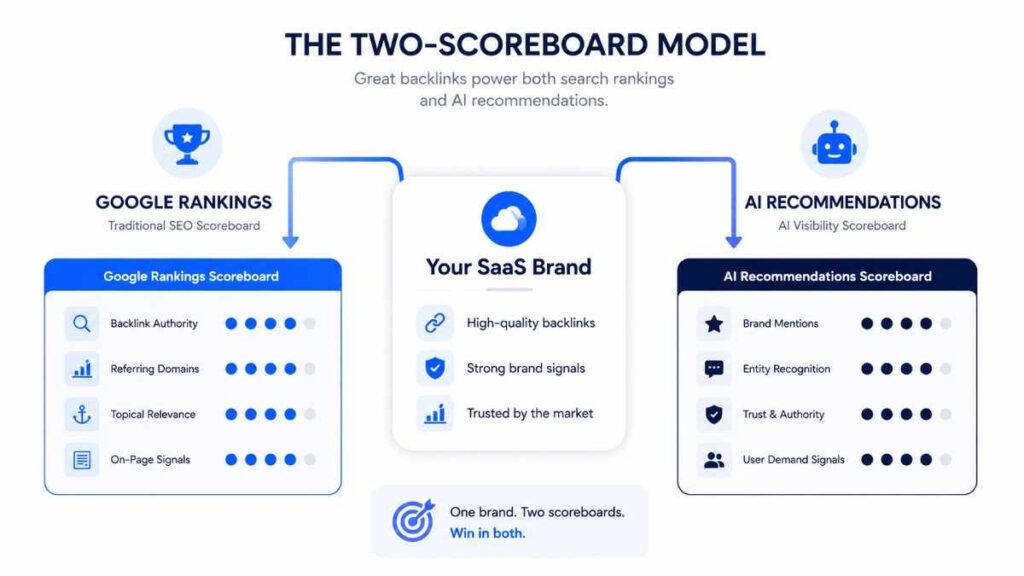
For B2B SaaS, backlinks are important but not magical. They rarely create demand on their own. What they do is decide who wins when several vendors have similar content, similar product claims, and similar keyword targets — which describes almost every SaaS category.
Put plainly: in SaaS, content gets you into the race. Links decide the finish order. And increasingly, the same signals decide whether an AI assistant mentions you at all.
Key Takeaways
- Backlinks are more important in B2B SaaS than in most industries — not because Google weights them differently, but because SaaS categories are crowded with near-identical content, and links are often the only remaining tiebreaker.
- Referring domains matter more than link count. Twenty relevant domains beat two hundred links from five sites.
- Links now serve two scoreboards. They lift Google rankings and feed the brand signals that decide whether ChatGPT, Gemini, Perplexity, and AI Overviews name you when a buyer asks for options.
- Your buyer is researching without you. Gartner’s 2026 survey of 646 B2B buyers found 67% prefer a rep-free experience, and 45% used AI during a recent purchase.
- The highest-ROI SaaS links are listicle placements, integration and partner pages, review-site presence, and original data — because they earn a link and a recommendation.
- Link building alone will not save weak positioning. It amplifies whatever your category story already is.
A Story Every SaaS Marketer Recognises
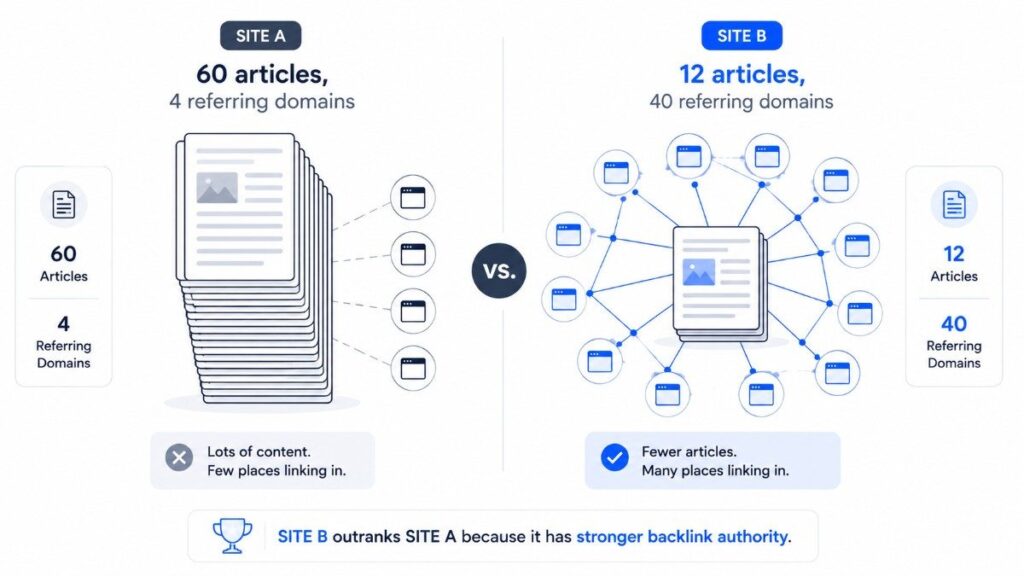
A Series A workflow-automation startup hires a content lead. She does everything right. Sixty articles in nine months, all genuinely useful, all mapped to real search intent, all technically clean. Fast site. Good schema. Proper internal linking.
Nine months in, organic traffic is roughly flat. Trial signups from search: negligible.
Meanwhile a direct competitor — same category, same price point, arguably a worse product — is outranking her on almost every commercial keyword with twelve articles.
She audits them, expecting to find some trick. There isn’t one. Their content is thinner than hers. What they have instead is this:
- They appear in nine “best workflow automation tools” roundups.
- They have integration pages on six partner sites, each linking back.
- A well-known industry newsletter quoted their pricing benchmark study.
- Their G2 and Capterra profiles are complete, reviewed, and linked from a dozen comparison articles.
Roughly forty referring domains. Hers: four, three of which are her own social profiles.
Then she does one more check. She opens ChatGPT and asks, “What are the best workflow automation tools for mid-market ops teams?”
The competitor is named. She is not.
That is the moment the lesson lands. She had been optimising the page. They had been optimising the conversation about the category. Google noticed. So did the language models.
Her content was never the problem. It was that nothing outside her own domain had ever said she existed.
Why SaaS Link Building Is Harder Than It Looks
Most industries have natural link magnets. Publishers get cited. Local businesses get directory listings. E-commerce gets product reviews and gift guides.
SaaS has a structural problem: nobody links to a pricing page. Your highest-value pages — product pages, feature pages, comparison pages, the pages that actually convert — are the least link-worthy things you own. No journalist links to “/features/workflow-builder.”
That creates three consequences that shape every good SaaS link strategy:
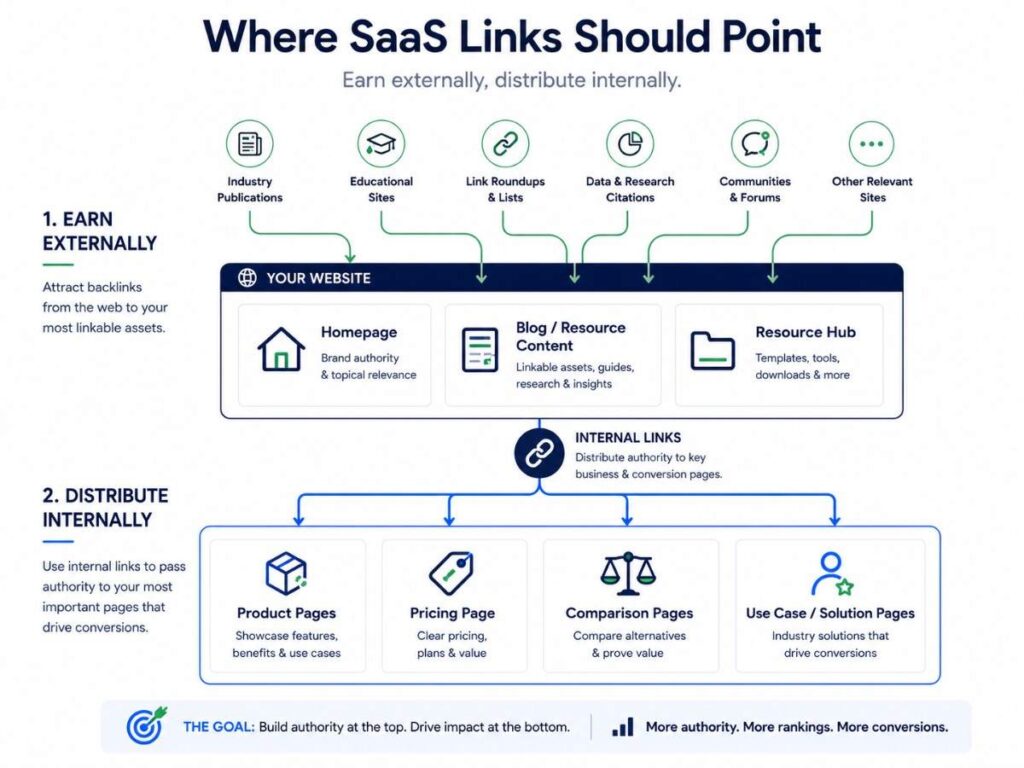
- You must earn links to assets, then distribute authority internally to the commercial pages that need it.
- You have to manufacture link-worthiness through original data, free tools, and benchmark reports, because your product alone will not generate it.
- Your competitors are doing the same thing, which is why category link profiles in SaaS tend to be tight, and why small gaps compound.
There is a second structural factor: your buyer. B2B software purchases involve a committee, a long evaluation, and a lot of unaccompanied research. Gartner’s 2026 survey of 646 B2B buyers found 67% prefer a rep-free buying experience and 45% used AI during a recent purchase. That buyer never speaks to your sales team until late. Everything that shapes their shortlist happens on pages you do not own.
Backlinks are how you show up on those pages.
What Backlinks Actually Do for a SaaS Company
Four distinct jobs. Most teams only count the first.
1. They break ranking ties on commercial keywords. For terms like “best [category] software” or “[competitor] alternatives,” every result is a competent page written by a competent marketer. Google needs an external signal to separate them. Referring domains are that signal.
2. They build third-party credibility during a rep-free evaluation. When your buyer is quietly comparing four vendors, being cited by sources they already trust does work your website cannot do for itself. This is E-E-A-T in practice — authoritativeness is something others confer on you.
3. They feed AI systems the brand signals that drive citations. This is the newest job and the least understood. AI assistants assemble answers from sources they retrieve and trust. A brand that appears consistently across roundups, reviews, and industry publications is far likelier to be named than one that only publishes on its own domain. Ahrefs’ analysis of roughly 75,000 brands found brand web mentions correlated with AI Overview visibility at about 0.66 versus roughly 0.22 for referring domains — which tells you the mention attached to the link is doing much of the work.
4. They send pipeline, not just traffic. A link inside a “best tools for X” article reaches someone actively building a shortlist. That is the highest-intent traffic in SaaS, and it converts at rates ordinary organic never touches.
So How Important Are Backlinks, Really? An Honest Stage-by-Stage Answer
Importance is not fixed. It scales with your category’s competitiveness and your stage.
| Stage | How much links matter | What to prioritise |
|---|---|---|
| Pre-PMF / very early | Low | Product, positioning, and one or two credible mentions. Links cannot sell an unclear product. |
| Early growth (seed–Series A) | Medium–high | Foundational credibility: review sites, niche directories, integration partners, founder-led PR, first guest posts. |
| Scaling (Series B+) | Very high | Systematic acquisition: original research, digital PR, listicle placements, competitive gap closing. |
| Category leader | High, defensive | Protecting share of voice, defending comparison keywords, staying in every roundup and AI answer. |
The honest caveat most agencies skip: link building amplifies, it does not originate. If your positioning is muddy or your category story is weak, more links will get more people to a page that does not convert. Fix the story first, then amplify it.
What Makes a High-Quality SaaS Backlink?
| Factor | What good looks like | Red flag |
|---|---|---|
| Relevance | The site’s audience overlaps your ICP | A generic “business tips” blog with no readership |
| Placement | Inside body content, high on the page | Footer, sidebar, author bio |
| Page traffic | The linking page actually ranks and gets visits | Zero-traffic page that exists to sell links |
| Anchor text | Branded or descriptive; varied | Repeated exact-match commercial anchors |
| Domain diversity | Many domains linking once | One domain linking sitewide |
| Commercial context | Roundups, comparisons, integration pages | Random mentions with no buying intent |
| Editorial standards | Real editors, real bylines | Sites publishing 40 sponsored posts a week |
A SaaS-specific test worth applying: would a real prospect plausibly click this link while evaluating vendors? If yes, it is a good link regardless of what the domain rating says. If no, it is a metric, not an asset.
9 Link Building Strategies That Work for B2B SaaS
Ordered roughly by time-to-value.
1. Reclaim unlinked brand mentions. Find places already naming your product without a link. Highest conversion rate of any outreach, because the relationship exists.
2. Complete your review-site and directory footprint. G2, Capterra, Product Hunt, and credible niche directories. Low link equity individually, but they anchor your brand as a recognised entity — which matters enormously for AI answers.
3. Build integration and partner links. Every tool you integrate with has a partner directory or app marketplace. These are relevant, contextual, and largely uncontested. Most SaaS teams leave half of them unclaimed.
4. Close competitor link gaps. Pull the referring domains of your three closest competitors. Any domain linking to two or more of them, but not to you, is a warm target — they have already demonstrated willingness to link to a company like yours.
5. Earn listicle and roundup placements. Getting into “best [category] tools” articles is the single highest-leverage play in SaaS. One placement delivers a backlink, high-intent referral traffic, and direct influence over what AI assistants recommend when someone asks for alternatives.
6. Publish original data. A benchmark report, salary study, or industry survey gives writers something they must cite. This is the only reliable engine for passive link acquisition in SaaS.
7. Ship free tools and calculators. ROI calculators, generators, and templates earn links for years and often outperform blog content per unit of effort.
8. Do founder-led digital PR. Expert commentary, podcast appearances, conference talks, and journalist outreach. Produces links and mentions simultaneously — the combination that matters most now.
9. Guest post selectively. Ten placements on publications your ICP actually reads beat two hundred on content farms. Treat it as distribution, not link buying.
Pair this with a strong on-site foundation — see our AI content strategy for organic growth — and, if you run a self-serve motion, our guide to product-led growth for B2B.
Where Should SaaS Links Point?
A question almost every reference glosses over.
| Target | Link approach | Why |
|---|---|---|
| Homepage | Natural landing point for PR, brand mentions, directories | Builds domain-level authority; hardest to over-optimise |
| Blog and resource assets | Primary target for editorial, data, and tool links | These are the pages people will actually link to |
| Comparison & alternatives pages | Listicles, review sites, selective placements | Highest commercial intent; also the pages AI cites for shortlist queries |
| Product / feature pages | Rarely direct — feed them via internal links | Nobody links to them naturally; forcing it looks manipulative |
The workflow: earn links to assets, then pass that authority internally to the pages that convert. Internal linking is not a footnote here — for SaaS it is the mechanism that makes external link building pay.
Mistakes That Waste SaaS Link Budgets
- Chasing domain rating over relevance. A DR 80 general-news site with no ICP overlap is worth less than a DR 40 publication your buyers read weekly.
- Buying link packages. Cheap placements on sites that sell to everyone produce links Google ignores. The usual outcome is not a penalty — it is wasted budget.
- Building links to pages that cannot convert. Authority pointed at a thin page is authority discarded.
- Over-optimised anchors. Repeated exact-match commercial anchors are the clearest manipulation signal there is.
- Treating link building as a project. It is a compounding programme. Three months of activity followed by nine months of silence produces a link profile that looks exactly as unnatural as it is.
- Measuring links instead of pipeline. Which brings us to the next section.
How to Measure SaaS Link Building
Track three layers. Most teams stop at the first.
Layer 1 — Link health: referring domains (not raw links), new vs lost domains monthly, anchor text distribution, link velocity, placement mix.
Layer 2 — Search impact: rankings on target commercial keywords, organic traffic to money pages, indexation speed for new content.
Layer 3 — Revenue: referral traffic by domain, trial signups and demos by referring source, pipeline influenced. This is the layer that justifies budget, and it is the layer almost nobody builds.
Then add the layer that is genuinely new: AI share of voice. Are you being named when buyers ask AI assistants for options in your category? Our guide on tracking AEO and GEO to measure AI share of voice covers how to instrument this.
Start with Google Search Console for first-party link data, layer a backlink tool for competitive comparison, and connect referring domains to your CRM so you can see which links produce revenue.
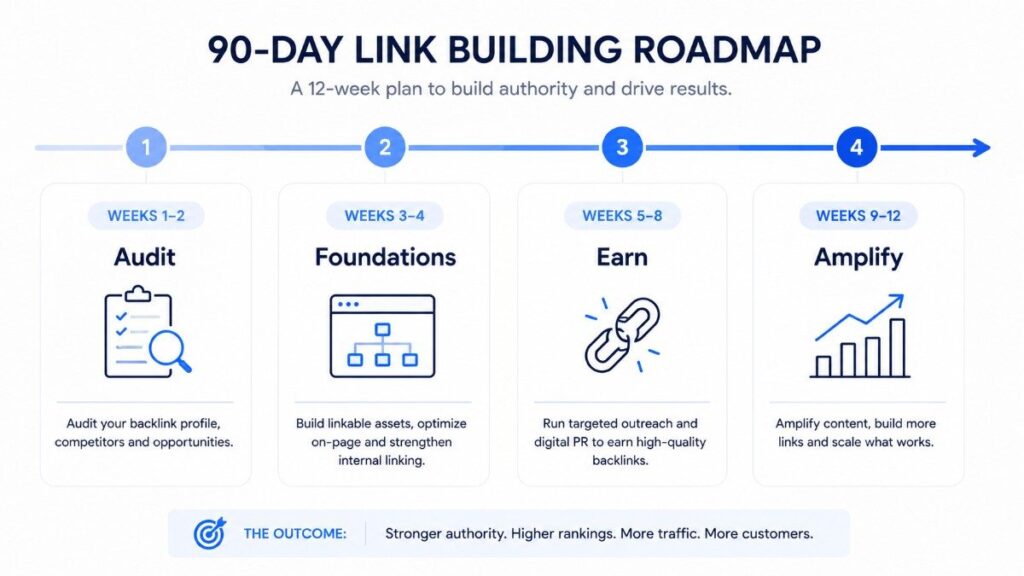
Your First 90 Days
| Weeks | Focus | Outcome |
|---|---|---|
| 1–2 | Audit backlink profile, competitor gap analysis, fix internal linking | Clear baseline and target list |
| 3–4 | Claim review sites, directories, integration and partner pages | Foundational entity signals live |
| 5–8 | Reclaim unlinked mentions, launch first data asset, begin outreach | First earned links landing |
| 9–12 | Listicle placements, guest posts, digital PR push, measure | Early ranking and AI citation movement |
Expect early signal around 60–90 days and meaningful compounding over six months. Anyone promising faster is selling links, not building authority.
The Part Most SaaS Link Building Misses
Traditional link building asks: how do I rank on page one?
Answer Engine Optimisation and Generative Engine Optimisation ask a harder question: when a buyer asks an AI assistant which tools they should consider, does it say your name?
Those two goals overlap more than most teams realise. The same placements that lift rankings — roundups, comparison articles, review platforms, cited research — are exactly the sources AI systems retrieve when assembling recommendations. A link is a mention with a URL attached, and in AI search, the mention is doing much of the work.
Which means a link campaign can be run two ways. One earns links. The other earns links and makes you recommendable. If AI systems are finding your content but never citing it, we explain why that happens here, and our AEO guide for B2B SaaS covers the full playbook.
This is what AEORanks built its service around. Our SaaS link building agency combines high-authority guest placements, contextual insertions, listicle inclusions, and digital PR with entity and citation strategy — so the same campaign that moves your Google rankings also increases how often ChatGPT, Gemini, Claude, and Perplexity name your brand. Most clients see movement in 60–90 days, with compounding gains over a six-month engagement.
How important are backlinks for B2B SaaS?
Very important, but as a tiebreaker rather than a demand generator. In crowded SaaS categories where every competitor publishes similar content, referring domains are usually the deciding ranking factor — and increasingly the signal that determines whether AI assistants recommend you.
How is SaaS link building different from regular link building?
Two differences. First, SaaS money pages (pricing, features, product) are inherently unlinkable, so you must earn links to assets and distribute authority internally. Second, SaaS has channels other industries do not — integration partners, app marketplaces, and review platforms like G2 and Capterra.
How many backlinks does a B2B SaaS site need to rank?
There is no universal number. Benchmark the referring domains of the specific pages currently ranking for your target keyword, take the median, and adjust for relevance. Niche-relevant links let you compete with fewer.
How long does SaaS link building take to work?
Expect early ranking movement around 60–90 days and compounding results over six months. Links must be crawled, indexed, and evaluated before they influence anything.
Do backlinks help with ChatGPT and AI Overviews?
Indirectly. Ahrefs’ 75,000-brand analysis found brand web mentions correlated with AI Overview visibility at roughly 0.66 versus about 0.22 for referring domains. Links help — but the brand mentions that come attached to them do more of the work.
Should SaaS companies buy backlinks?
No. Paid links without
rel="sponsored"violate Google’s guidelines, and the typical outcome is that Google ignores them — wasted budget rather than a penalty. Invest the same money in digital PR and original research instead.Which backlinks drive the most SaaS pipeline?
Listicle and roundup placements, review-site profiles, and integration partner pages. They reach buyers already building a shortlist, which is why their referral traffic converts far better than average organic.
Should I link to my homepage or product pages?
Point external links at your homepage and linkable assets. Feed product and pricing pages through internal links instead — nobody links to a feature page naturally, and forcing it looks manipulative.
What is the best link building strategy for early-stage SaaS?
Claim your review-site and directory footprint, secure integration partner links, and pursue founder-led PR. These build entity recognition fast and require no content budget.
Is link building still worth it in 2026?
Yes, but the definition has widened. The goal is no longer just accumulating links — it is building the web-wide presence that makes both Google and AI systems treat your brand as a credible option in your category.