Getting cited by AI means ChatGPT, Gemini, Claude, Perplexity, or Google AI Overviews name your page as a source – either by linking to it directly (a citation) or by naming your brand inside the generated answer (a mention). You earn it by being the clearest, best-evidenced, most independently corroborated source on a question – not by ranking highest on Google.
Key Takeaways
- Answer first. Put a direct, 40–60 word answer at the top of every page and every section. Roughly 44% of all AI citations come from the first 30% of a page’s text.
- Evidence beats style. Adding statistics, citing credible sources, and including expert quotes are the highest-lift changes in the research. Persuasive tone and keyword stuffing do close to nothing.
- The platforms are different. Perplexity favours recency and Reddit. ChatGPT rewards depth and backlinks. AI Overviews mostly pull from top-10 pages. Claude rewards honesty about limitations.
- Third-party corroboration is the strongest lever. AI systems check whether the rest of the web agrees with you. Brands whose claims appear across 5+ external domains see citation rates improve by around 67%.
- Measure a rate, not a moment. Between 40–60% of cited sources change month to month. One check tells you nothing; a weekly trend tells you everything.
SERP has changed from Rankings to Recommendations
Search behaviour has quietly divided in two. In one world, people still type queries into Google and visit ranked pages. In the other – growing faster every quarter – they ask ChatGPT, Gemini, Claude, or Perplexity a question and expect one synthesised answer, often with zero clicks.
That second world runs on different rules. Ranking first on Google no longer guarantees you’re the source an AI model quotes, summarises, or recommends. That work is now called answer engine optimization (AEO) or generative engine optimization (GEO), and it asks a different question than SEO does.
Not: how do I rank? But: how do I become the source the model chooses to reference?
That question has an answerable, evidence-backed answer. Here it is.
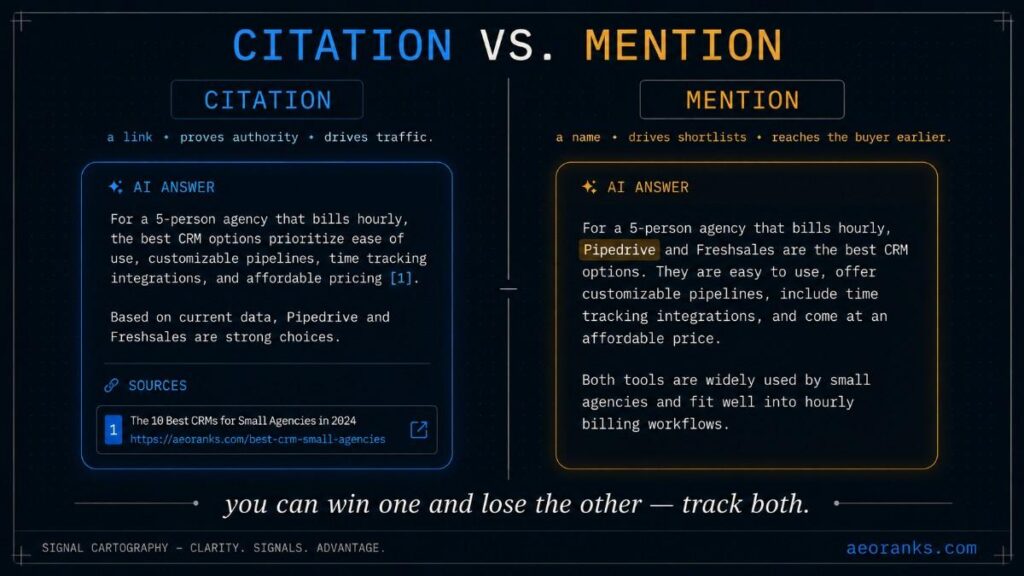
Citation vs. Mention: Two Different Wins
A citation is a link. A mention is a name. They are not interchangeable, and most teams track only one of them.
- A citation is when the model attributes a fact, statistic, or claim to your page and links to it – usually in a sources list or a small numbered reference.
- A mention is when your brand name appears inside the generated text, typically for a recommendation query like “what’s the best project management tool”, with or without a link.
Both matter. Citations drive traffic and prove authority. Mentions drive shortlists and often reach the buyer earlier – the moment the model is deciding who belongs in the answer at all.
The distinction matters practically: you can be cited constantly and never mentioned (your data is useful, but your brand isn’t the recommendation), or mentioned constantly and never cited (people know you, but your pages aren’t the reference). Track both separately.
How AI Models Choose What to Cite
AI assistants pull from two places, and only one of them produces visible citations.
- Training data: the static knowledge baked in during model training. Answers drawn purely from here usually arrive without live citations.
- Retrieval-Augmented Generation (RAG): a live web search the model runs to find current information. This is where nearly all visible citations come from, and it’s the part you can influence.
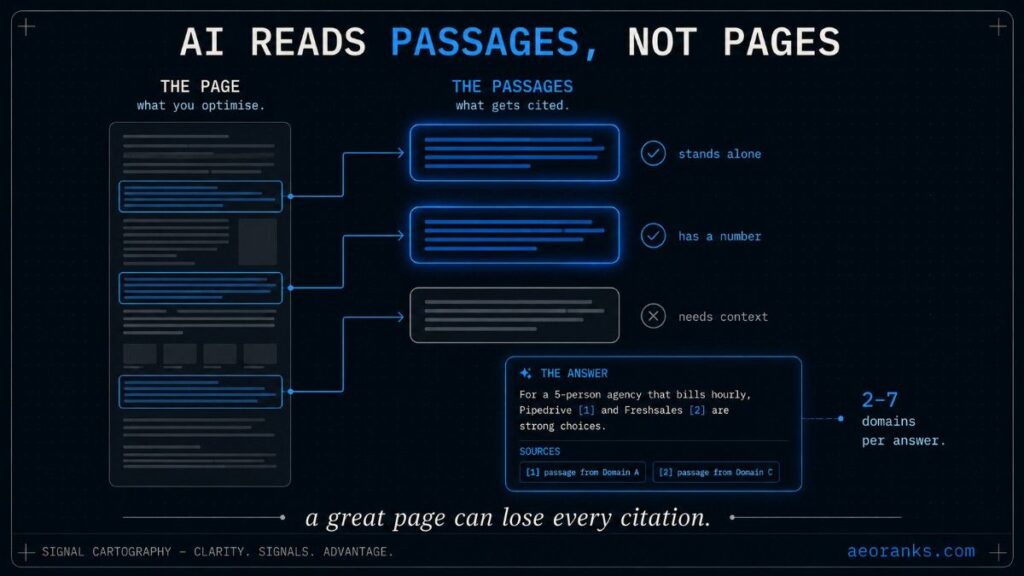
The important detail: RAG systems make citation decisions at the passage level, not the page level. The model isn’t asking “is this a good page?” It’s asking “is this specific passage a clean, trustworthy answer to the question in front of me?”
That changes what you optimise. A page can be excellent overall and still lose every citation because no individual paragraph stands on its own.
When a retrieval system evaluates a passage, four things carry the most weight:
- Semantic clarity: can this passage be lifted out and still make sense without the surrounding text?
- Factual density: does it contain verifiable numbers, dates, and sourced claims?
- Structural organisation: do headings and lists make the content’s shape obvious?
- Authority signals: do other trusted sources trust this one?
And a constraint worth internalising: most AI answers cite only two to seven domains, compared with Google’s ten blue links. The shortlist is shorter than the one you’re used to competing for.
How Citation Behaviour Differs by Platform
Treating “AI” as one destination is the most common and most expensive mistake in this discipline. The four major platforms pull from different sources and reward different signals. Optimising for all of them identically leaves visibility on the table.
ChatGPT – rewards depth and traditional authority
ChatGPT leans toward comprehensive, encyclopedic content – the same instinct that makes Wikipedia one of its most-cited sources. Backlinks and domain authority still matter more here than on other platforms, so classic link building keeps paying off.
What to do: build pillar pages that cover a topic completely rather than short, narrow posts. Keep your About page and product description precise and factual – ChatGPT pulls entity information from them directly when answering recommendation queries.
Perplexity – rewards freshness and community
Perplexity is the most distinct of the four. It strongly favours content published within roughly the last 12 months, and it draws heavily on Reddit — one analysis puts Reddit at 46.5% of Perplexity’s citations.
What to do: publish and refresh on a consistent cadence, participate genuinely in relevant subreddits and communities, and cite multiple credible sources inside your own content (Perplexity appears to favour content that has already done its synthesis work). Perplexity also lets brands create Pages that can appear as cited sources – an underused direct route.
Google AI Overviews – rewards what already ranks
AI Overviews mostly extract from pages already ranking in the traditional top 10, which means classic SEO fundamentals still carry real weight here. After standard web content, Reddit (21%) and YouTube (18.8%) are its most-cited source types.
What to do: keep your top-ranking pages fresh, and format for featured snippets – a direct answer in the opening lines, clean step lists, tight definitions. That formatting transfers almost directly to AI Overview extraction. Our guide to ranking in Google AI Overviews covers this in full.
Claude – rewards honesty and primary sources
Claude is the most selective and the most sceptical of promotional language. It favours writing that reads like expert analysis, cites its sources inline, and – counterintuitively – rewards content that names its own limitations and trade-offs rather than overselling. Claude also cross-verifies unusually hard: it will prefer the original study over your summary of it.
What to do: write with authoritative neutrality, link primary sources rather than recaps, replace superlatives with specific claims, and don’t hide the caveats. Claude’s user base skews toward professionals and enterprise decision-makers, which makes it disproportionately valuable for B2B despite lower referral volume.
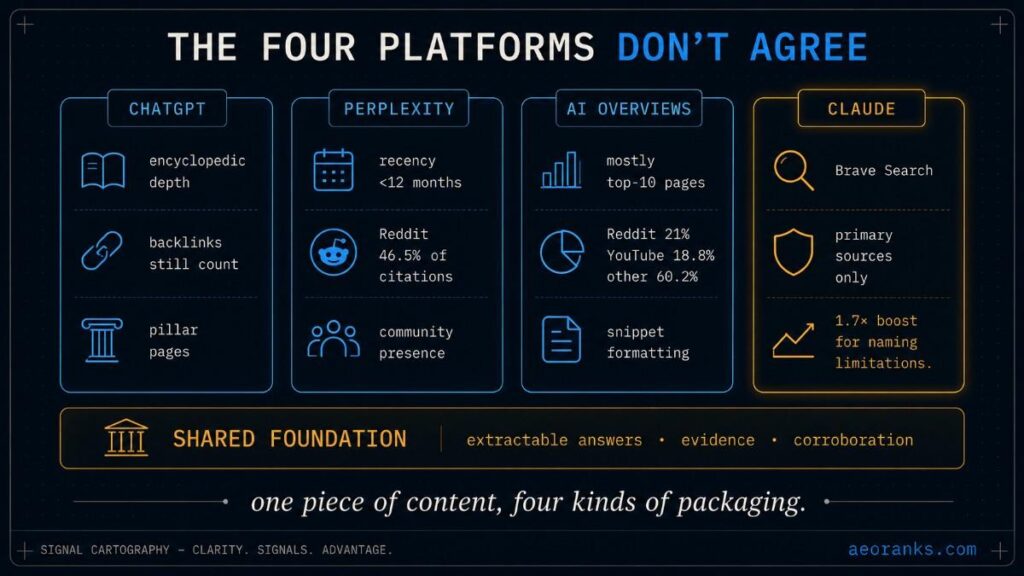
The practical takeaway: build one strong piece of content, then adjust its packaging – backlinks for ChatGPT, community presence and freshness for Perplexity, top-10 ranking for AI Overviews, primary sourcing and intellectual honesty for Claude.
What actually improves your brand citations
Not all optimisation tactics work equally, and some don’t work at all. The academic research that founded generative engine optimization tested nine content tactics across 10,000 queries. Here’s what held up, alongside findings from more recent industry analysis.
| Optimization area | Reported lift | Source |
|---|---|---|
| Cite credible sources | 30–40% | Princeton-led GEO research (KDD 2024) |
| Add statistics and data points | Up to 37% | Princeton-led GEO research (KDD 2024) |
| Add expert quotations | 22% as a single method | Princeton-led GEO research (KDD 2024) |
| Add schema markup | 30–40% more likely to be cited | Industry analysis, 2026 |
| Structured formats vs. plain paragraphs | 3x more citations | |
| Multi-source validation (5+ external domains) | ~67% higher citation rate | Search Engine Land, 2026 |
| Comparison-format articles | 32.5% of all AI citations | Frase GEO Playbook, 2026 |
What didn’t work: keyword stuffing produced no meaningful improvement, and on a live engine performed worse than doing nothing. “Authoritative tone” without supporting evidence barely moved results either.
The pattern across all of it is simple: evidence beats style. Generative engines read meaning and verifiability, not keyword density or confidence.
One more finding worth acting on: the biggest gains went to sites ranked lower in traditional search. Sources sitting around position five saw visibility jump by over 100% when optimised. In AI answers, content quality can genuinely outweigh domain size – which is why this channel is still open to smaller brands in a way SEO hasn’t been for a decade.
Rank Across AI Search Platforms
Grow visibility across ChatGPT, Claude, Gemini & Perplexity with AI-first SEO strategies.
Book Free Strategy Call ChatGPT
 Claude
 Gemini
 Perplexity
 Grok
Grok
The Seven Traits of Content That Gets Cited
These patterns appear across independent studies again and again. None works alone; they compound.
1. Answer the question immediately
Put a direct answer in the first 40–60 words, before any context. Roughly 44% of all AI citations come from the first 30% of a page’s text — your introduction isn’t preamble, it’s the most valuable real estate on the page.
Apply the same rule to every section: direct answer first, supporting detail second.
Weak — buries the answer:
“There are many factors that go into choosing the right CRM for a small business, and it really depends on your team size, budget, and workflow needs, which is why we’ve put together this comprehensive guide…”
Strong — answers first:
“The best CRM for a five-person agency is usually one with built-in time tracking and simple pipeline views. HubSpot’s free tier and Pipedrive both fit this well. Here’s how to choose between them.”
The second version can be lifted out and used as an answer. The first can’t be used at all.
2. Publish original research nobody else has
AI models cite primary sources, so become one. Rewriting what already exists makes you one of a hundred interchangeable options. Publishing something new makes you the only option.
Formats that work: industry surveys, case studies with real numbers, internal benchmark data, original frameworks, and documented experiments.
Instead of writing:
“Most websites should improve their Core Web Vitals.”
Publish:
“After analysing 18,000 news articles across 32 publishers, we found pages with an LCP below 2.5 seconds received 28% more Google Discover impressions.”
The first sentence is advice anyone could write. The second is a fact that can only be attributed to you — and once a model uses it, you’re the citation.
3. Build topical authority, not scattered posts
AI systems trust specialists over generalists. One article about a topic gives a model very little evidence you’re an authority on it. Thirty well-connected articles covering every angle of that topic gives it a lot.
Think of it the way a patient does: for heart surgery advice, a cardiologist beats a general physician. Retrieval systems apply a similar logic — they favour domains with consistent, deep coverage of a subject over domains that touched it once.
Build hubs, not orphans. Each article should link naturally to related pages in the cluster, which helps both readers and machines understand how your content connects. Our guide to AEO and GEO best practices covers how to structure these clusters.
4. Demonstrate real expertise (E-E-A-T)
There is no separate “AI version” of expertise. The same Experience, Expertise, Authoritativeness, and Trustworthiness signals that help a page rank in Google are what put it in the pool models draw from.
Strengthen them with:
- Author bylines carrying real credentials, placed near the top of the page — AI systems scan for trust indicators within roughly the first 200 words
- First-hand experience: real examples, case studies, documented methodology
- Links to supporting research and recognised industry sources
- A visible editorial or fact-checking policy
- Current publication and “last updated” dates
For YMYL topics — finance, health, legal — expert validation carries even more weight.
5. Structure content a model can parse without effort
Structure is what turns good content into extractable content. A model scanning your page isn’t reading top to bottom; it’s hunting for a passage that answers one question and survives being lifted out of context.
A structure that parses cleanly:
- H1 — the exact question, in plain language
- A 40–60 word direct answer immediately below it
- H2s phrased as sub-questions (“How does X work?” not “Overview of X”)
- Short paragraphs — two to four sentences
- A comparison table wherever two or more options exist
- Plain-text statistics — never numbers baked into an image
- An FAQ block with schema markup at the end
One useful rule of thumb: include a verifiable data point every 150–200 words. Fact density is one of the clearest separators between cited and ignored content.
6. Get mentioned on trusted third-party sites
This is the strongest lever in the entire discipline, and the most neglected. AI systems don’t only read what your site says about you — they check whether the rest of the web agrees. Brands whose claims appear across five or more external domains see citation rates improve by roughly 67%.
The reason is straightforward: your own site has every incentive to present you favourably. Independent sources don’t. Corroboration is the cheapest trust signal a model has.
Where that corroboration comes from:
- Review platforms — G2 is the most-cited software review platform across ChatGPT, Perplexity, and AI Overviews. Encourage detailed, use-case-specific reviews rather than star ratings.
- Reddit and communities — 21% of AI Overview citations and 46.5% of Perplexity’s. Participate genuinely; promotional posting gets you nothing.
- Industry media and guest articles — a byline in a relevant publication creates both a link and an entity association.
- LinkedIn long-form — indexed and cited, particularly for professional queries.
- Podcasts and expert interviews — transcripts and show notes create diverse, independent citation sources.
This corroboration gap is the single most common reason AI finds your content but doesn’t cite it. The page is discoverable; nothing external vouches for it. Our guide to earning AI citations covers the full playbook.
7. Keep content fresh – and prove it
Recency is a ranking factor in AI retrieval, and a visible one. A “last updated” date isn’t decoration; it’s a signal models actively check when deciding whether a source is still reliable.
Refresh quarterly at minimum: update statistics, add recent examples, remove anything that’s aged out, and update the timestamp honestly. This matters most for fast-moving topics – tools, pricing, compliance, frameworks – where a two-year-old page is actively misleading.
The Schema Markup That Actually Helps
Schema doesn’t guarantee a citation, but it removes ambiguity – it tells an AI crawler exactly what a passage is, who wrote it, and when. Pages with correct markup are meaningfully more likely to be cited.
Start with Article schema on every editorial page:
json
{
  "@context": "https://schema.org",
  "@type": "Article",
  "headline": "Your Article Title",
  "author": { "@type": "Person", "name": "Author Name" },
  "datePublished": "2026-01-15",
  "dateModified": "2026-08-02",
  "description": "One-sentence summary of the article"
}
Then add:
- FAQPage schema on any question-and-answer content. This is the highest-impact schema type for AI visibility, because retrieval systems are built to parse Q&A pairs directly.
- Organization schema sitewide, so your brand name, logo, and description stay consistent everywhere a model encounters you.
- HowTo schema for step-by-step guides, and Product schema if you sell products – AI systems use it to populate comparison answers.
Two implementation notes that trip teams up: use JSON-LD, and implement it server-side. AI crawlers frequently don’t execute JavaScript, so client-side schema is invisible to them. Validate everything in Google’s Rich Results Test before publishing.
What Actively Hurts Your Citation Odds
Worth stating plainly, because most of these are habits rather than decisions:
- Long unbroken paragraphs with no headings or visual breaks – nothing can be cleanly extracted.
- Vague claims with no number – “many businesses,” “recent research,” “significant improvement.”
- Statistics locked inside images instead of plain text.
- Marketing superlatives with nothing behind them – “revolutionary,” “best-in-class,” “industry-leading.”
- Thin introductions that delay the actual answer past the first paragraph.
- Excessive hedging that leaves a passage with no clear claim to quote.
Does Ranking Still Matter?
Yes — but far less than most teams assume, and differently on each platform.
The research is genuinely mixed. Some studies find AI models frequently cite pages outside Google’s top 10; others find higher-ranking pages get referenced more often. Both are true, because the platforms differ: Google AI Overviews lean heavily on top-10 results, while roughly 90% of ChatGPT citations come from outside Google’s top 20.
There’s a second reason ranking alone doesn’t carry you: models rewrite your question into several related queries before searching. Someone asking about improving AI visibility might trigger retrievals for technical SEO practices, Core Web Vitals, internal linking, E-E-A-T guidelines, and schema implementation — pulling sources from five different searches, none of which is the original phrase you optimised for.
So a strong ranking increases your odds of being discovered. It doesn’t decide whether you’re cited. That decision is made on extractability, evidence, and corroboration. Our guide to AI and SEO covers how the two disciplines fit together.
How to Measure AI Visibility
You can’t improve what you don’t measure — and a single spot-check measures nothing. Between 40% and 60% of cited sources change from month to month as models update and competitors adapt. Your real position is a rate, tracked over time.
Track these specifically:
- Appearance rate — the percentage of your priority questions where you’re cited at least once.
- Share of voice — how often you appear versus named competitors across the same question set.
- Prominence — whether you’re named early and clearly, or buried as a secondary mention.
- AI-referred sessions — track
chatgpt.com,perplexity.ai,claude.ai, andgemini.google.comas referral sources in GA4. - Citation sentiment — is the model describing you accurately? An inaccurate mention can cost more than no mention.
- Trend velocity — is your rate rising, flat, or falling month over month? This is the number that actually tells you whether your work is working.
Build a list of 15–20 questions your buyers genuinely ask, split across four types — category definition (“what is X”), comparison (“X vs Y”), problem-solving (“how do I…”), and commercial (“best X for…”) — and test them on a fixed weekly cadence across all four platforms. Dedicated tools (Otterly.ai, Peec AI, Scrunch AI) automate this once you’re tracking more than a handful.
Our full walkthrough is in how to track AEO and GEO and measure AI share of voice.
Want to know where your brand stands right now? Book a free AI visibility audit with AEORanks. We’ll test your priority questions across ChatGPT, Perplexity, Gemini, Claude, and Google AI Overviews, show you exactly where competitors are cited instead of you, and map the fastest wins.
30-Day Plan to improve AI citations
If you do nothing else, do these in this order:
- Week 1 — Baseline. Build your 15–20 question list and test it manually across all four platforms. Record where you’re cited, mentioned, or absent, and which competitors appear instead.
- Week 2 — Fix your top pages. Take your five highest-traffic pages and restructure them answer-first: direct answer under the H1, question-shaped H2s, short paragraphs, a comparison table, an FAQ block.
- Week 3 — Add evidence and schema. Replace every vague claim with a sourced number. Add Article, FAQPage, and Organization schema server-side. Update your timestamps.
- Week 4 — Start the off-site work. Claim and populate your G2 profile, identify three publications to pitch, and find the two or three community threads where your buyers actually ask their questions.
Structural fixes tend to show up fastest — most teams see measurable movement within four to eight weeks, with Perplexity usually responding first because of its recency bias. Off-site corroboration takes longer but produces the most durable visibility.
Frequently Asked Questions
Does getting cited by AI actually drive meaningful traffic?
Not in raw volume yet — AI referrals remain a small share of total traffic for most sites. But the visitors who do click arrive having already read a summary and chosen to go deeper, and analyses consistently show they convert at several times the rate of standard organic traffic. The value is in conversion quality and brand authority, not session count
Do I need to publish original research to get cited at all?
No. Clear structure, direct answers, and genuine expertise can earn citations without it. But original data is consistently the strongest differentiator between a page that gets cited once and one that becomes a model’s default reference for a topic — because it makes you the only possible source.
What’s the difference between AEO and GEO?
They describe the same underlying practice with slightly different emphases. AEO grew out of answer-box and featured-snippet optimisation; GEO was coined in academic research on generative engines. Most teams now treat them as one discipline. See our guide to generative engine optimization for the full background.
Why does AI find my content but never cite it?
Almost always one of two gaps. Either your content isn’t extractable — no passage answers a question cleanly on its own — or it isn’t corroborated, meaning nothing outside your own domain vouches for the claims. The second is more common and takes longer to fix. We break both down in why AI finds content but doesn’t cite it.
Can a small brand realistically compete for AI citations?
Yes — more realistically than in traditional SEO. The founding GEO research found the largest visibility gains went to lower-ranked sources, with position-five sites more than doubling their visibility when optimised. Because citation decisions are made at the passage level on evidence and clarity, a small brand with genuinely better answers can outperform a large one with a bigger domain.