Key Takeaways
- Backlinking is the practice of earning links from other websites back to yours. Each link acts as a third-party vote that a page is worth reading.
- Backlinks remain one of Google’s strongest ranking signals, because they are one of the few signals a site owner cannot fully control.
- Quality beats quantity. One relevant, in-content link from a trusted site outperforms hundreds of directory or footer links.
- Backlinks do three jobs at once: pass authority, speed up discovery and indexing, and send qualified referral traffic.
- In AI search, the link is no longer the whole story. Ahrefs’ analysis of 75,000 brands found brand web mentions correlated with AI Overview visibility at roughly 0.66, versus 0.22 for referring domains.
- The winning 2026 play is link building that also produces mentions: digital PR, original data, listicle placements, and expert commentary.
What Is Backlinking?
Backlinking is the process of earning links from other websites that point to pages on your site. Those incoming links are called backlinks, inbound links, or referring links.
Search engines treat a backlink as an endorsement. When a respected publication links to your guide, it is publicly staking a bit of its own reputation on your content being useful. Google has used that idea since its founding: the original PageRank algorithm ranked pages largely by counting and weighting the links pointing at them.
Backlinking is a core part of off-page SEO – the work that happens outside your own website to build authority and trust, as opposed to on-page SEO (content, structure, keywords) and technical SEO (speed, crawlability, indexation).
Backlink vs internal link vs outbound link
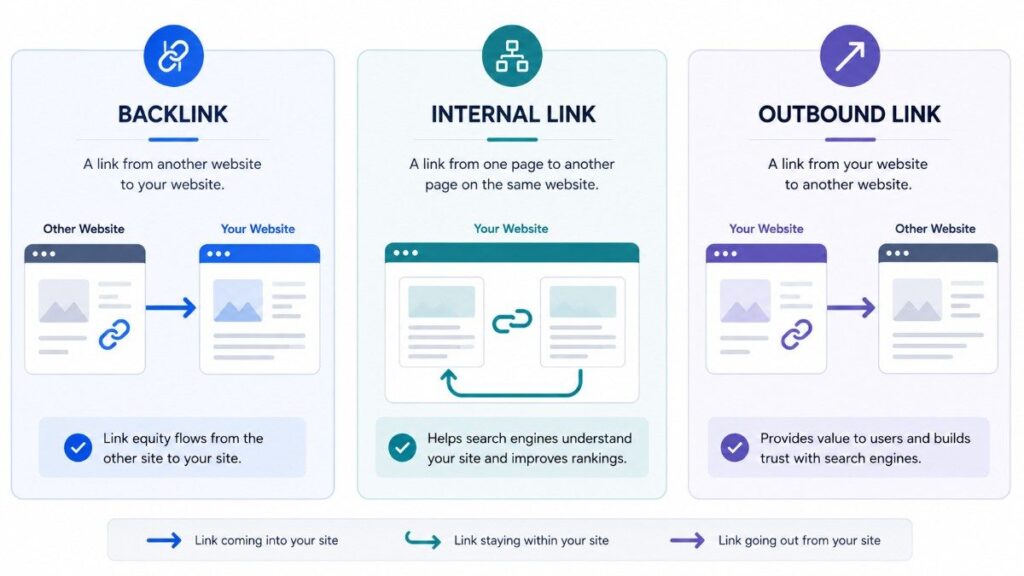
People mix these up constantly. The distinction matters because each one does a different job.
| Link type | Direction | What it does for you |
|---|---|---|
| Backlink (inbound) | Another site → your site | Passes authority and trust from outside. The hardest to get, the most valuable. |
| Internal link | Your site → your site | Distributes authority around your own pages and shows topical relationships. Fully under your control. |
| Outbound (external) link | Your site → another site | Supports your claims with sources. Helps credibility and E-E-A-T; passes authority away from you. |
A simple rule: internal links organise the authority you already have. Backlinks are how you get more of it.
How Do Backlinks Actually Work?
Backlinks influence rankings through four separate mechanisms. Most articles blur them together; understanding them separately is what makes link building strategic instead of random.
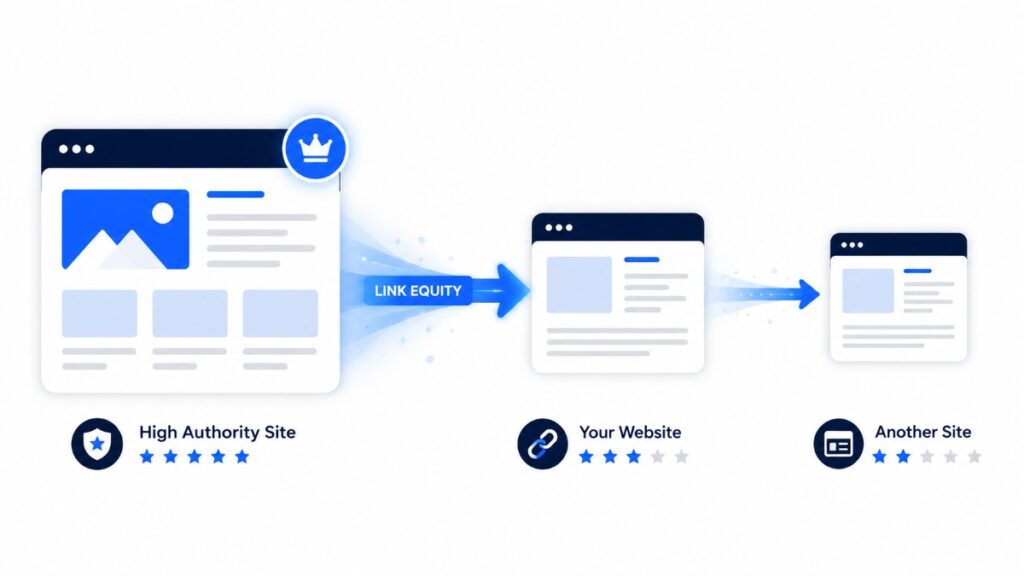
1. Authority transfer (link equity). When Page A links to Page B, part of Page A’s earned authority flows to Page B. A link from a page that itself has strong links is worth far more than one from a page nobody references. This is why a single link from an established industry publication moves rankings that fifty forum links never will.
2. Relevance via anchor text. The clickable words tell search engines what the destination is about. “B2B SaaS pricing benchmarks” is a far stronger topical signal than “click here.” Anchor text is powerful — which is exactly why over-optimising it triggers spam filters.
3. Discovery and indexation. Crawlers find new pages by following links. A backlink from a frequently crawled site is often the fastest route to getting a new page indexed. For young sites, this is usually the real bottleneck, not ranking.
4. Referral traffic and demand. A link on a page humans actually read sends real visitors, who then search your brand and sometimes link to you themselves. This second-order effect is the one most link programmes ignore, and the one that compounds.
Why Are Backlinks Important for SEO?
Here are the concrete outcomes, in the order they usually show up.
- Higher rankings for competitive keywords. For any query worth money, competitors already have good content. Links are usually the deciding variable between two similar pages.
- Faster indexing. Well-linked domains get crawled more often, so new content enters the index in hours rather than weeks.
- Stronger domain-level authority. A healthy profile lifts the baseline for every page on the site, including pages with no links of their own.
- E-E-A-T support. Google’s quality framework is partly assessed through how the wider web treats you. Being cited by respected sources is direct evidence of authoritativeness.
- Qualified referral traffic. A link inside a relevant article reaches people already in your problem space, and it usually converts better than generic organic.
- Competitive defence. Content can be copied in an afternoon; ten years of earned links cannot.
Do Backlinks Still Matter in the Age of AI Search?
Yes — but their role has changed, and this is where most backlink guides are still stuck in 2019.
AI assistants like ChatGPT, Perplexity, Gemini, Claude, and Google’s AI Overviews do not simply reproduce the top ten blue links. They assemble answers from sources they consider trustworthy, and they lean heavily on how often and how consistently a brand appears across the web.
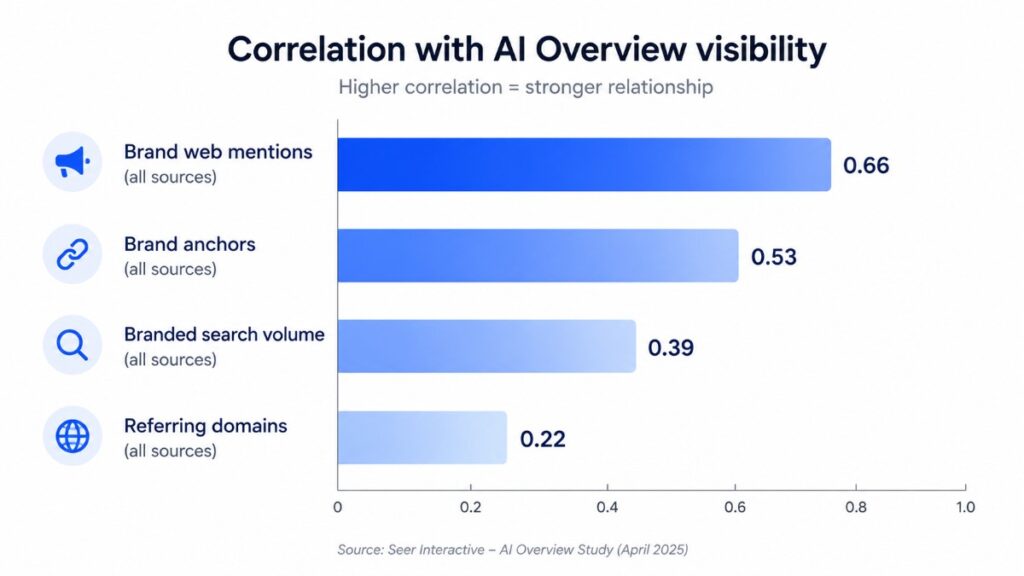
The clearest available data comes from Ahrefs’ study of roughly 75,000 brands, which measured how different signals correlated with appearing in AI Overviews:
| Signal | Correlation with AI visibility |
|---|---|
| Brand web mentions | ~0.66 |
| Brand anchors | ~0.53 |
| Branded search volume | ~0.39 |
| Referring domains (classic backlinks) | ~0.22 |
This does not say backlinks stopped working. It says being talked about across the web predicts AI visibility better than the raw count of domains linking to you. Correlation is not causation, and the signals overlap heavily – the same PR campaign that earns a link usually earns a mention too.
The practical conclusion:
A link is a mention with a URL attached. In AI search, the mention is doing much of the work – so build links in ways that also produce unlinked mentions, quotes, and brand references.
That reframes what a good campaign looks like. A guest post on a dead blog gets you a link and nothing else. A quoted statistic in an industry report gets you a link, a brand mention, a branded anchor, and a passage language models can lift straight into an answer.
For the full picture of how AI systems choose sources, see our guides on AI citations for AEO visibility and how to rank in Google AI Overviews.
What Makes a High-Quality Backlink?
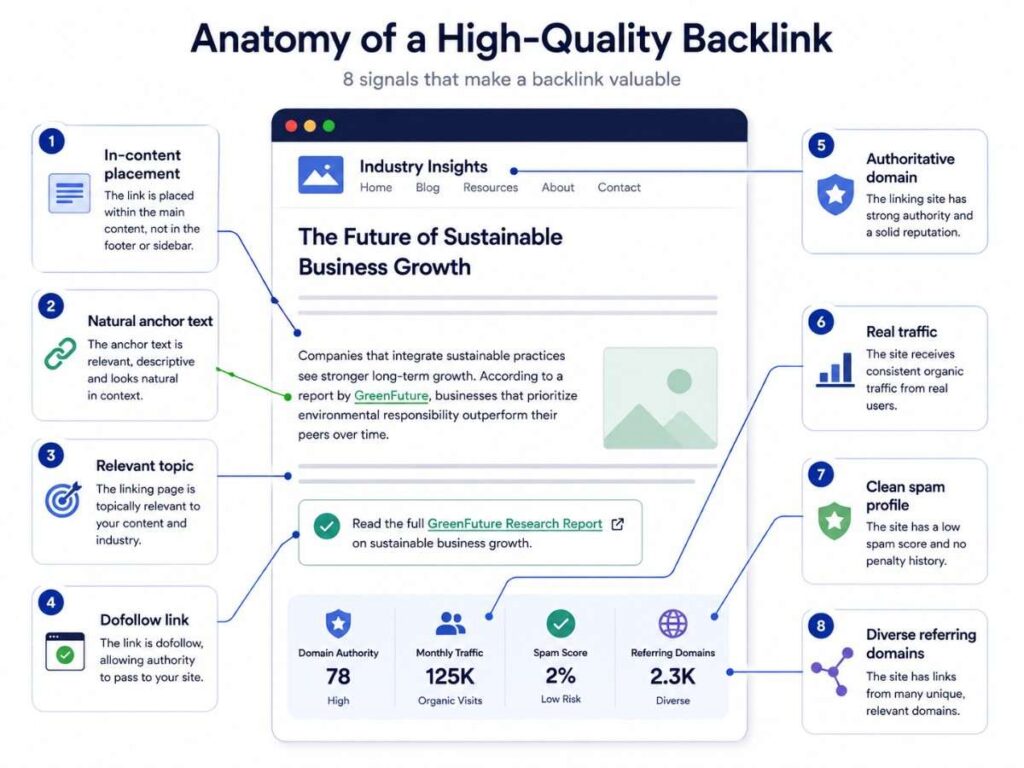
Not all backlinks are equal, and some actively hurt. Use this checklist to evaluate any link opportunity before you chase it.
| Quality factor | What good looks like | What to avoid |
|---|---|---|
| Domain authority | Established site with its own strong link profile | Brand-new domains with no traffic history |
| Topical relevance | Site and page cover your subject area | Random casino, crypto, or off-topic blogs |
| Link placement | Inside the main body content, high on the page | Footers, sidebars, author bios, comment sections |
| Anchor text | Descriptive and natural; branded and partial-match | Repeated exact-match commercial keywords |
| Follow attribute | Dofollow for equity; nofollow still adds discovery and brand exposure | Programmes that are 100% nofollow paid placements |
| Referring domain diversity | Many different domains linking once | One domain linking 500 times sitewide |
| Real audience | The page gets actual organic traffic | Pages with zero traffic that exist only to sell links |
| Spam signals | Clean outbound profile, editorial standards | Link farms, PBNs, sites with hundreds of outbound paid links |
Gut check: would you still want this link if search engines did not exist? If a real prospect could plausibly find you through it, it is a good link.
Dofollow, nofollow, sponsored, and UGC
Google recognises four link states:
- Dofollow — the default. Passes link equity.
rel="nofollow"— tells Google not to pass ranking credit. Still delivers traffic, brand exposure, and profile diversity.rel="sponsored"— required on paid or affiliate links.rel="ugc"— for user-generated content like comments and forum posts.
Since 2019 Google treats these as hints rather than strict directives, so nofollow links are not worthless. A natural profile contains a mix. A profile that is 100% dofollow exact-match anchors looks engineered — because it is.
Types of Backlinks (And What Each Is Worth)
| Type | How you get it | Value | Risk |
|---|---|---|---|
| Editorial / earned | Someone cites your content unprompted | Highest | None |
| Digital PR & media | Original data, expert commentary, newsjacking | Very high | Low |
| Guest posts | Contributed articles on relevant sites | High when the site is genuinely good | Medium if done at scale on junk sites |
| Listicle & roundup placements | Inclusion in “best X tools” comparisons | Very high commercial intent | Low |
| Resource page links | Featured on curated industry lists | High | Low |
| Link insertions | Adding your link into an existing ranking article | Medium–high | Medium |
| Business directories & citations | Listing your company | Low but foundational, useful for local and entity building | Low if reputable |
| Social & profile links | Bios, profiles, community posts | Low equity, decent for brand entity signals | Low |
| Forum & comment links | Manual posting | Very low | High if spammy |
Notice the pattern: the types that build brand entity recognition – digital PR, listicles, directories, expert quotes — are the same ones that feed AI systems’ understanding of who you are. That is not a coincidence, and it is the logic behind our SaaS link building service.
How to Build Backlinks: 7 Tactics That Still Work
1. Build linkable assets. Original research, benchmark data, calculators, and surveys earn links passively for years. Opinion pieces rarely do. Ask: what would another writer need to cite to make their point?
2. Do digital PR. Package a data point or expert perspective and pitch journalists and industry newsletters. Highest-leverage tactic in 2026, because it produces links and mentions at once.
3. Reverse-engineer competitors. Pull the referring domains of the three sites outranking you. Prioritise domains linking to two or more competitors but not to you — they have already shown willingness to link to a company like yours.
4. Reclaim unlinked mentions. Find places where your brand is mentioned without a link. A short, polite email converts far better than cold outreach, because the relationship already exists.
5. Broken link building. Find dead pages in your niche that still have links pointing at them, build the better replacement, and tell everyone still linking to the 404.
6. Earn listicle placements. For B2B SaaS, getting into “best tools for X” roundups delivers backlinks, referral traffic, and direct influence over what AI assistants recommend when someone asks for alternatives.
7. Guest post selectively. Ten well-placed guest posts beat two hundred on content farms.
Pair all of this with a strong on-site foundation — see our AI content strategy for organic growth — because links pointing at thin content waste the opportunity.
Link Building Practices to Avoid
Google’s link spam systems, including SpamBrain, are now good enough that these tactics are a liability rather than a shortcut:
- Buying links without
rel="sponsored" - Private blog networks (PBNs)
- Reciprocal link exchanges at scale
- Automated link building tools and bots
- Keyword-stuffed exact-match anchors
- Mass low-quality directory submissions
- Bulk guest posting on irrelevant sites
Modern algorithms typically ignore manipulative links rather than penalising instantly — which means the most common outcome is not a penalty but wasted budget. Manual actions do still happen, and recovery is slow.
On disavowing: most sites never need to. Google is generally good at ignoring junk links, and disavowing aggressively can remove links that were helping. Reserve the disavow file for clear negative SEO attacks or a documented manual action.
How to Audit and Measure Your Backlink Profile
Your backlink profile is the complete set of links pointing to your domain, plus their quality, anchor distribution, and growth pattern. Track it monthly:
- Referring domains — the count of unique linking domains. More predictive than raw link count.
- New vs lost links — a sudden spike in lost links can explain a ranking drop.
- Anchor text distribution — branded and natural anchors should dominate. If exact-match commercial anchors exceed roughly 10–15%, rebalance.
- Link velocity — steady growth looks natural; a sudden spike from nowhere does not.
- Link placement mix — what percentage sits in body content versus footers and sidebars?
- Toxic or spam-flagged domains — watch for unexplained surges.
- Referral traffic per link — the sanity check nobody runs. A link sending zero visits in six months tells you something.
Start with Google Search Console (Links report) for free first-party data, then layer a dedicated backlink tool for competitor comparison.
Then add the layer most teams are still missing: are these links translating into AI citations? Our guide on tracking AEO and GEO to measure AI share of voice covers how to measure that side.
How Many Backlinks Do You Need?
There is no universal number, and anyone quoting one is guessing. The answer is always relative: you need enough referring domains, of comparable quality and relevance, to compete with the pages currently ranking for your target keyword.
The method: list the top five ranking URLs for your keyword, check the referring domains for each of those specific pages (not their homepages), take the median, then adjust for relevance — if their links are generic and yours are niche-relevant, you need fewer.
For a low-competition long-tail term, strong content and internal links may be enough with almost no external links. For a commercial head term in a crowded SaaS category, expect to need dozens of quality referring domains per page.
Where Backlinking Fits in a Modern AEO and GEO Strategy
Here is the shift worth internalising. Traditional SEO asked: how do I rank on page one? Answer Engine Optimisation and Generative Engine Optimisation ask a harder question: when an AI assembles an answer, does it use my brand as a source — and does it recommend me?
Backlinks contribute to both, but through slightly different routes:
| Goal | What backlinks contribute |
|---|---|
| Google rankings | Authority transfer, relevance, crawl discovery |
| AI Overviews & AI Mode | Source trust, plus the brand mentions that come attached to links |
| ChatGPT, Gemini, Perplexity | Presence and consistency across the sources these systems retrieve from |
| Being recommended, not just cited | Repeated appearance in comparison content, roundups, and expert lists |
If AI systems are finding your content but not citing it, links alone are not the fix — we cover why that happens here. And if you are in B2B software, the intersection of links, entity building, and AI visibility is exactly the ground covered in our AEO guide for B2B SaaS.
AEORanks builds link programmes for both destinations at once. Our SaaS link building agency service combines high-authority guest placements, contextual insertions, listicle inclusions, and digital PR with entity and citation strategy — so the same campaign that lifts your Google rankings also increases how often ChatGPT, Gemini, Claude, and Perplexity name your brand. Most teams see movement within 60–90 days, with compounding gains over a six-month horizon.
What is a backlink in simple terms?
A backlink is a link on another website that points to your website. Search engines treat it as a vote of confidence that your page is worth reading.
Why are backlinks important for SEO?
Backlinks pass authority from trusted sites to yours, help search engines discover and index your pages faster, support E-E-A-T signals, and send qualified referral traffic. For competitive keywords, they are often the deciding ranking factor between two similar pages.
Are backlinks still a ranking factor in 2026?
Yes. Backlinks remain one of Google’s strongest signals. What has changed is that their relative weight has shifted — brand mentions, entity clarity, and content structure now matter alongside links, especially for visibility in AI-generated answers.
Do backlinks help with ChatGPT and AI Overviews?
Indirectly, and less than most people assume. Ahrefs’ 75,000-brand analysis found brand web mentions correlated with AI Overview visibility at around 0.66 versus roughly 0.22 for referring domains. Links still help — but the mentions and brand references that come with them do more of the work.
What is the difference between dofollow and nofollow backlinks?
Dofollow links pass ranking credit. Nofollow links tell search engines not to pass credit, but still deliver referral traffic, brand exposure, and profile diversity. A natural backlink profile contains both.
How many backlinks do I need to rank?
There is no fixed number. Benchmark the referring domains of the specific pages currently ranking for your target keyword and aim for a comparable count with better relevance.
Can backlinks hurt my SEO?
Yes, if they come from link farms, PBNs, or paid schemes without proper attributes. In most cases Google now ignores manipulative links rather than penalising, so the usual damage is wasted budget rather than a penalty.
Do internal links matter as much as backlinks?
They do different jobs. Internal links distribute authority you already have and clarify topical structure. Backlinks bring new authority in. You need both.