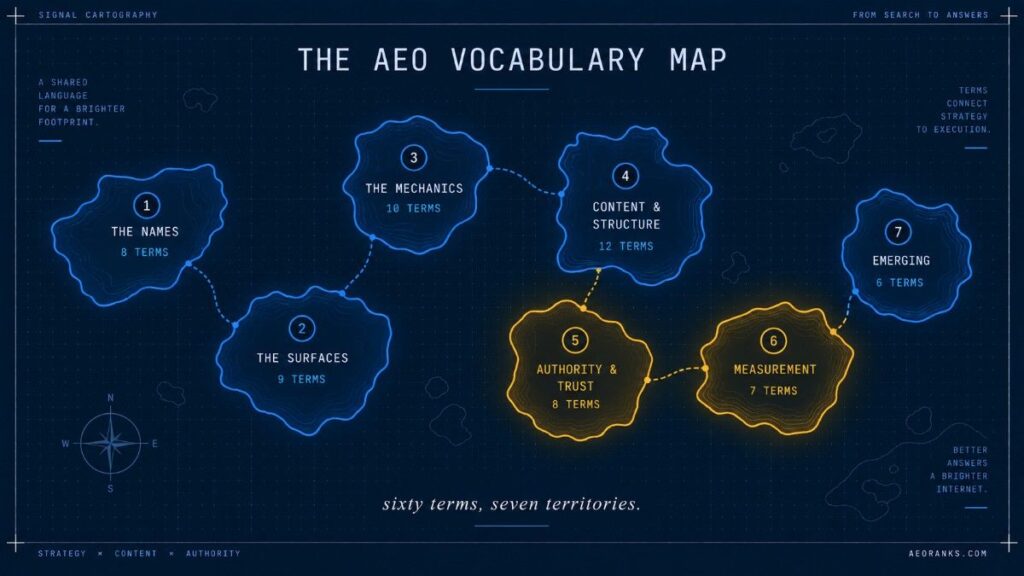
This glossary defines the terms you’ll hear in any conversation about AI search — AEO, GEO, RAG, chunking, share of voice, entity, llms.txt and 70 more — in language anyone on a marketing team can follow. Every definition starts with one plain sentence you could read aloud in a meeting, followed by why it actually matters.
You don’t need to memorise these. The industry hasn’t even finished agreeing on some of them. Use this page the way you’d use a dictionary: when a term shows up in a strategy doc, a report, or a LinkedIn post, come back and look it up.
New to this space? Start with the naming section below — the AEO/GEO/AIO confusion trips up more people than any other part of this vocabulary. If you want the strategic picture rather than definitions, read our guide to answer engine optimization first, then come back.
1. The Naming Problem: AEO, GEO, AIO, LLMO and CAO
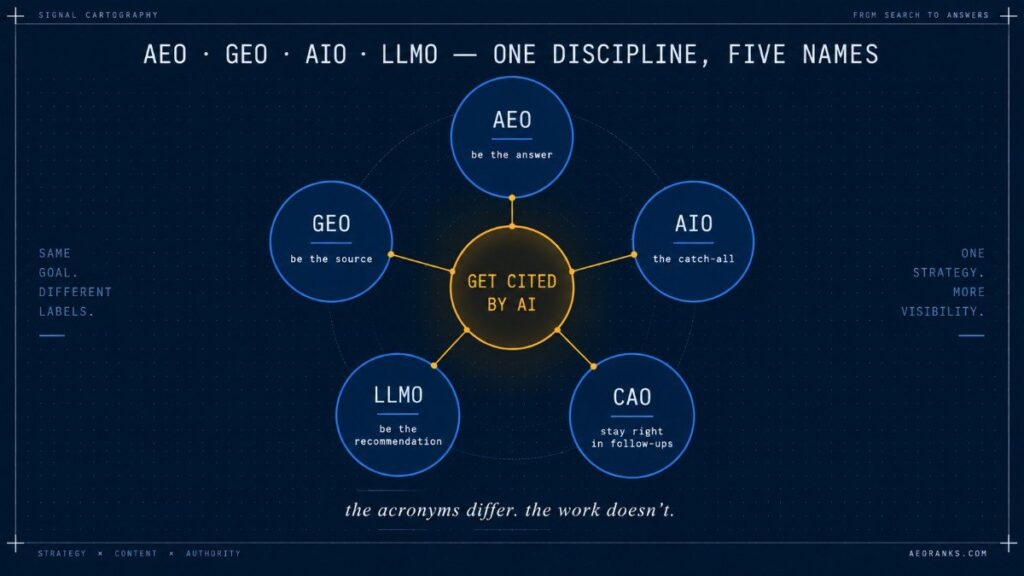
These terms overlap heavily and are used interchangeably by most practitioners. The differences are real but small, and nobody will misunderstand you if you pick one and stay consistent. Here’s what each actually means.
| Term | Stands for | The distinction people draw | Where it came from |
|---|---|---|---|
| AEO | Answer Engine Optimization | Being the answer itself — the passage lifted into the response | Marketing community, evolved from featured-snippet work |
| GEO | Generative Engine Optimization | Being a source the answer draws from | Academic research (2023 paper) |
| AIO | AI Optimization | Broadest catch-all; sometimes means Google AI Overviews specifically | Marketing community |
| LLMO | Large Language Model Optimization | How your brand shows up when an AI recommends vendors, not just answers questions | Marketing community |
| CAO | Conversational Answer Optimization | Staying accurate across follow-up questions, not just the first answer | Newer, less established |
| SXO | Search Experience Optimization | SEO plus user experience — speed, layout, clarity as ranking inputs | Predates AI search |
Our recommendation: use AEO for the practice and GEO when referencing the research. Don’t spend meetings debating the acronym — the underlying work is the same.
AEO (Answer Engine Optimization)
The practice of structuring your content and brand signals so AI answer engines retrieve, cite and correctly describe you. Traditional SEO aims for a ranking. AEO aims for a place inside the answer itself — which may happen without any click at all.
GEO (Generative Engine Optimization)
The same discipline, named in academic research. The term was introduced in a November 2023 paper by researchers from Princeton, Georgia Tech, the Allen Institute for AI and IIT Delhi, which showed specific writing techniques could lift visibility inside AI answers by up to 40%. Our full GEO guide covers the research and its findings in detail.
Answer Engine
Any system that answers a question directly instead of returning a list of links. ChatGPT, Perplexity, Claude, Gemini and Google AI Overviews are all answer engines. The defining feature isn’t the AI — it’s that one composed answer replaces ten competing options.
AI Search
The umbrella term for finding information through AI-generated answers rather than a results page. Useful when you want to describe the shift without picking an acronym.
2. Where Answers Appear: Platforms and Surfaces
Each platform behaves differently, so knowing which surface you’re talking about matters more than it did in SEO.
Google AI Overviews (AIO)
The AI-generated summary box that appears above traditional results on a Google search page. It synthesises several sources and often answers the question completely, absorbing clicks that used to reach websites. Our guide to ranking in Google AI Overviews covers this surface specifically.
Google AI Mode
A separate, conversational Google experience where AI answers replace the results page entirely. Unlike AI Overviews, which sit on top of normal results, AI Mode is its own space built for back-and-forth follow-up questions.
SGE (Search Generative Experience)
Google’s original name for its AI-answer experiment, which shipped as AI Overviews. You’ll still see SGE used as shorthand for the broader answer-first shift, even though the product name changed.
LLM (Large Language Model)
The AI system that reads, reasons and writes — the “brain” behind the tools you use. ChatGPT, Claude and Gemini are applications; GPT, Claude and Gemini models are the LLMs powering them. A useful comparison: the app is the phone, the model is the operating system.
Generative AI
AI that creates new content — text, images, audio, video or code — based on patterns learned from existing data. LLMs are the text-generating subset.
Zero-Click Search
A search that ends without anyone visiting a website, because the answer appeared on the results page or inside the AI response. Zero-click predates AI, but AI answers have accelerated it sharply. Fewer than half of US Google searches now send a click to the open web.
Zero-Click Visibility
Brand exposure that happens inside an AI answer with no site visit. Someone reads your brand name in a ChatGPT response, never clicks, and still remembers you later. It’s real value that traditional analytics can’t see.
Conversational Search
Searching by asking questions in natural language and getting synthesised answers, with the ability to follow up. This interaction model is the entire reason AEO exists: when one answer replaces ten links, only cited sources stay visible.
Voice Search
Spoken queries answered aloud by an assistant. Voice was the original “answer engine” problem — one answer, no results page — and much of early AEO thinking came from optimising for it.
3. How AI Finds and Uses Your Content
This section explains the machinery. Understanding it is what separates guessing from strategy.
RAG (Retrieval-Augmented Generation)
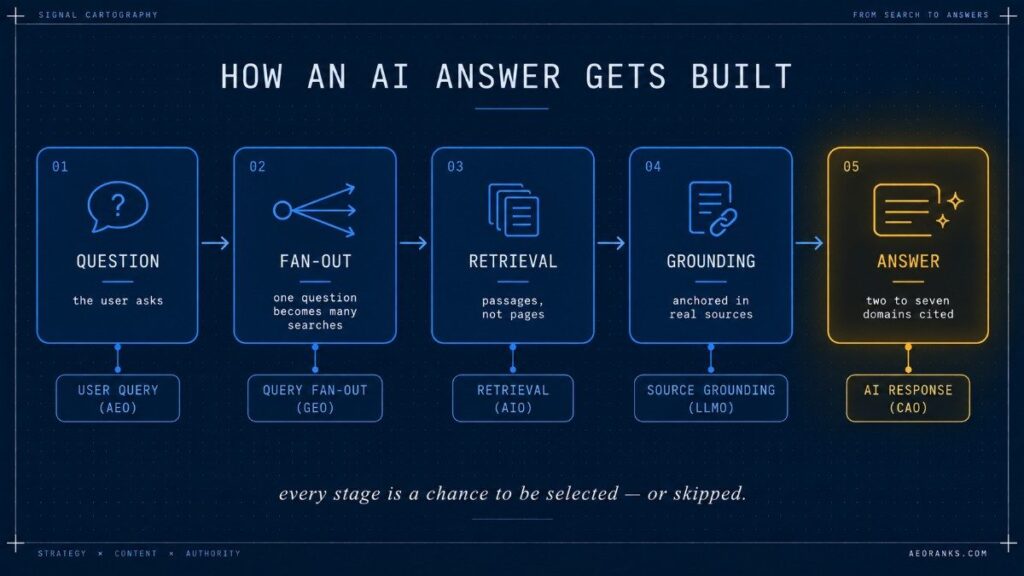
The process where an AI searches the live web for relevant passages, then writes its answer using what it found. Without RAG, a model answers only from what it learned during training. Nearly all visible citations come from RAG, which makes it the part of the system you can actually influence.
Example: “What is the stock market?” can be answered from training data. “Should I buy this stock today?” requires retrieval.
Training Data
The fixed body of text a model learned from before it was released. Answers drawn purely from training data usually arrive without citations, because there’s no live source to link to.
Grounding
Anchoring an AI’s answer in real, retrieved sources rather than letting it generate from memory. Grounding is what produces citation links — and what reduces hallucination.
Hallucination
When an AI states something false or unsupported that wasn’t in any retrieved source. Clear, factual, well-structured content reduces the odds of a model inventing details about your brand.
Passage Retrieval
The step where the system scans its index and selects specific text chunks — not whole pages — to build an answer from. This is the single most important mechanical fact in AEO: citation decisions happen at the passage level. A great page can lose every citation if no individual paragraph stands on its own.
Chunking
Breaking content into discrete segments that can be indexed and retrieved independently. Clean headings and self-contained sections produce clean chunks. Rambling paragraphs that blend three ideas produce chunks nothing can use.
Note: practitioners disagree on how much deliberate “chunking for AI” helps beyond simply writing well-structured content. Good structure for humans usually produces good chunks anyway.
Query Fan-Out
When an AI turns one user question into several background searches before answering. Google introduced this publicly with AI Mode in 2025. Ask “best CRM for a small agency” and the system may quietly search for pricing comparisons, feature lists and alternatives before composing one answer.
Why it matters: you’re no longer optimising for one query. Each sub-query is a separate chance to be selected, which is why pages covering a topic from multiple angles outperform narrow ones.
Semantic Search
Matching based on meaning rather than exact words. A search for “how to reduce customer churn” can surface a page titled “retention strategies that work,” because the system understands the concepts are related.
Embedding / Vector
A numerical representation of meaning that lets AI systems compare ideas mathematically. Two passages with similar embeddings are treated as being about similar things, even with no shared keywords. You don’t need to work with these directly — but it’s why keyword density stopped mattering.
Token
A fragment of text — roughly three-quarters of a word — that AI systems use as their basic unit. Models have token limits, which is why a 10,000-word report may only ever be represented by a single 300-token passage in an answer.
AI Crawler / AI Bot
Automated bots that AI companies use to read web content. The main ones: GPTBot and OAI-SearchBot (OpenAI), ClaudeBot (Anthropic), PerplexityBot (Perplexity), Google-Extended (Google).
They serve different purposes — training bots absorb content to improve models, search bots index it for later retrieval, and agent bots visit in real time to complete a user’s task. Blocking them in robots.txt is a real strategic decision, not a technical detail.
AI Crawlability
Whether AI bots can actually reach, render and read your pages. If a crawler is blocked or your content only appears after JavaScript runs, you’re invisible no matter how good the writing is.
Crawl Budget
The limited attention any bot gives your site. If crawlers spend it on thin or duplicate pages, your important content may never be retrieved — and content that isn’t retrieved can never be cited.
4. Content and Structure Terms
These terms describe what “AI-friendly content” concretely means in practice.
Extractability
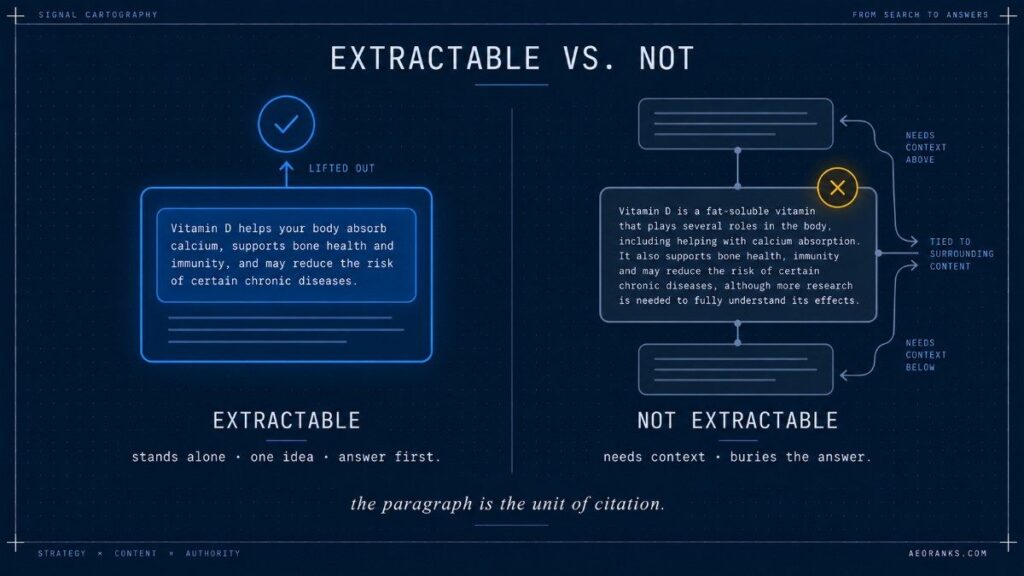
How cleanly a passage can be lifted out of your page and still make sense. This is the core content skill in AEO.
Extractable: “A content brief is a document that outlines the goal, audience and structure of a planned piece.” Not extractable: “As we discussed above, this document should also include…”
Atomic Answer
A self-contained answer of one to three sentences that fully addresses one question without needing surrounding context. These are the units answer engines actually cite.
BLUF (Bottom Line Up Front)
A writing pattern that puts the conclusion in the first sentence instead of building up to it. Roughly 44% of AI citations come from the first 30% of a page, so front-loading isn’t a style preference — it’s placement strategy.
Answer-First Writing
Structuring every section so the direct answer comes first and the supporting detail follows. The same discipline as BLUF, applied at every heading rather than just the intro.
Micro-Answer Block
A compact, extractable element such as a definition box, a step list or a pros-and-cons table. Each one adds another surface an engine can pull from.
Q&A Structuring
Formatting content as question-shaped headings with the answer immediately beneath. It matches exactly how answer engines look for content, which makes it disproportionately likely to be lifted.
Multi-Question Coverage
Deliberately answering adjacent sub-questions on the same page. In a fan-out world, one page that covers definition, comparison, process and cost can be retrieved for all four.
Hub and Spoke
A pillar page covering a core concept, surrounded by linked pages covering its sub-topics. Gives engines many related passages to draw from and signals depth on the topic.
Topic Cluster
A group of interlinked pages covering one subject comprehensively. The practical unit of topical authority — and the structure AI systems reward most.
Information Gain
The unique value your content adds beyond what already exists on the topic. If fifty pages define a term identically, an engine has no reason to cite yours. Original data, first-hand experience or a genuinely different angle gives it one.
Structured Evidence
Sourced, quantified support — statistics, benchmarks, named quotes — presented clearly. Replace “significant improvement” with “34% increase over 90 days (internal data, n=127)” and you’ve made the passage citable.
Freshness Signal
Visible and machine-readable cues that content is current: last-updated dates, recent statistics, version notes. AI systems favour recent sources, especially for fast-moving topics.
Recency Refresh
A lightweight update — new data, a current example, a change note — that maintains freshness without a full rewrite. The highest-leverage maintenance habit in AEO.
Topic Drift
Mixing several unrelated primary intents into one URL. It confuses retrieval systems, which can’t confidently decide what the page is for, and suppresses your odds for all of them.
Semantic Drift
Describing the same thing with different words across your own site. If your homepage says “content platform,” your product page says “content operations software” and your blog says “content tool,” AI systems may not connect them into one entity.
Structured Data / Schema Markup
Code added to a page that explicitly labels what the content is — an article, an FAQ, a product, an organisation. It removes guesswork for machines. The highest-impact types for AI visibility are FAQPage, Article, Organization and, for a glossary like this one, DefinedTermSet.
FAQ Schema
Markup that tags question-and-answer pairs so engines can find them instantly. Because retrieval systems are built to parse Q&A, this is often the fastest structural win available.
5. Authority and Trust Signals
These terms explain why an engine picks you rather than a competitor with equally good content.
E-E-A-T (Experience, Expertise, Authoritativeness, Trustworthiness)
Google’s framework for judging whether content comes from a credible source. In AI search it functions less as a ranking factor and more as a filter: it decides whether you’re in the pool of sources considered citable at all. Named authors, real credentials, first-hand experience and transparent methodology are the practical levers.
Entity
A distinct, recognisable thing — a brand, product, person, or concept — that AI systems can identify and connect to other information. Keywords are what people type. Entities are what those words refer to. AI search runs on entities.
Entity Recognition
How a system identifies your brand as a known thing with properties, rather than as a string of characters. The difference between “AEORanks” being three syllables and “AEORanks is an AI visibility agency.”
Entity Strengthening
Making your brand’s name, description and category consistent everywhere it appears. Every inconsistency gives the model a reason to hesitate before naming you.
Knowledge Graph
A structured map of things and the relationships between them, used by search engines and AI systems to understand the world. Being accurately represented in one improves how confidently you’re cited.
Triple
A three-part fact in subject-predicate-object form — “AEORanks → provides → AI visibility services.” Writing in clear factual statements makes your content easier to convert into these relationships.
Third-Party Corroboration
Independent sources confirming what you say about yourself. Your own site has every incentive to flatter you; review platforms, communities and press don’t. This is the strongest and most neglected lever in AEO — it’s the usual answer to why AI finds your content but doesn’t cite it.
Cross-Platform Validation
Your brand appearing across several independent surfaces — Reddit, YouTube, G2, LinkedIn, industry media. One platform is easy to manipulate; five is not, and models weight that difference. Reddit alone accounts for roughly 46% of Perplexity’s citations and about 21% of Google AI Overview citations.
Brand Co-occurrence
Your brand name appearing near the topics and competitors you want to be associated with, even without a link. Models learn association from proximity and frequency, which means an unlinked mention in the right context can be worth more than a backlink.
Source Tiering
The informal hierarchy engines apply to sources — research, government and established publications at the top, thin or anonymous sites at the bottom. Not every citation carries equal weight.
Source Diversity
The tendency of AI systems to pull from several different sources rather than leaning on one. It’s why a single dominant page rarely wins an entire answer, and why breadth of presence beats depth on one URL.
AI Citation
When an AI names your page as the source of a fact and links to it. The closest equivalent to a ranking position in AI search. Our guide to earning AI citations covers how to build them.
Brand Mention
When your brand name appears inside the generated answer, with or without a link. Different from a citation, and often more valuable commercially — it’s what puts you on a buyer’s shortlist.
Citation Gap
A query where you rank well in Google but are absent from the AI answer. These are the highest-priority opportunities in any AI visibility audit, because the content already exists and only needs restructuring.
6. Measurement Terms
Rankings don’t translate to AI search. These are the metrics that replace them. For the full setup, see our guide to tracking AEO and GEO.
AI Share of Voice
How often your brand appears in AI answers compared with competitors, across the same set of questions. The headline AEO metric — the closest thing to a ranking report.
Citation Rate
The percentage of relevant AI answers that cite your domain as a source. Measured across a fixed question set, tracked over time.
Appearance Rate / Coverage Rate
The percentage of your tracked questions where you appear at least once. Answers “are we in the conversation at all?” before you ask “how prominently?”
Prompt Set
A defined, repeatable list of realistic questions you test on a regular schedule. Without a fixed prompt set, you’re comparing different things each time and learning nothing.
Prompt Testing
Running that question list through AI platforms on a fixed cadence to see whether and how you appear. This is how AI visibility is actually measured today — there’s no universal rank tracker equivalent yet.
Prominence
Where in the answer your brand appears — named first and clearly, or buried as an afterthought. Position inside an answer matters the way position on a results page used to.
AI Sentiment
Whether the AI describes your brand accurately and positively. An inaccurate mention can cost more than no mention at all.
Trend Velocity
Whether your citation rate is rising, flat or falling over time. Between 40% and 60% of cited sources change month to month, so a single check tells you almost nothing — the trend is the signal.
AI Referral Traffic
Visits that arrive from an AI tool, tracked in analytics via sources like chatgpt.com, perplexity.ai, claude.ai and gemini.google.com. Volumes are still small for most sites, but these visitors have already read a summary and chosen to go deeper — analysis from Semrush suggests they’re worth several times a standard organic visit.
AI Content Gap
Information competitors have on their sites that you don’t, causing engines to favour them. The diagnostic that turns a visibility problem into a content brief.
7. Technical and Emerging Terms
Newer terms you’ll increasingly hear. Some are genuinely important; some are hype. We’ve flagged which is which.
llms.txt
A proposed Markdown file at your site root that gives AI systems a map of your most important content. Think robots.txt for the AI era.
Honest assessment: adoption is low and the evidence is weak. One study of roughly 300,000 domains found about 10% had the file and found no clear effect on citation frequency; separate research found the vast majority are never read. Google has said it won’t hurt but won’t help. Ship it if it’s cheap; don’t build a strategy on it.
Markdown
A lightweight plain-text formatting system that machines parse far more efficiently than HTML. AI agents burn fewer tokens reading Markdown because there’s no layout code to wade through. Created by John Gruber in 2004, long before anyone thought about AI crawlers.
Semantic HTML
Using HTML tags for their actual meaning — <button>, <nav>, <main> — instead of generic <div>s. A styled <div> looks like a button to a human and like nothing at all to an AI agent.
Accessibility Tree
A simplified structural map of a page, originally built for screen readers. AI agents read pages much the same way, which means accessibility work and AI-agent readiness are largely the same job.
Agentic AI
AI that takes multi-step action on a task rather than just answering a question. Instead of telling you which flights exist, it searches, compares and books one.
Agentic Search / Agentic Browsing
When an AI agent navigates websites directly on a user’s behalf — clicking, filling forms, comparing options. It shifts the audience for your site: your pages now need to persuade a system, not just inform a reader.
MCP (Model Context Protocol)
A standard that lets AI assistants connect securely to external data and tools. It’s why an assistant can pull live data from your analytics or CRM instead of guessing from training data.
AI Visibility
The umbrella term for how present and accurately represented your brand is across AI answers. The outcome all of the above serves.
Answer Graph
Interlinked content covering one topic from every angle — definition, comparison, how-to, mistakes, benchmarks, FAQs. A structural pattern that gives retrieval systems dense, connected evidence to draw from.
Prompt Cluster
A group of related user intents that a single well-built page can satisfy. The AI-era replacement for one-page-per-keyword thinking.
8. If You Only Learn 12 Terms
For stakeholders who need to follow the conversation without studying it, these twelve carry most of the meaning:
- AEO — optimising to be inside AI answers
- GEO — the same thing, academic name
- Answer engine — anything that answers instead of listing links
- RAG — the live search that produces citations
- Passage retrieval — engines cite paragraphs, not pages
- Extractability — can a paragraph stand on its own?
- Query fan-out — one question becomes many searches
- Entity — your brand as a recognised thing, not a keyword
- Citation vs. mention — a link versus a name
- AI share of voice — how often you appear versus competitors
- Third-party corroboration — does the web agree with you?
- Zero-click visibility — value that never shows up in analytics
Not sure how many of these your brand is already winning? Book a free AI visibility audit with AEORanks. We’ll test your priority questions across ChatGPT, Perplexity, Gemini, Claude and Google AI Overviews, and show you exactly where competitors are cited instead of you.
What is AEO in simple terms?
AEO, or answer engine optimization, is the practice of setting up your content and brand so AI tools like ChatGPT, Perplexity and Google AI Overviews name you in their answers. Traditional SEO aims for a ranking on a results page. AEO aims for a place inside the answer itself.
What’s the difference between AEO and GEO?
Very little in practice. AEO grew out of marketing work on featured snippets and answer boxes; GEO came from a 2023 academic paper on generative engines. Some practitioners say AEO means being the answer while GEO means being a source the answer draws from, but most teams use them interchangeably.
Is AEO replacing SEO?
No. AEO builds on SEO. AI systems rely on crawlability, structure and authority — all things SEO creates — to find your content in the first place. What changes is the goal: citations and mentions instead of rankings and clicks. See our guide to AI and SEO for how the two fit together.
Which AEO terms actually matter day to day?
Extractability, passage retrieval, entity, citation versus mention, and AI share of voice. Those five cover most real decisions: how to write, how engines choose, how you’re identified, what counts as a win, and how you measure it.
What is the most misunderstood term in AEO?
Chunking. Many people treat it as a separate optimisation task, but in practice it usually just means writing in clear, self-contained sections — something good editors have always done. Structure your content well for humans and the chunks take care of themselves.
Do I need to know all of these terms to do AEO well?
No. The twelve in section eight are enough to follow any strategy conversation. The rest are useful when you encounter them in a specific report or technical audit — which is exactly what this page is for.