Key takeaways
- There is no standard AEO score. Every tool defines its own, and the numbers aren’t comparable.
- Most scores fall into three types: readiness (can AI read you), prediction (are you likely to be cited), and visibility (are you actually being cited).
- A readiness or readability score is the only one you fully control, and it’s page-level.
- The highest-weighted fix across almost every scoring model is the same: a direct 40–60 word answer at the top of the page.
- A perfect readiness score doesn’t mean AI will cite you. It means nothing is stopping it.
If you’ve run your site through an AEO checker and got a number back, you probably had two reactions. First: is that good? Second: what do I actually fix?
That second question is the one people ask on Reddit, and it’s the harder one — because the answer depends on which tool gave you the score, and most tools don’t explain what they measured.
So let’s fix that first, then get to the fixes.
What is an AEO score?
An AEO score is a number a tool gives your page or brand to estimate how well it’s set up to be used by answer engines like ChatGPT, Perplexity, Google AI Overviews and Gemini. Higher usually means your content is easier for an AI system to read, extract and quote.
Here’s the part nobody tells you: there’s no industry standard behind it. Unlike a Core Web Vitals threshold or an HTTP status code, “AEO score” isn’t defined by anyone. Each tool built its own model, and they measure genuinely different things.
Three real examples, all calling their output an AEO score:
- AEO GEO Checker runs a weighted on-page checklist — answer-first openings, question headings, FAQ schema — and publishes the weights.
- Blufy (from VedanX) returns an AEO readiness score across five areas: answer clarity, structure, topical context, evidence, and technical foundations.
- Profound built a machine-learning AEO Content Score trained on millions of top-cited pages, predicting how likely your content is to become one.
A 90 from the first and a 90 from the third aren’t the same claim. One says your page is well-formatted. The other says a model thinks you’ll get cited.
So before you act on a score, ask what it measured. Otherwise you’ll optimise for one tool’s checklist and wonder why nothing changed.
The three kinds of AEO score
| Type | What it answers | Who controls it | Page or brand |
|---|---|---|---|
| Readiness / readability | Can AI parse and extract my content? | You, fully | Page |
| Prediction | Am I likely to be cited? | Partly — it’s a model’s guess | Page |
| Visibility | Am I actually being cited right now? | Indirectly | Brand |
Most people searching “how to improve my AEO score” have a readiness score in hand, because those are the ones that are free and instant. That’s the right place to start — it’s the only layer you control outright.
But know the ceiling. Readiness is necessary, not sufficient. We’ve written about why AI finds your content but doesn’t cite it, and the short version is that a flawless page still loses to a competitor with more third-party mentions.
What is an AEO readability score?
An AEO readability score measures how easily an answer engine can lift a usable answer out of your page. It’s not the same as a Flesch reading score, though sentence length feeds into it.
It typically looks at:
- Whether a direct answer appears early, in a self-contained passage
- Whether headings are phrased as questions people actually ask
- Sentence and paragraph length
- Whether steps, comparisons and criteria use lists and tables
- Whether the page is snippet-eligible (no
nosnippet, nomax-snippet:0)
Think of it as asking: if an AI had to quote one paragraph from this page, is there a clean one to take?
On most pages, there isn’t. The opening is a warm-up paragraph, the real answer is buried in section three, and it only makes sense if you’ve read sections one and two. That’s the problem a readability score is detecting.
9 Steps to improve your AEO Score
These are drawn from what the scoring models actually weight most heavily, plus what Google’s own AI Overview for this query emphasises.
1. Put a direct answer in the first 50–150 words
The single highest-weighted factor in nearly every model. Open with the subject: “An AEO score is…”, “GEO costs…”. No preamble, no “in today’s fast-moving landscape.”
2. Write in self-contained 40–60 word passages
Each key passage should make sense if someone lifted it out and pasted it elsewhere — because that’s literally what happens. Avoid “as mentioned above” and “this means that.”
3. Turn headings into questions
“Pricing” becomes “How much does it cost?” Headings phrased as real questions match how people prompt, and they give AI systems a clean question-answer pair.
4. Add a real FAQ section
Four to eight questions customers genuinely ask — pull them from sales calls and support tickets, not a keyword tool. Mark them up with FAQPage schema.
5. Use JSON-LD schema, server-side
FAQPage, HowTo, Article, Organization, and Product/Review where relevant. Profound’s research notes that FAQ schema is favoured over generic Article schema. Render it server-side — AI crawlers don’t execute JavaScript.
6. Add evidence AI can quote
Original data, benchmarks, named authors with credentials, visible publish and update dates. A passage with a number in it gets quoted more than one with an adjective in it.
7. Use lists and tables for anything comparable
Steps as numbered lists, comparisons as tables. Both are high-extractability formats and both score well.
8. Fix the technical basics
Crawlable, indexable, fast, mobile-friendly, clean HTML, correct canonical, in the sitemap. An unreadable page can’t score at all. If this is where your gaps are, start with AEO and GEO best practices for AI visibility.
9. Build off-site mentions
The one no on-page score can measure. AI systems lean on Reddit, Quora, YouTube, review platforms and industry sites when deciding who to name. This is slower than everything above and matters more. See how AI citations are actually earned.
One sequencing note: fixes 1–7 take an afternoon on a single page. Fix 9 takes a quarter. Do the fast ones first, but don’t mistake finishing them for being done.
Where to apply this first
Don’t rewrite your whole site. The highest-return pages are the ones already ranking in positions 6–15 for queries you care about — they’re close enough that extractability changes can tip them, and they already have enough authority to be considered.
Start there, measure, then widen.
What is an influence score in AEO?
An influence score estimates how much a given source shapes what AI systems say about a topic or brand — not just whether you’re mentioned, but whether your content is doing the work behind the answer.
It’s a visibility-layer metric, not a readiness one. Tools calculate it differently and the term isn’t standardised, so treat a specific number as directional. The underlying question is a fair one though: a mention in a listicle and a citation that forms the backbone of an answer are not equal, and a plain mention count hides that difference.
Which AEO tools score sentiment by prompt?
Sentiment-by-prompt is a visibility tool feature, not something a free page checker does. It works by running a fixed set of prompts repeatedly and classifying how your brand is described in each answer — positive, neutral, negative — so you can see not just where you appear but how you’re characterised.
If you’re evaluating tools for this, check two things: whether sentiment is reported per prompt or only as a brand-level average, and whether the tool shows you the underlying answer text. An average hides the one prompt where you’re being described badly, which is usually the one worth knowing about.
For how to build this kind of measurement properly, see how to track AEO and GEO and measure AI share of voice.
How to check your AEO score for free
Run the page through a readiness checker, fix what it flags, re-scan. The whole loop takes under an hour for one page.
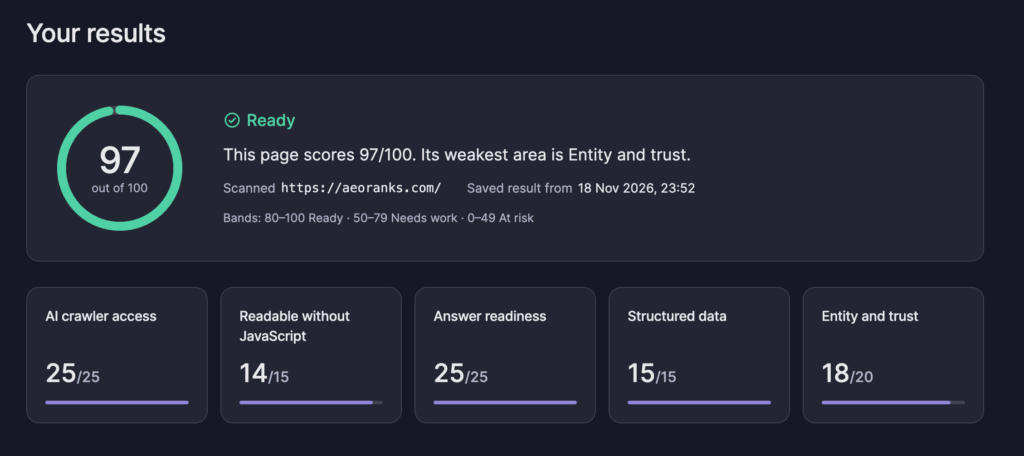
Our AEO Readiness Checker is free and checks the extractability factors above — whether you have a quotable opening, whether headings match real questions, whether your schema is in place and server-rendered, and whether anything is blocking AI crawlers.
It tells you what’s stopping AI from using your content. It won’t tell you whether ChatGPT currently recommends you — that’s the visibility layer, and it needs prompt testing. Worth being clear about which problem you’re solving.
What a good score doesn’t mean
A high readiness score means nothing is stopping an answer engine from using your page. That’s it.
It doesn’t mean you’ll be cited. Citation depends on authority, on third-party coverage, on whether you’re the best available source for that specific question. Plenty of perfectly structured pages never get quoted because a competitor is mentioned in more places that AI systems trust.
Treat the score as a diagnostic, not a target. Chasing 100 on a checker is a good way to spend a month on formatting while the actual gap is that nobody outside your own site mentions you.
What is an AEO score?
An AEO score is a number a tool assigns to estimate how well your content is set up for answer engines like ChatGPT, Perplexity and Google AI Overviews. There’s no industry standard — each tool uses its own model, so scores aren’t comparable between tools.
What is a good AEO score?
There’s no universal benchmark, because the scales differ. What matters is which specific factors a tool flagged as missing and whether your score improves after you fix them. A number without a breakdown isn’t actionable.
What’s the difference between an AEO score and an AEO readability score?
A readability or readiness score measures one specific thing: how easily AI can extract an answer from your page. “AEO score” is a broader label that some tools use for readiness, others for predicted citation likelihood, and others for actual visibility in AI answers.
How do I improve my AEO score fastest?
Add a direct 40–60 word answer at the top of the page, rewrite headings as questions, and add a real FAQ section with
FAQPageschema. Those three cover the highest-weighted factors in most scoring models and take well under an hour.How do I check my AEO score for free?
Run the page through a free readiness checker like the AEO Readiness Checker. Fix what it flags, then re-scan to confirm the change registered.
Does a high AEO score mean AI will cite me?
No. A high readiness score means nothing is blocking AI from using your content. Whether it actually cites you depends on authority and third-party mentions, which no on-page score can measure.
What’s the difference between AEO and GEO scores?
Broadly, AEO scores focus on whether your content can be extracted as a direct answer, while GEO scores focus on whether you’re being cited and referenced by generative systems. The split isn’t consistent across tools — check how each defines it. Our glossary covers the terminology.