Key Takeaways
- SEO earns rankings and clicks in traditional search results. AEO earns mentions and citations inside AI-generated answers on ChatGPT, Gemini, Perplexity, and Google AI Overviews.
- The deepest difference isn’t tactics – it’s mechanics. Rankings are deterministic positions; AI visibility is a probability that changes between runs and engines.
- They measure success differently: SEO tracks rankings, traffic, and CTR; AEO tracks citations, brand mentions, share of voice, and prompt coverage.
- You don’t choose between them. They share one foundation – crawlable pages, structured content, real authority – and strong SEO is the delivery system AEO runs on.
- The winning approach is one workflow optimized for both: answer-first content, entity consistency, evidence-rich pages, and off-site trust, measured on both scoreboards.
The difference between AEO and SEO comes down to where you want to be found. Search engine optimization (SEO) gets your pages ranked in traditional search results so people click through to your site. Answer engine optimization (AEO) gets your brand mentioned and cited inside AI-generated answers – on ChatGPT, Gemini, Claude, Perplexity, and Google’s AI Overviews.
AI discovery is now one of the most important channels in user acquisition and brand perception. Terms like AEO, AIO, and GEO are the results of this massive shift in user search behaviour. To see why that difference matters, follow one buyer through both worlds.
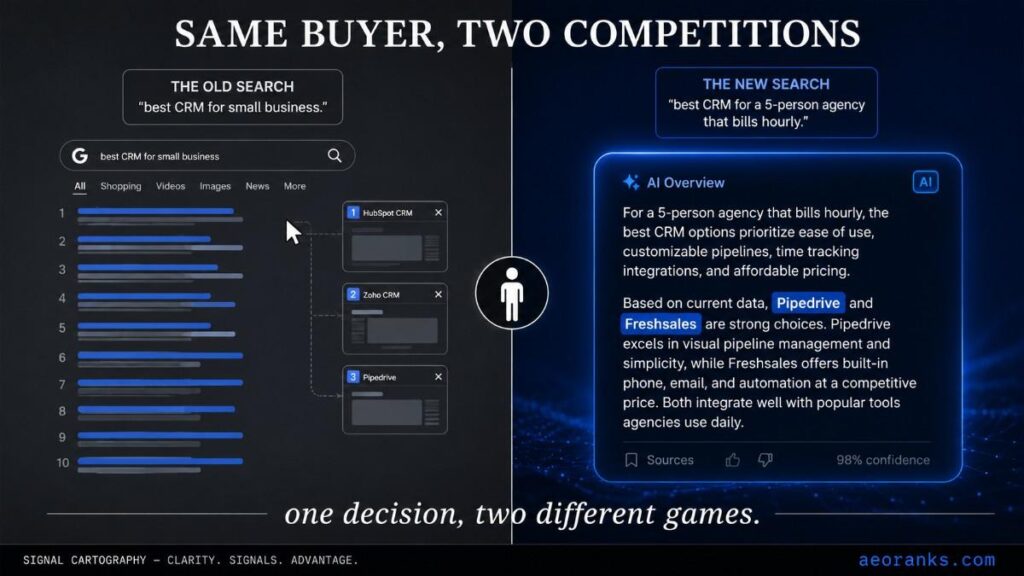
She needs a CRM for her five-person agency. In the old world, she types “best CRM for small business” into Google, scans ten links, opens three tabs, and starts comparing. Rankings decide who gets into her tabs — that’s the game SEO plays.
In the new world, she asks ChatGPT: “What’s the best CRM for a 5-person agency that bills hourly?” She gets one answer naming two or three products, with a short reason for each. She might click a citation. More often she doesn’t — she just shortlists the names in the answer. That’s the game AEO plays.
Same buyer. Same decision. Two completely different competitions. This guide breaks down where they differ, where they overlap, and the single workflow that wins both — in plain language, with the reasoning behind every recommendation.
What Is SEO?
Search engine optimization is the practice of improving your website so it ranks higher in traditional search engine results eg. Google and Bing.
Here’s what happens under the hood: Google crawls your pages, stores them in an index, and – when someone searches – ranks every relevant page using hundreds of signals, chiefly relevance (does this page match the query?) and authority (do other credible sites find it helpful). SEO is the discipline of strengthening both: keyword research to match real queries, on-page optimization and technical health so crawlers can read you, and backlinks that prove the wider web trusts you.
The payoff is a position. Positions earn clicks, clicks become traffic, and traffic converts on your site. SEO still works, and it still matters — search remains a massive discovery channel, and as we’ll see, the infrastructure SEO builds is exactly what AI engines use to find your content in the first place. For the full picture of how the two disciplines interact, see our guide on AI and SEO.
What Is AEO?
Answer engine optimization is the practice of making your brand the answer — cited, mentioned, and recommended inside AI-generated responses.
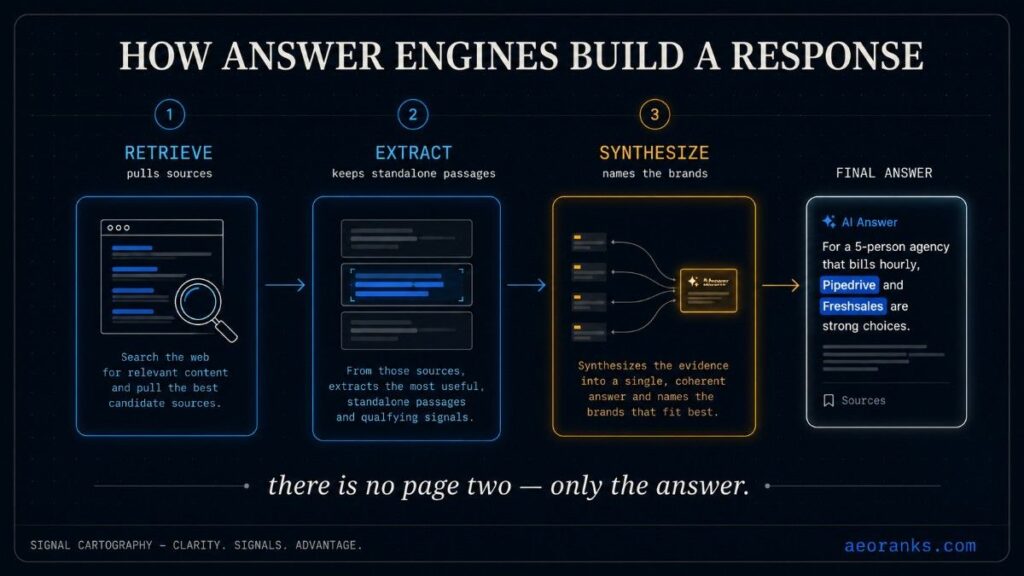
Answer engines work differently from search engines, and understanding the difference is what makes AEO make sense. When our agency owner asks her CRM question, the AI does three things in seconds:
- Retrieves — it searches the web (often breaking her question into several smaller searches) and pulls in relevant sources.
- Extracts — it breaks those sources into passages and keeps the ones that answer the question directly and stand on their own.
- Synthesizes — it composes one answer from those passages, naming the brands and citing the sources it leaned on.
Notice what that means: there is no page two. There isn’t even a page one — just an answer with two or three brands inside it, and everyone else invisible. AEO is the discipline of being retrievable (step 1), extractable (step 2), and trustworthy enough to be named (step 3). Our full guide to what answer engine optimization is covers the fundamentals; below, we focus on how it changes the job you already know.
AEO vs SEO: The Key Differences at a Glance
| SEO | AEO | |
|---|---|---|
| Goal | Rank pages, earn clicks | Be cited and mentioned in AI answers |
| Where you appear | Search results pages (Google, Bing) | ChatGPT, Gemini, Claude, Perplexity, AI Overviews, Copilot |
| Query type | Short, keyword-based (“best crm”) | Long, conversational, contextual (“best CRM for a 5-person agency that bills hourly”) |
| Unit of competition | Your page vs. other pages | Your brand vs. other brands, inside one synthesized answer |
| Content that wins | Comprehensive, keyword-aligned pages | Answer-first, extractable passages backed by evidence |
| How results behave | Deterministic — you hold a position | Probabilistic — the same prompt can cite different brands between runs |
| Success metrics | Rankings, organic traffic, CTR | Citations, brand mentions, AI share of voice, prompt coverage, sentiment |
| Payoff | Traffic you convert on your site | Recommendations delivered before the click — buyers arrive pre-sold |
A table shows you what differs. The next four sections explain why — because the reasoning is what tells you how to act.
1. Different goals: clicks vs. citations
SEO’s endpoint is a visit. AEO’s endpoint often happens without one: the AI delivers your brand’s name and claim inside its answer, and the buyer forms a shortlist right there.
That’s not a consolation prize – it may be the more valuable placement. In studies of AI-assisted buying, roughly three-quarters of users chose the brand ranked first in the AI’s response, and most clicked nothing at all during their task. The comparison work buyers used to do across ten tabs is now done for them, inside the answer. In AI search, the mention is the shelf space – and if you’re not on the shelf, there’s no aisle for the buyer to wander down and find you anyway.
The practical shift: SEO optimizes the path to your site. AEO optimizes what gets said about you before anyone arrives.
2. Different queries: keywords vs. conversations
Keyword tools tell you people search “best body wash” 40,000 times a month. What they can’t tell you is that the same person asks an AI for “body wash recommendations for dry skin that doesn’t have a lot of fragrance.”
The difference isn’t just length – it’s information. AI queries carry the use case, the constraint, and the situation. That context is a gift: it tells you exactly what content to create. But it also means your keyword export is the wrong research foundation for AEO. The teams that win AI visibility build their question maps from places where real context lives – sales calls, support tickets, community threads, reviews — and cover the five prompt types buyers actually use: what is it, how does it compare, what are the alternatives, when do I use it, which should I buy.
The practical shift: keep keyword research for SEO targeting. Layer question research on top for AEO. Every content brief should carry both.
3. Different mechanics: positions vs. probabilities
This is the difference most comparisons skip, and it’s the most consequential one.
A Google ranking is deterministic. For a given query, at a given moment, you hold position four — check it a hundred times and it’s position four a hundred times. An AI answer is probabilistic: ask the same question twice and you can get different brands, because the model re-retrieves and re-composes each time. And each engine draws from a different pool of sources — being visible in ChatGPT says little about Perplexity or Gemini.
Why does this matter so much? Because it breaks the measurement habits SEO taught you. Checking ChatGPT once and celebrating (or panicking) is like judging a coin by one flip. Your real AI visibility is a share of voice: out of twenty runs of your key prompts, across four engines, how often does your brand appear? Measured weekly, read as a trend. Our guide to tracking AI share of voice covers the full setup.
The practical shift: stop asking “do we show up?” Start asking “how often, where, and is it trending up?”
4. Different content rules: coverage vs. extraction
SEO rewards comprehensive pages — cover the topic fully and the rankings follow. AEO adds a stricter test: can a machine lift your answer cleanly?
Picture the AI scanning your page for our agency owner’s CRM question. It isn’t reading top to bottom like a person. It’s hunting for a passage that answers her question directly, makes sense on its own, and can be quoted without dragging along the surrounding paragraphs. A section that opens with “Before we answer that, let’s consider the history of customer relationship software…” fails that test. A section that opens with “For a five-person services team, the best CRM is usually one with built-in time tracking — here’s why” passes it.
The evidence bar is higher too. The academic research that founded generative engine optimization tested nine content tactics across 10,000 queries and found that adding quotations, statistics, and cited sources lifted AI visibility by up to 40% — while keyword stuffing, the classic SEO shortcut, did nothing, and on a live engine actually performed worse than no optimization. Generative engines read meaning and evidence, not keyword density.
The practical shift: answer first, evidence always, one idea per passage. (Notice that this also makes content better for humans — which is why the two disciplines converge more than they conflict.)
What AEO and SEO Share
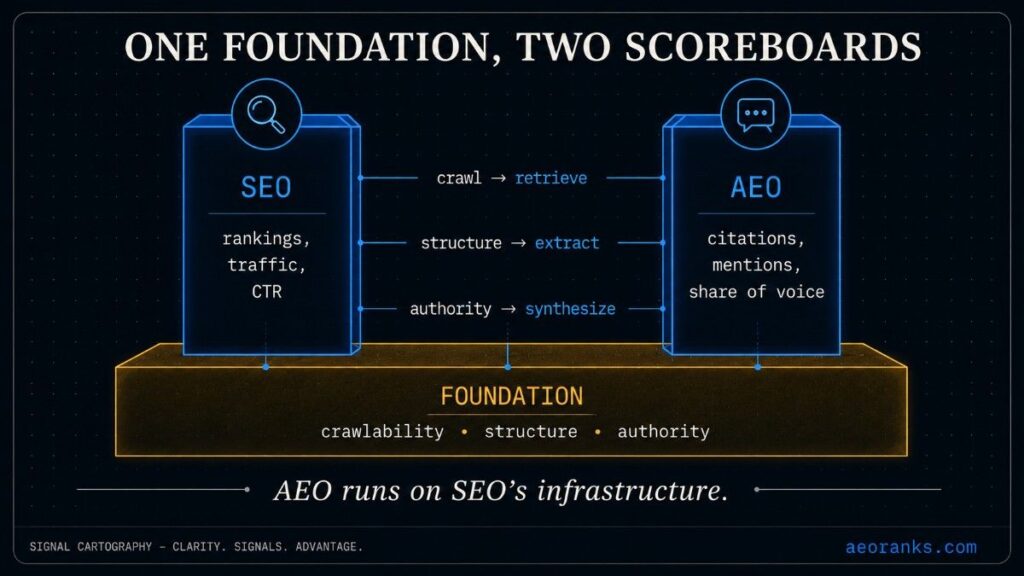
Here’s what the “SEO is dead” crowd gets wrong: AEO runs on SEO’s infrastructure.
Walk back through the answer engine’s three steps. Retrieval depends on crawlability and indexing — the technical SEO you’ve already built (extended to AI crawlers like GPTBot and PerplexityBot). Extraction depends on structure — the headings, schema, and clean architecture SEO taught you. And synthesis — the decision to name your brand — depends on authority and trust, the same E-E-A-T signals search engines have rewarded for a decade.
The shared foundation, concretely:
- Crawlability and indexing — if search engines can’t reach you, neither can AI retrieval.
- Structured content — clear headings, schema markup, and clean information architecture serve both readers, human and machine.
- Authority and trust — expertise, quality, and credible third-party signals feed both algorithms.
- User intent — both disciplines ultimately reward genuinely answering what people ask.
This is why treating AEO as a separate workstream is the most common failure mode we see. Teams spin up an “AI visibility project” beside their SEO program, duplicate half the work, and starve both. Strong SEO doesn’t compete with AEO — it’s the delivery system AEO depends on.
How to Optimize for Both: One Workflow, Two Scoreboards
You don’t need two teams or two content calendars. You need one workflow where every piece is built for both surfaces:
1. Fix the foundation first. Technical health, indexing, site speed, and crawler access — including AI bots (check your robots.txt isn’t blocking GPTBot or PerplexityBot unintentionally). No AEO tactic works on a site engines can’t read. This step is boring, which is why skipping it is the most common mistake.
2. Research questions, not just keywords. Pull your keyword targets as usual, then layer the real questions: mine sales calls, support tickets, and community threads for the phrasing buyers actually use. Map every target topic to the five prompt types (definition, comparison, alternatives, use case, buying question). If a topic can’t fill those five, it may not be a topic you can own.
3. Write answer-first, then go deep. Open every section with the direct answer in one or two sentences — the passage a model can lift — then expand with the depth, examples, and internal links SEO rewards. This structure isn’t a compromise between the two disciplines; it improves featured-snippet capture, reader experience, and AI extraction simultaneously.
4. Add evidence, entities, and schema. Work statistics, expert quotations, and cited sources into every substantive page — the tactics with the strongest proven effect on AI visibility. Keep your brand’s name and category description identical everywhere it appears. Mark pages up with FAQ, Article, and Organization schema so machines parse them the way you intend. Deep, interlinked coverage of your core topics is how engines come to treat you as the authority — the full playbook is in our guide to topical authority for AI search.
5. Build authority off-site. Backlinks still serve SEO. For AEO, the signal set is wider: reviews, community discussions, comparison articles, independent roundups — the places AI engines look to check whether the web agrees with what you say about yourself. This corroboration gap is why so much content gets found by AI but never cited: the page is discoverable, but nothing external vouches for it. The earning playbook is in our guide to AI citations.
6. Measure both scoreboards. Keep rankings, traffic, and conversions for SEO. Add citations, mentions, share of voice, and prompt coverage for AEO — tracked weekly, across engines, on repeated runs. One dashboard, two columns. When a page moves on one scoreboard and not the other, that gap tells you exactly which discipline needs work.
Which Should You Prioritize?
If your SEO foundation is weak: fix it first. AEO built on an uncrawlable, unindexed site is decoration on a house with no door.
If your SEO is solid but AI visibility is zero: shift new effort toward AEO — and move now. Research across 1,000+ categories shows most AI-search topics still have no dominant brand, but once a brand earns a clear lead in AI mentions, it keeps that lead in roughly 90% of month-over-month comparisons. Early presence compounds; waiting donates the category to whoever moves first.
If you’re in a competitive B2B category: run both aggressively, with AEO weighted toward off-site signals and comparison content — the assets AI engines cite when buyers ask “which one should I choose?” (Our AEO for B2B SaaS guide covers this in depth.)
Not sure where your brand stands on either scoreboard? Book a free AI strategy call with AEORanks. We’ll baseline your rankings and your AI visibility across ChatGPT, Gemini, and AI Overviews — and show you where the fastest wins are.
Is AEO replacing SEO?
No. AEO extends SEO to new surfaces rather than replacing it. AI engines rely on the crawlability, structure, and authority signals SEO builds — and traditional search still drives significant traffic. The brands winning right now run both as one program.
Can AEO and SEO work together?
Yes — they’re complementary by design. SEO provides the technical foundation and topical research; AEO adds answer-first structure, entity consistency, evidence-rich content, and off-site trust signals. Most optimizations help both: a well-structured, authoritative page ranks better and gets cited more.
Does good SEO automatically give me AI visibility?
No — and this surprises many teams. Ranking well helps AI engines find you, but citation decisions weigh different factors: extractability, evidence, entity clarity, and third-party corroboration. In research on AI answers, the most-cited domain was rarely the most-mentioned brand. You can rank #1 and still be absent from the answer.
What’s the difference between AEO and GEO?
They describe the same underlying practice — optimizing to appear in AI-generated answers — with slightly different emphases. AEO grew from answer-box and featured-snippet optimization; GEO (generative engine optimization) was coined in academic research on generative engines. In practice, most teams treat them as one discipline.
How do I measure AEO compared to SEO?
SEO is measured in rankings, organic traffic, and click-through rate. AEO is measured in citation frequency, brand mentions, AI share of voice, prompt coverage, and sentiment — tracked across engines on repeated weekly runs, because AI answers vary between runs. Trends over weeks are signal; single checks are noise.
How long does AEO take compared to SEO?
On-page AEO changes can influence AI answers within weeks, since models re-retrieve sources continuously — often faster than ranking movements. But entity authority and off-site corroboration, the signals behind brand mentions, build over months, similar to SEO authority. Plan in quarters for both.