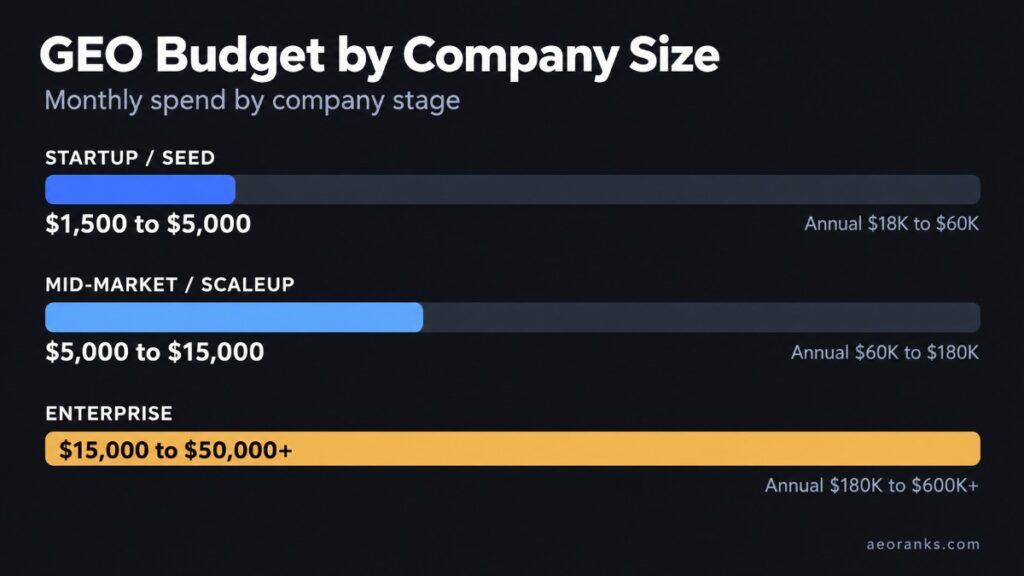
Most B2B companies spend between $1,500 and $50,000 per month on generative engine optimization in 2026. Startups typically run $1,500–$5,000, mid-market scaleups $5,000–$15,000, and enterprise programs $15,000–$50,000 and above. The range is wide because GEO cost is driven less by company size than by one factor: how much SEO and authority groundwork you already have.
That single sentence answers the question. The rest of this guide explains what sits inside those numbers, so you can build a budget instead of guessing at one.
Key Takeaways
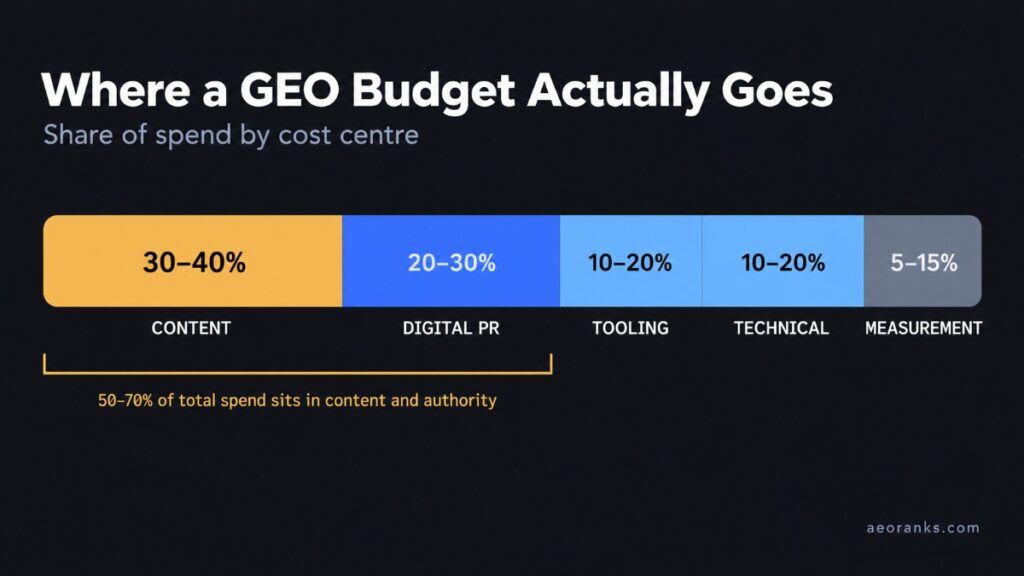
- Five cost centres make up any GEO budget: tooling, content, technical foundations, digital PR, and measurement. Content and PR together usually consume 50–70% of the total.
- Your existing SEO foundation is the biggest cost lever. Companies starting from a weak content library pay two to three times more in the content line than those with a mature one.
- Tools are the smallest line, not the biggest. Monitoring starts around $50–$200 a month. Tooling is typically 10–20% of spend – the rest is execution.
- A one-time audit ($2,000–$5,000) saves money. Teams that skip the baseline and jump straight to production spend more overall, because they can’t tell what’s working.
- GEO should sit at roughly 10–20% of your organic budget in 2026, not as a separate empire alongside it.
Why GEO Budgeting Is Harder Than SEO Budgeting
SEO has twenty years of published benchmarks behind it. GEO has two. That gap is the real problem for anyone defending a line item in a planning cycle — not the cost itself, but the absence of a number to anchor to.
There’s a structural difference underneath it too. An SEO budget buys visibility on essentially one engine. A GEO budget buys citation presence across at least five surfaces — ChatGPT, Google AI Overviews, Gemini, Perplexity and Claude — and each one retrieves differently, rewards different content, and needs its own monitoring. You aren’t funding one channel; you’re funding coverage across five, with overlapping but non-identical requirements.
The third complication is that GEO doesn’t price in isolation. A company with clean technical SEO and genuine domain authority needs far less incremental spend than one starting cold, because half the prerequisites are already paid for. Your GEO budget is partly a function of how mature your organic program already is — which is exactly why every credible benchmark comes as a range rather than a figure.
One framing note that matters at budget-approval time. Gartner’s 2025 CMO Spend Survey puts marketing budgets flat at around 7.7% of company revenue, so GEO almost never arrives as new money — it comes out of the existing pool. The version of this conversation that works with a CFO isn’t “we need budget for a new channel.” It’s “this is organic investment extended into the surfaces our buyers have already moved to.” Same argument, very different reception.
What Exactly Are You Paying For?
A GEO budget pays for five things, not one. Most confusion about pricing comes from comparing quotes that include wildly different scopes. Here’s the standard breakdown, with the share of budget each typically takes:
| Cost centre | What it covers | Share of budget | Typical cost |
|---|---|---|---|
| AI visibility tooling | Tracking citations and mentions across ChatGPT, Gemini, Perplexity, Claude, AI Overviews | 10–20% | $50–$2,000/mo (enterprise: $3,000–$6,000) |
| Content creation | Answer-first pages, comparison content, entity-rich assets | 30–40% | $300–$1,500 per page |
| Technical foundations | Schema, crawlability for AI bots, site speed, llms.txt | 10–20% | $2,000–$8,000 one-time |
| Digital PR & authority | Third-party citations, review platforms, editorial placements | 20–30% | $2,000–$8,000/mo |
| Measurement & governance | Dashboards, reporting, pipeline attribution | 5–15% | Internal time or ops resource |
Ranges reflect published 2026 pricing across agencies including TripleDart, RevvGrowth, First Page Sage and WebFX. Treat them as market benchmarks, not quotes.
Here’s what sits inside each line.
1. AI visibility tooling: the cost floor
Monitoring is where every program starts, and it’s the smallest line in the budget. Price scales with three things: how many prompts you track, how many competitors you track against, and how many surfaces you cover.
- Entry level ($50–$200/month): limited prompt sets, one or two surfaces. Enough to establish a baseline.
- Mid-tier ($500–$2,000/month): broader surface coverage plus competitor tracking. The realistic level for a mid-market program.
- Enterprise ($3,000–$6,000+/month): API access, custom dashboards, multi-brand or multi-region tracking.
The established options include Profound, Ahrefs Brand Radar and Semrush’s AI Optimization suite, alongside a growing set of lighter-weight trackers. Manual testing across two or three platforms is a perfectly legitimate free starting point — it just stops scaling once you’re tracking more than a handful of questions. Our breakdown of the best AEO tools for AI visibility tracking compares what each tier actually delivers.
The trap here: teams buy a tool, watch a dashboard, and call it a GEO program. A subscription tells you where you stand. It doesn’t move you.
2. Content creation: usually the largest line
Content that gets cited has a specific profile, and producing it at the velocity GEO needs is typically the single biggest cost centre. The profile: direct answers up front, structured comparisons, entity-rich pages, and first-hand evidence like original data or client results.
Cost drivers:
- Writer and editor time: $300–$1,500 per page, depending on depth and research load
- Subject-matter expert input: significant in technical or regulated categories, where a generalist writer can’t produce citable accuracy
- Reformatting labour: restructuring existing pages into answer-ready shape
That last point is the important one for budgeting. Reformatting an existing page costs a fraction of commissioning a new one. If you have 200 published posts, a large share of your content budget should go to enriching what already exists rather than adding to the pile. Agencies running these programs report that companies with thin content libraries pay roughly two to three times more in this line than those with a mature SEO foundation (TripleDart, 2026). Depth on your core topics is what compounds — see topical authority for AI search.
3. Technical foundations: one time, not ongoing
For most companies this is a one-time fix, not a monthly line. The technical prerequisites for being citable overlap almost entirely with technical SEO: clean crawlability, schema at scale, HTTPS, reasonable page speed, and AI crawler access in robots.txt.
Budget $2,000–$8,000 for an initial audit and implementation, then light maintenance. Sites with real technical debt or very large page counts sit above that — schema work in particular scales with the number of templates, not the number of pages.
The one genuinely new item is llms.txt, and it’s worth being honest about it: adoption is low and the published evidence for citation impact is weak. Implement it if it’s cheap. Don’t build a case around it.
If schema is your main gap, our free schema markup generator produces the markup types that matter most for AI retrieval, which removes a meaningful chunk of this line item.
4. Digital PR and authority: the highest ceiling
This is the most variable line in any GEO budget, and the one teams most often cut first. AI engines don’t just read what your site says about you; they check whether independent sources agree. That corroboration is built through editorial placements, review platforms, Wikipedia and Wikidata presence, and mentions in publications the models already trust.
- Ongoing retainers: $2,000–$8,000/month for GEO-focused authority work
- Individual placements: $500–$3,000 each through editorial outreach
- Competitive categories: materially higher, because every competitor is chasing the same citations
Two things make this spend different from the rest. It has the longest lead time — months, not weeks — and it has the longest tail, because an earned citation keeps working through future retrievals and model updates. The corroboration gap is also the single most common reason a page gets found but never cited, which we break down in why AI finds content but doesn’t cite it and AI citations vs backlinks.
5. Measurement and governance: small line, disproportionate consequence
Budget 5–15% here and don’t skip it. Measuring GEO means tracking citation rate, share of voice across surfaces, and AI-referred pipeline in your CRM. The third one is what separates a defensible program from a vanity-metric one, and it requires coordination between content, PR and RevOps that most organisations haven’t built yet.
Scale matters here. A startup can run measurement with one person and a $200/month stack. An enterprise with several business units needs named ownership, custom dashboards and a governance rhythm to keep surface coverage consistent. Whatever the size, the pipeline attribution question arrives in every budget review — build for it before you’re asked.
GEO Budget Benchmarks by Company Size
Match your stage to the range, then adjust for the cost drivers in the next section.
| Stage | Monthly budget | Annual | What it realistically buys |
|---|---|---|---|
| Startup / seed | $1,500–$5,000 | $18K–$60K | Technical foundations, 2–4 content pieces a month, monitoring on 1–2 surfaces |
| Mid-market / scaleup | $5,000–$15,000 | $60K–$180K | Full tooling, 6–12 pieces a month, emerging digital PR |
| Enterprise | $15,000–$50,000+ | $180K–$600K+ | Multi-surface coverage, dedicated ownership, deep PR, pipeline reporting |
If you’re a startup
Spend on foundations, not retainers. Get schema and crawler access right once, publish two to four genuinely useful pages a month, and monitor ChatGPT and Perplexity manually if you have to. Skip enterprise monitoring platforms and digital PR retainers – you don’t yet have the content depth to amplify.
If you’re mid-market
This is where most B2B SaaS companies sit, and where the two classic mistakes appear. Over-spending looks like three monitoring subscriptions and nobody accountable for acting on the data. Under-spending looks like strong content with zero off-site authority behind it, which plateaus quietly. Our AEO guide for B2B SaaS covers the balance in more depth.
If you’re enterprise
The extra spend buys coverage and defence: multiple AI surfaces, multiple business units, legal review in regulated categories, and reporting that ties citations to pipeline. At this level GEO is a program with an owner, not a project.
How Delivery Model Changes the Price
The same outcome costs very different amounts depending on who does the work.
| Model | Monthly cost | Time to results | Best for |
|---|---|---|---|
| DIY with tools only | $200–$2,000 | Monitoring only | Establishing a baseline |
| Agency / partner retainer | $3,000–$15,000 | 1–3 months | Series A and beyond |
| Hybrid (in-house owner + partner) | $4,000–$12,000 | 2–3 months | Mid-market default |
| Fully in-house | $8,000–$25,000 fully loaded | 6–12 months | Large orgs with steady volume |
In-house looks cheaper on a spreadsheet until you price it properly. A dedicated AI search specialist earns roughly $90,000–$140,000 a year in the US – about $7,500–$11,700 a month before tooling, and typically three to six months before they’re fully productive. You pay for the expertise well before it produces anything.
The hybrid model is where most scaleups land: an internal owner who controls strategy, brand voice and approvals, with an external team handling production, outreach and monitoring.
One efficiency worth knowing: running GEO and SEO as one contract rather than two typically saves 20–30%, because the content calendar, dashboards and reporting are shared rather than duplicated. GEO is not a parallel discipline – it’s an extension of the same work, as we explain in AEO vs SEO.
What Pushes Your Budget Up or Down
Use these drivers to place yourself within a range rather than defaulting to its midpoint.
Pushes cost down:
- A strong existing SEO foundation. A site with real domain authority and a few hundred indexed pages is already retrievable. Your incremental cost is tooling and reformatting.
- A large content library. Reformatting an existing page for extractability costs far less than commissioning a new one.
- A low-competition category. Categories with three or fewer serious players spend roughly 30–50% less on authority building than crowded ones.
Pushes cost up:
- Starting from a weak foundation. Expect $5,000–$15,000 of front-loaded technical and authority work before content begins compounding.
- More AI surfaces. Covering five engines costs meaningfully more than two – each has its own retrieval behaviour and monitoring requirement.
- Competitive categories. Cybersecurity, fintech and HR tech all have eight-plus brands chasing the same citations.
- Regulated or multilingual content. Legal review and translation both multiply per-page cost.
A practical shortcut: if your technical foundations are already solid, you can cover the schema portion yourself. Our free schema markup generator handles the markup types that matter most for AI retrieval.
How to Phase a GEO Budget
Don’t buy the whole program in month one. The sequence below is what keeps spend defensible.
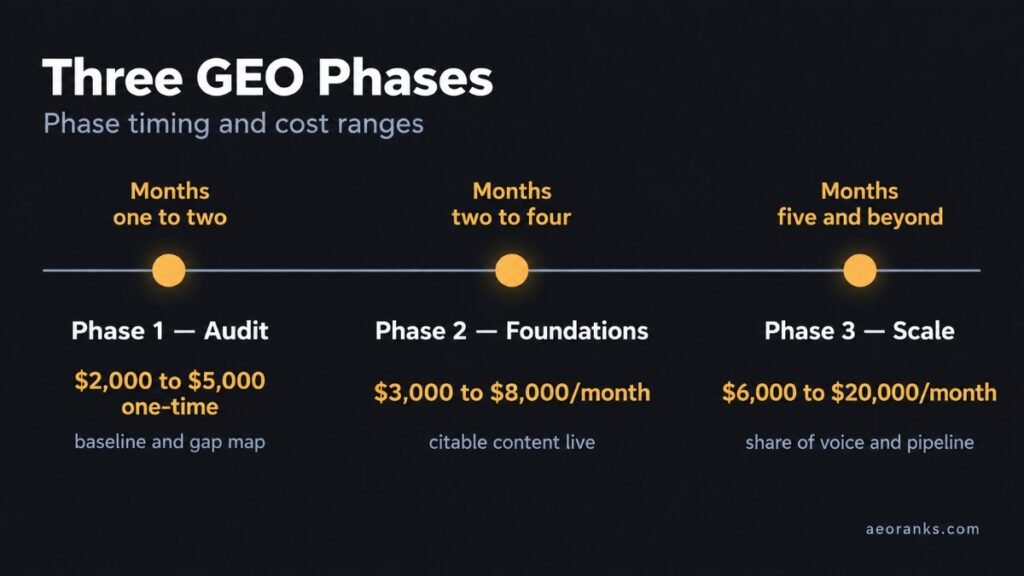
Phase 1: Audit (months 1–2). One-time: $2,000–$5,000. Run 20–30 real buyer questions across ChatGPT, Perplexity, Gemini and AI Overviews. Record where you appear, where competitors appear instead, and which sources they’re cited from. Output: a baseline, a citation gap, and a list of technical blockers.
Phase 2: Foundations (months 2–4). $3,000–$8,000 per month. Fix crawlability and schema, publish six to twelve answer-first pages on your highest-intent questions, and stand up monitoring. Output: citable content and a measurement baseline.
Phase 3: Scale (month 5 onward). $6,000–$20,000 per month. Increase content velocity, start earning third-party citations, expand surface coverage, and connect reporting to your CRM. Output: measurable share of voice and attributable pipeline.
Teams that skip Phase 1 and start at Phase 3 almost always spend more in total. Without a baseline you can’t tell which activity produced which result, so nothing can be cut with confidence.
What Does GEO Actually Return?
The business case rests on three measurable outcomes, not on mention counts.
1. Presence at the research stage. Buyers increasingly shortlist from an AI answer before visiting any website. If two competitors are named in that answer and you aren’t, you’ve lost the evaluation before it started – with no impression, no click and no analytics event to tell you it happened.
2. Higher-quality traffic. The visits that do arrive from AI answers come from people who already read a summary and chose to go deeper. Multiple 2026 analyses put their conversion rate several times higher than standard organic traffic.
3. Compounding authority. A citation earned in an editorial placement or a review platform keeps working across future retrievals and model updates. Unlike paid media, the asset doesn’t switch off when the budget pauses.
A simple way to model it
Work backwards from deal value rather than forwards from cost:
If your average deal is worth $30,000, your win rate on qualified opportunities is 20%, and GEO puts you in front of 10 additional research-stage buyers a month – of whom 3 become qualified – that’s roughly $18,000 in monthly pipeline value from a $6,000 program.
Run that calculation with your own numbers before you approve or reject a budget. For most B2B companies with deal sizes above $10,000, the threshold for GEO paying for itself is a handful of additional opportunities a quarter.
The three metrics to report
| Metric | What it tells you | Cadence |
|---|---|---|
| Citation rate | How often you’re cited for your target questions | Weekly |
| AI share of voice | Your presence versus named competitors | Monthly |
| AI-referred pipeline | Demos and SQLs traced to an AI referral | Quarterly |
The third one is what makes the budget survive a CFO review. Tracking mentions without connecting them to pipeline produces a number nobody can defend. Our guide to tracking AEO and GEO share of voice covers the full setup.
How Much Should GEO Be as a Share of Your Budget?
In 2026, GEO should sit at roughly 10–20% of your total organic and SEO budget, or 5–10% of total marketing spend for companies with a heavy paid mix. Where organic is your primary acquisition channel, that share goes higher.
Resist the temptation to set it up as a separate empire. GEO and SEO share the same foundations – crawlability, structure, authority – so two competing budget lines invite a cut that damages both, and two separate contracts duplicate work you’re already paying for once. A deeper explanation of how the disciplines connect is in AI and SEO.
The wider market context helps the case: worldwide generative AI spending was forecast to reach roughly $644 billion in 2025, up over 76% year on year (Gartner). Your buyers are already researching inside these tools. The only open question is whether your brand appears when they do.
Your GEO Budget Checklist
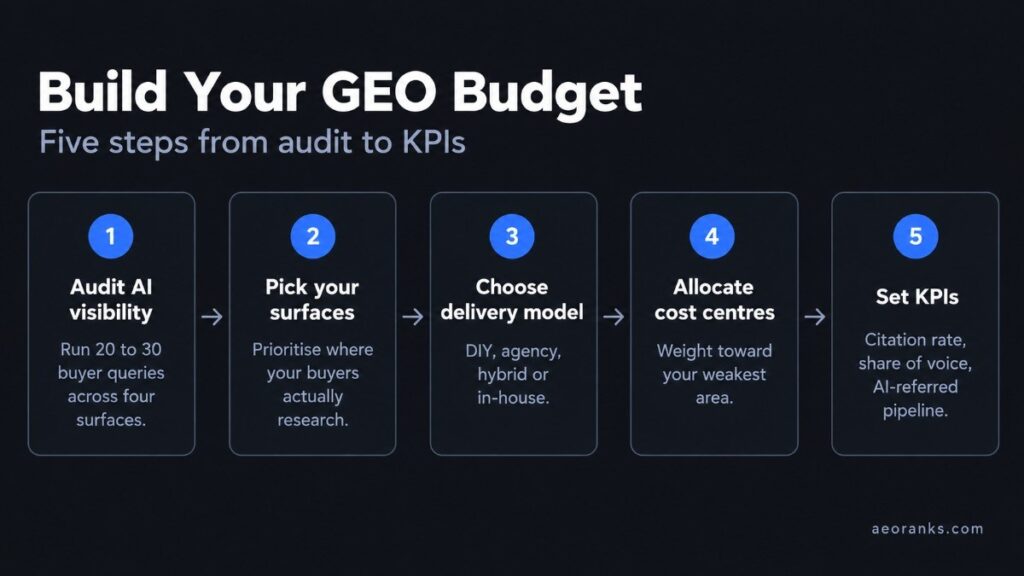
- Run a baseline audit across 20–30 buyer questions before spending anything
- Confirm AI crawlers aren’t blocked in robots.txt
- Decide your delivery model – DIY, agency, hybrid or in-house
- Allocate across the five cost centres, weighted by your weakest area
- Set citation rate and share-of-voice targets before the first invoice
- Connect AI referral sources to your CRM from day one
- Review spend allocation at 90 days, not 12 months
Not sure what your baseline looks like? Book a free AI visibility audit with AEORanks. We’ll test your priority questions across ChatGPT, Perplexity, Gemini, Claude and Google AI Overviews, show you exactly where competitors are cited instead of you, and give you a costed roadmap – including where your existing foundation reduces the number.
How much does GEO cost per month?
Most B2B programs run $1,500–$5,000 a month at startup stage, $5,000–$15,000 at mid-market, and $15,000–$50,000 or more at enterprise. Standalone tooling can start under $200 a month, but tools only measure visibility — they don’t create it.
Is GEO more expensive than SEO?
Slightly, at equivalent scope, because it adds content restructuring and multi-platform monitoring on top of SEO fundamentals. But running them as one program rather than two contracts typically saves 20–30%, since the content, dashboards and reporting overlap heavily.=
How long before GEO shows results?
Most programs see measurable visibility movement in three to six months. Structural fixes to existing high-traffic pages move fastest — often within four to eight weeks. Off-site authority takes longer but holds longer.
Can we do GEO in-house?
Yes, and it makes sense at scale. But price it honestly: a specialist costs $90,000–$140,000 a year plus tooling, with three to six months of ramp before output. For most companies below enterprise scale, a hybrid model reaches results faster and cheaper.
What’s the minimum viable GEO budget?
Around $1,500–$2,000 a month, assuming you already have a working website and some content. Below that, spend the money on a one-time audit and technical fixes instead of a thin ongoing retainer — front-loaded foundation work delivers more at small budgets.
Do we need to pay for AI visibility tools?
Not immediately. Manual testing across two or three platforms is a legitimate starting point and costs only time. Tools become worthwhile once you’re tracking more than a handful of questions or need competitor comparison. See our AEO tools breakdown for what each tier actually delivers.
What’s the difference between GEO, AEO and AI SEO?
They describe substantially the same practice with different emphases and origins. GEO came from academic research, AEO from marketing. Budget for them as one line, not three. Definitions for these and 70 other terms are in our AEO glossary, and the discipline itself is explained in what is generative engine optimization