Search is changing, and so is user behaviour. People are reading direct answers in the form of AI overviews and answers from LLMs. These answers include direct answers to the query and citations to related resources, products, and services from the web. AI Overviews appear in roughly half of Google searches, and more than 700 million people use ChatGPT every week. If your brand isn’t part of those answers, you’re invisible at the exact moment a buyer is deciding.
For decades, marketers used to track brand visibility via GSC and Google Analytics. Now, AI visibility tracking is becoming an emerging need as LLMs play an important role in customer discovery.
Answer Engine Optimisation (AEO) tools solve this. They measure how often AI engines mention, cite, or recommend your brand – and show you what to fix when they don’t. This guide explains how these tools work, compares the best options from free checkers to enterprise platforms with real pricing, and shows you how to choose the right one for your business.
Key Takeaways
- AEO tools track how often AI assistants like ChatGPT, Gemini, Claude, Perplexity, and Google AI Overviews mention and cite your site – and where you stand against competitors.
- Mentions and citations are different metrics: a mention names your brand, a citation links your page as a source. Track both; they’re earned differently.
- AI answers are probabilistic. Good tools run prompts multiple times across multiple engines, because the same question can produce different brand lists on different runs.
- Free tools (HubSpot AEO Grader, ProductRank.ai) are useful for spot checks – but only scheduled weekly tracking measures real progress.
- Tools show you the gaps. Closing them – answer-first content, entity clarity, third-party citations – is strategy work no dashboard does for you.
Don’t Just Measure AI Visibility.
Become the Brand AI Recommends.
Discover how visible your brand is across ChatGPT, Gemini, Claude, Perplexity and Google AI Overviews—and uncover the fastest opportunities to increase AI citations, visibility and qualified leads.
📅 Book Your Free AI Discovery Call →30-minute strategy session • No obligation • Actionable recommendations
Why AI Visibility Tracking Matters for Businesses
Answer engines show one answer, not ten links. When someone asks “best AEO tool for a small team,” a single synthesized response names two or three brands – and the rest don’t exist in that conversation. The brands that appear capture attention, citations, and pipeline. The brands that don’t never get a chance to compete.
You can’t improve what you can’t see. Tracking your AI visibility across ChatGPT, Gemini, Claude, and Google AI Overviews is the first step of any AEO program – it tells you where you stand, who’s beating you, and which sources AI trusts in your category.
Not sure where your brand stands in AI answers today? AEORanks helps businesses audit their current AI visibility and build a strategic AEO growth plan. Book a free AI strategy call – we’ll show you how ChatGPT, Gemini, and Google AI Overviews currently describe your brand, and what to fix first.
What does an AEO tool actually do?
“AEO tool” is an umbrella term covering four different jobs. Buying the wrong category is the most common mistake teams make:
| What you want to do | Tool type | Examples |
|---|---|---|
| See if AI engines cite my brand | AI visibility tracking | Otterly.AI, Geoptie, Profound, Searchable, AirOps |
| Add AEO to my existing SEO stack | SEO suite with AI features | Semrush, Ahrefs Brand Radar, SE Ranking |
| Find the questions buyers ask | Question research | AlsoAsked, AnswerThePublic |
| Check my site’s AI-readiness | Audit & grading | HubSpot AEO Grader, schema generators |
Decide which job you need first. Then read the matching section below.
How AI Visibility Tools Work
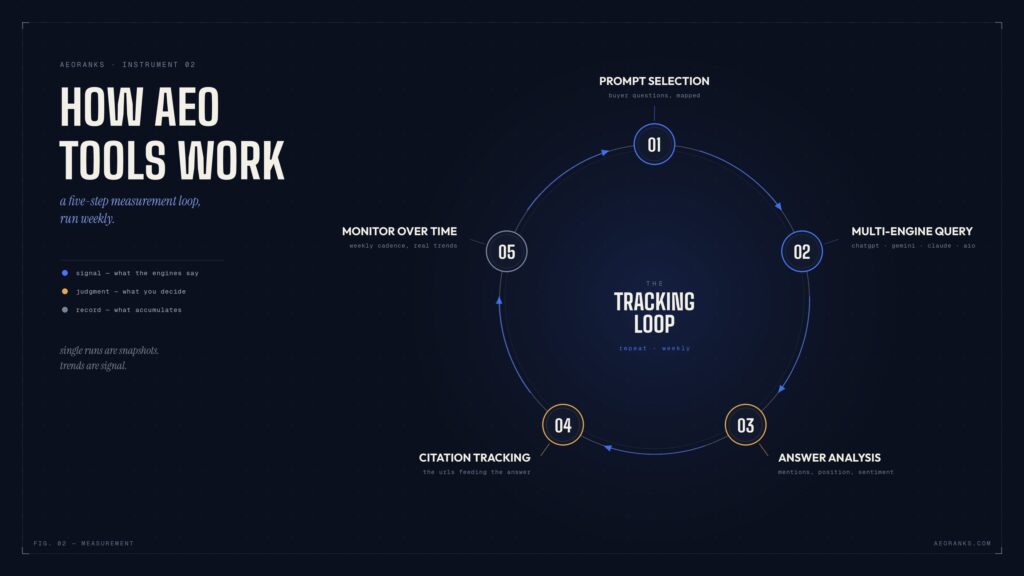
AEO tools are like rank trackers for AI chat – they automate what you’d otherwise test by hand. Every credible platform runs the same five-step loop:
- Prompt selection. You define the questions customers actually ask: buyer queries (“best CRM for small business”), branded questions, comparisons. Strong tools help generate these from your keywords, competitors, and analytics data.
- Multi-engine querying. Each prompt runs through the answer engines that matter: ChatGPT, Gemini, Perplexity, Google AI Overviews and AI Mode and ideally Claude and Copilot. This is crucial because each engine cites from a different source pool.
- Answer analysis. The tool parses each response: were you mentioned? Cited first, second, or buried? Was the framing positive or negative?
- Citation tracking. It extracts every source URL the AI used – showing which of your pages (or which competitor pages, Reddit threads, and review sites) actually fed the answer. Citation data is the gold: it shows how the AI found the answer.
- Monitoring over time. The loop repeats weekly, turning one-off tests into trends: which prompts are rising, whether your visibility is improving, and which site changes had an impact.
One thing makes this fundamentally harder than rank tracking: AI answers are probabilistic. The same prompt asked twice can name different brands, so your visibility is a probability, not a fixed rank. That’s why serious tools run each prompt multiple times and report share of voice across runs – and why a single ChatGPT screenshot is a snapshot, not a signal. We go deeper in our guide to tracking AEO/GEO and measuring AI share of voice.
Comparison: Best AEO Tools at a Glance
| Tool | Best for | AI engines tracked | Starting price |
|---|---|---|---|
| Otterly.AI | Budget-friendly daily tracking | ChatGPT, AI Overviews, AI Mode, Perplexity, Gemini, Copilot | $29/mo |
| AirOps | Teams that want strategy and execution, not just a dashboard | ChatGPT, AI Overviews, AI Mode, Perplexity, Gemini, Copilot, Grok | Custom (Start for free) |
| Geoptie | Broad engine coverage at entry price | ChatGPT, Claude, Perplexity, Gemini | $49/mo |
| LLM Pulse | Weekly multi-engine measurement | ChatGPT, Perplexity, Gemini, AI Mode, AI Overviews | €49/mo |
| GetIntel | Tracking AI performance, diagnose with Audits & Report | ChatGPT, Perplexity, Gemini, AI Overviews | $29/mo |
| AIclicks | Tracking + action list for founders | ChatGPT, Gemini, Perplexity, Copilot | ~$79/mo |
| Peec AI | Fast multi-engine insights | 7 engines (choose 3 on self-serve) | €89/mo |
| Profound | Enterprise analytics & reporting | Up to 10 engines (Enterprise) | $99/mo |
| Searchable | Tracking + content output in one | ChatGPT, AI Overviews, Perplexity (+more on Enterprise) | $125/mo |
| Writesonic | Tracking + execution workflows | 6 engines | $199/mo |
| Scrunch | Monitoring + AI crawler analytics | 4 LLMs (Core), 9 (Enterprise) | $250/mo |
Entry-level prices as of mid-2026; they scale with prompts, seats, and add-ons. Verify on vendor sites.
Best 10 Answer Engine Optimization Tools (Reviewed)
Otterly.AI: best budget entry point
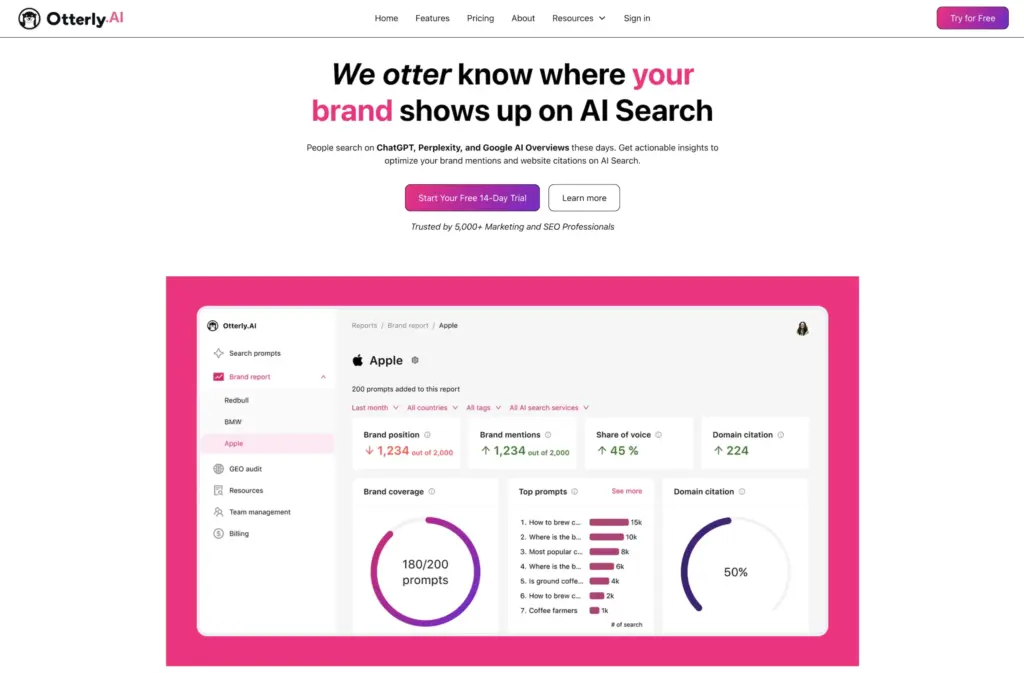
Otterly.AI runs your prompts daily across six engines. Its standout is citation analysis: it shows which publishers and URLs AI engines cite most in your topic, turning the tool from a scoreboard into a target list for digital PR.
Pricing: Lite $29/mo, Standard $189/mo, Premium $489/mo. Free trial.
Best for: small teams and agencies starting AEO tracking.
Watch out: monitoring only – no content or execution features.

AirOps:
AirOps pairs an AI search platform with a team of channel experts who set and execute the strategy across the surfaces agents actually weigh: owned content, third-party placements where AI already looks, AI ad surfaces, community, and social. Instead of handing over a login, the team runs the work hands-on and ties results back to pipeline and revenue, so AI search reads as an investable channel rather than a visibility experiment.
Best for: enterprise marketing teams that need both measurement and the execution to move from citation to selection.
Watch out: this is a partner engagement, not a self-serve subscription, so pricing is custom and fit depends on a strategy conversation.
Geoptie: best broad coverage at entry price
Geoptie tracks all four leading conversational engines – ChatGPT, Claude, Perplexity, and Gemini – on its cheapest plan, where most competitors gate full coverage behind higher tiers. It combines prompt tracking, citation analysis, competitor benchmarking, and free standalone audit tools.
Pricing: Starter $49/mo (15 prompts, 2 brands), Professional $99/mo (100 prompts, 10 brands), Enterprise $199/mo.
Best for: budget-conscious teams that want Claude coverage without enterprise pricing.
Watch out: low prompt limits on Starter; a younger platform than the SEO incumbents.
LLM Pulse: best for disciplined weekly measurement
LLM Pulse runs every prompt across five surfaces – ChatGPT, Perplexity, Gemini, Google AI Mode, and AI Overviews – on a weekly cadence, with citations, sentiment, and share of voice against named competitors. Unlimited seats on every plan.
Pricing: Starter €49/mo (50 prompts), Growth €99/mo, Scale €299/mo. 14-day trial.
Best for: SMBs and agencies that want rigorous multi-engine measurement at a fair price.
Watch out: Claude, Copilot, and Grok are Enterprise add-ons.
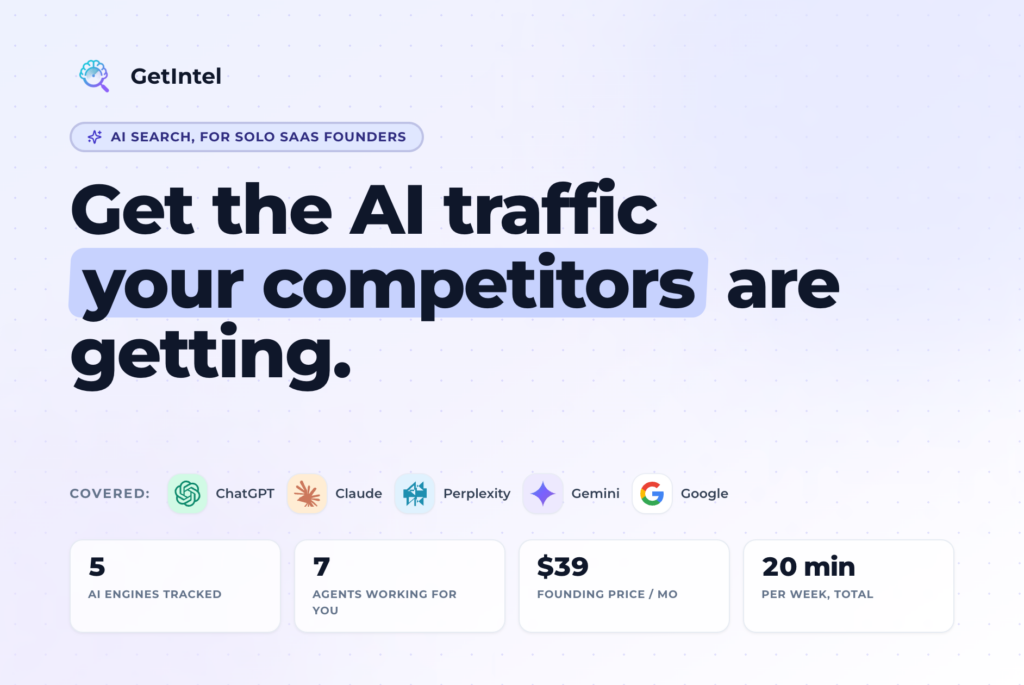
GetIntel: AI Visibility Tool
Tracks the buyer questions your category gets asked, then scores where ChatGPT, Claude, Perplexity, Gemini and Google AI Overviews rank you against competitors. When an answer names someone else, it shows the exact sources behind that answer, drafts the fix, and ships it through your own coding agent as a pull request you approve. Findability Score, Share of Voice and Average Citation Rank, refreshed daily.
Free check runs 20 buyer questions across 3 engines in about 2 minutes, no signup. Plans from $29 a month. Visit GetIntel.
Searchable: best for tracking plus content output
Searchable pairs daily visibility tracking with two things most trackers skip: AI-optimized article generation and technical site audits, in one plan. White-label reports make it practical for agencies.
Pricing: Starter $125/mo (100 prompts, 20 articles, 200 audits), Growth for high volume, custom Enterprise adds Claude, Copilot, Grok, and API access. 14-day trial.
Best for: growing teams that want monitoring and content production under one subscription.
Watch out: entry tier tracks three engines.
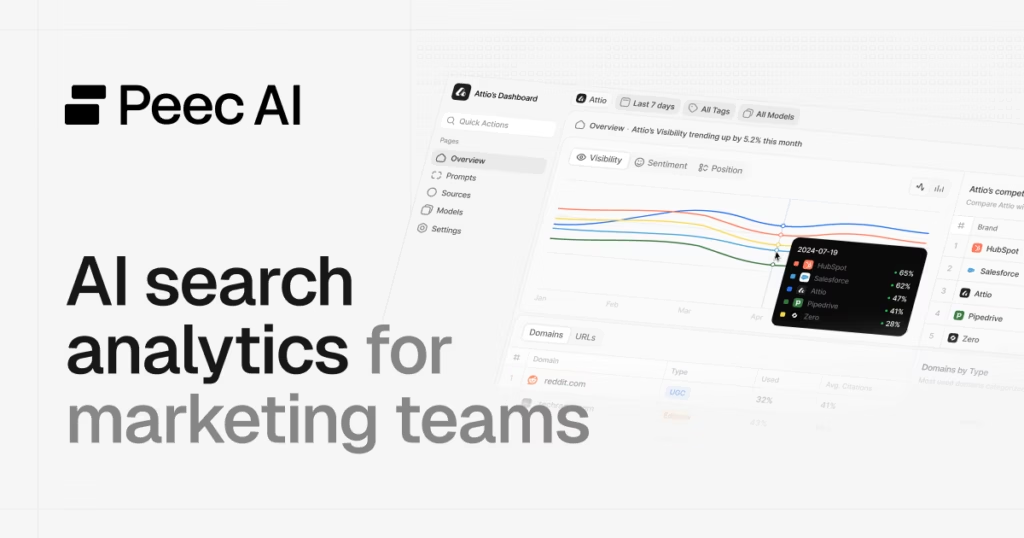
Peec AI: best for fast, clean insights
Peec AI tracks brand rankings across major engines, identifies the sources influencing answers, and flags content gaps. Clean UI, daily updates, and unlimited seats on every plan.
Pricing: Starter €89/mo (choose 3 of 7 engines), Pro €245/mo, Advanced €495/mo. 7-day trial.
Best for: marketing teams that can turn data into strategy themselves.
Watch out: the 3-of-7 engine cap on self-serve plans; Claude is Enterprise-only.

Profound: best for enterprise analytics
One of the earliest serious AEO players: brand mentions, competitor benchmarking, prompt volume data from millions of real user prompts, SOC 2 compliance, and agent analytics showing which AI crawlers visit your site. In daily use it behaves like “Google Analytics for AI search” – rich data and clean executive reports, but what to do next is still on you.
Pricing: Starter $99/mo (ChatGPT only, 50 prompts), Growth $399/mo (3 engines), custom Enterprise (up to 10 engines).
Best for: enterprise teams that need dashboards a CMO can defend in a budget meeting.
Watch out: the best features sit behind Enterprise pricing.

Writesonic: best tracking + execution workflows
Writesonic tracks prompts, citations, and sentiment across six engines, and its Action Centre turns gaps into step-by-step fixes: update this page, resolve this technical issue, target this missed answer.
Pricing: Professional $199/mo (annual), Advanced $399/mo, custom Enterprise.
Best for: teams that want tracking and content optimization together.
Watch out: feature depth can overwhelm smaller teams.
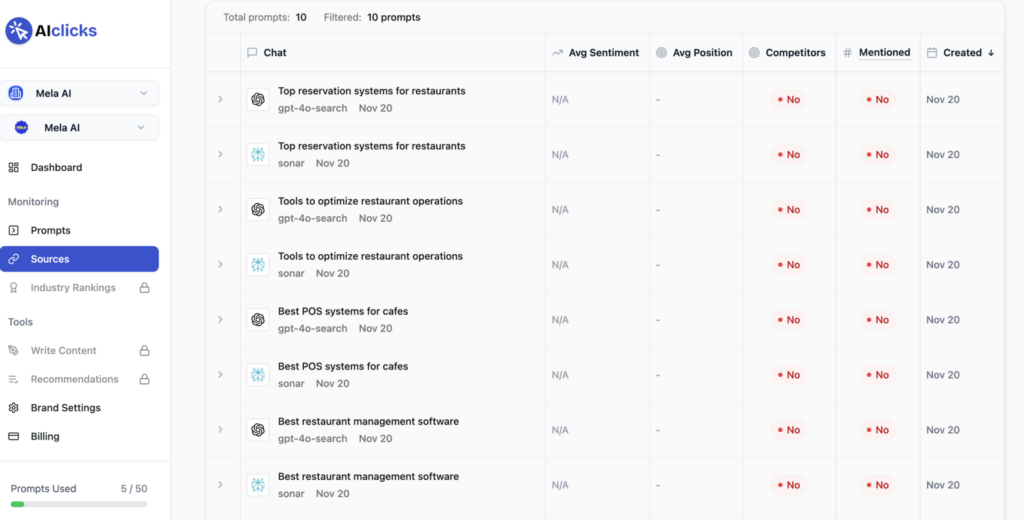
AIclicks: best for founders on a budget
AIclicks combines prompt-level tracking, citation intelligence, and region-specific GEO audits – useful if your market spans languages or regions, since AI answers vary by geography. It ships a prioritized to-do list rather than just charts.
Pricing: from ~$79/mo. Free trial.
Best for: founders and lean teams that want tracking plus a clear action list.
Watch out: lighter enterprise features than the platforms above.
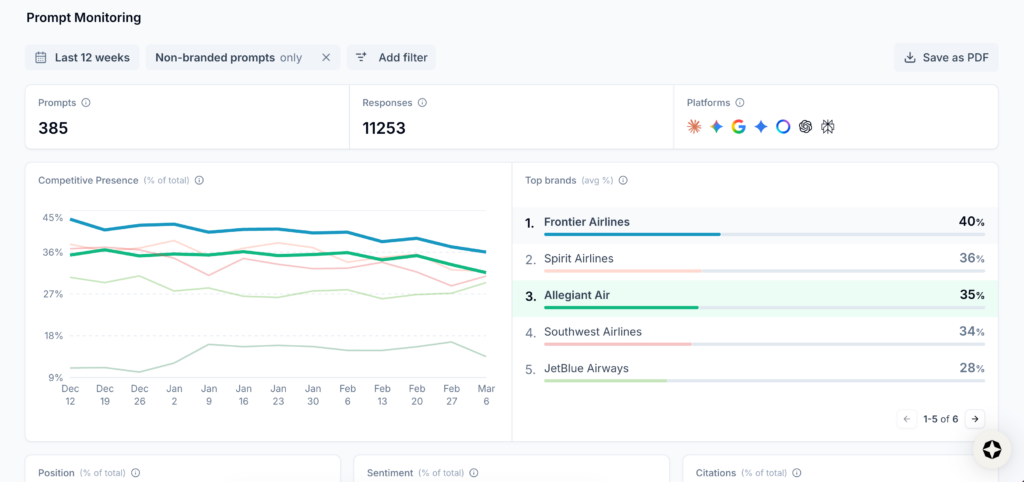
Scrunch: best for monitoring plus crawler analytics
Scrunch combines LLM monitoring with AI crawler analytics – how AI bots and agents interact with your site – plus page auditing and AI-first content delivery.
Pricing: Core $250/mo (4 engines, 125 prompts, 5 seats), custom Enterprise (9 engines).
Best for: enterprises and agencies that want monitoring, site optimization, and crawler data together.
Watch out: broadest engine coverage requires Enterprise.
Best SEO Suites With AEO Visibility Features
Already paying for an SEO platform? Check what it includes before buying anything new. One workflow and one bill are the advantages; the tradeoff is that suite AI features are usually shallower than dedicated tools.
- Semrush AI Visibility Toolkit: tracks ChatGPT, AI Overviews, AI Mode, Gemini, and Perplexity alongside your SEO data. The catch: the add-on is priced at $99/mo per domain per user, which multiplies quickly across a team.
- Ahrefs Brand Radar: powered by one of the largest prompt databases (400M+ monthly prompts from real search behavior) across seven platforms, with a free tier for baseline checks. Full access is steep: from ~$398/mo per platform on top of an Ahrefs plan.
- SE Ranking AI Search / SE Visible: SE Visible (from $99/mo, 10-day trial) tracks visibility, sentiment, and sources across five engines using real AI responses; SE Ranking’s suite (from $65/mo) handles SEO execution. A sensible pairing for teams that want both jobs in one ecosystem.
- Conductor: enterprise platform combining AEO tracking across 9+ engines with content creation and technical monitoring, from $1,500/mo. Built for large teams consolidating tool sprawl.
If AI Overviews are your priority surface, our guide on how to rank in Google AI Overviews covers the content side these suites don’t.
Best Free and Low-Cost AEO Tools
Starting out? These get you a baseline without a budget:
- HubSpot AEO Grader (free): one-shot diagnostic scoring your brand across presence, sentiment, and share of voice on ChatGPT, Perplexity, and Gemini. Continuous monitoring available at $50/mo – the cheapest paid plan on the market.
- ProductRank.ai (free): instant spot-checks of how AI models rank brands in your category. No dashboards, but useful for a first look.
- Ahrefs Brand Radar free tier – quick brand and competitor mention checks.
- AlsoAsked (low-cost): maps how real user questions branch and relate. Consistently rated the best question-discovery tool by practitioners.
- Free schema generators: for FAQ, HowTo, Organization, and Product markup.
- Manual prompt testing (free): ask ChatGPT, Gemini, Claude, and Perplexity the same 20–30 buyer questions and log who gets named, who gets cited, and how your category is described.
Limitations: free tools are good for single-query checks and demos, not for measuring progress. AI answers are nondeterministic, so one-off tests can mislead. Establish your baseline free – then move to scheduled weekly tracking once AEO matters to your pipeline.
How to Choose the Right AEO Tool
Match the tool to your scale first, then pressure-test with five questions.
By business size:
- Solo founder / early stage: manual prompts + HubSpot AEO Grader, then Geoptie or Otterly.AI Lite. Budget: $0–$79/mo.
- Startup / SMB: Otterly.AI, LLM Pulse, or Peec AI for tracking + AlsoAsked for questions. Budget: $100–$300/mo.
- Growing team needing content output: Searchable or Writesonic. Budget: $125–$400/mo.
- Agency: Otterly.AI Standard, LLM Pulse, or Searchable Growth – look for white-label reports, unlimited seats, multi-client workspaces. Budget: $189–$500/mo.
- Enterprise: Profound, Conductor, or Airops – multi-engine depth, SOC 2/SSO, API and BI integration. Budget: $1,000+/mo.
Then ask these five questions before paying:
- Does it run each prompt multiple times? One check per prompt gives a misleading snapshot of a probabilistic system.
- Does it cover the engines your buyers use? At minimum ChatGPT, Gemini, Perplexity, and Google AI Overviews – and confirm Claude coverage if your audience uses it, since many tools gate it behind enterprise tiers.
- Does it show how AI describes you – not just whether you’re mentioned? One agency found every AI model categorized their client as “invoicing software for accountants” when the real customer was mid-market manufacturing CFOs. Months of optimized content moved nothing, because the framing was wrong. If the interpretation layer is off, faster execution just amplifies the wrong narrative.
- Does it reveal which third-party sources get cited? The Reddit threads, review sites, and comparison articles pulling competitors above you are the assets you’ll need to influence. More in our guide to earning AI citations.
- Does it connect insight to action? Insight without a path to action creates a reporting burden, not a competitive advantage. If the tool stops at a dashboard, budget for strategy and content work separately.
Driving Growth With AEO: From Tracking to AI Discovery
Investing in AEO isn’t an experiment anymore – it’s a demand channel. Appearing in AI answers puts your brand in front of buyers earlier and with more authority than a blue link:
- New visibility where search volume tools see nothing. AI conversations surface long-tail, high-intent questions that classic keyword tools never report. Being the cited source there means reaching buyers competitors don’t know exist.
- Better-qualified attention. AI queries tend to be specific and decision-stage (“top accounting software for startups”). Being the AI’s source on those means entering the conversation closest to the decision.
- SEO synergy. The fundamentals overlap: clear answers, schema, authoritative content. Content built for AEO usually strengthens classic SEO too – our AI content strategy guide covers how to build once and win both.
- Compounding advantage. Citations earn trust signals that beget more citations. Early movers in a category are hard to displace once AI engines settle on their trusted sources.
But here’s the honest part every practitioner community keeps arriving at: tools monitor; they don’t fix. A tracker can tell you Perplexity recommends your competitor. It can’t rewrite your content into answer-first format, build your entity presence, or earn the third-party mentions AI engines actually weigh. Schema makes you citable; authority and corroboration make you cited – which is why AI sometimes finds your content but doesn’t cite it.
The full workflow looks like this:
- Baseline: free tools or manual prompts.
- Diagnose: check how AI categorizes and describes your brand.
- Track: pick one tool from this guide that matches your scale.
- Fix & earn: answer-first content, entity clarity, third-party corroboration. Playbook in our AEO/GEO best practices guide.
- Measure: watch AI share of voice trend over months, not days.
Tools handle steps 1, 3, and 5. Steps 2 and 4 – the ones that change what AI says about you – are strategy work. That’s where AEORanks fits: we audit your current AI visibility, diagnose how AI engines interpret your brand, and build the content, entity, and citation strategy that makes ChatGPT, Gemini, Claude, and Google AI Overviews recommend you. For B2B SaaS especially, this is becoming a primary growth channel – see AEO for B2B SaaS.
Ready to grow through AI discovery? Book a free AI strategy call with AEORanks. We’ll audit how AI currently sees your brand and hand you a prioritized AEO growth plan – one you can execute with or without us.
What is an AEO tool?
An AEO tool is software that tracks how your brand appears in AI-generated answers. It runs buyer questions through engines like ChatGPT, Gemini, and Perplexity on a schedule, then reports mentions, citations, share of voice versus competitors, and sentiment – so you can improve your AI visibility over time.
How is AEO different from traditional SEO?
SEO optimizes content to rank in traditional search results. AEO optimizes content to be included u003cemu003einsideu003c/emu003e AI answers – cited and recommended. Think of SEO as winning page-one real estate, and AEO as winning the mention in the assistant’s answer. You need both: SEO for the search traffic that still exists, AEO for the growing share of AI-driven discovery.
What’s the most effective tool for AEO?
It depends on your bottleneck. Otterly.AI and Geoptie lead on value, Searchable and Writesonic best combine tracking with execution, Airops goes deepest on share-of-answer, Profound leads enterprise analytics, and AlsoAsked is unmatched for question discovery. No tool replaces a clear strategy for what AI should say about you.
How much do AEO tools cost?
Free tools (HubSpot AEO Grader, ProductRank.ai) cover baseline checks. Entry-level trackers run $29–$99/month, mid-market platforms $125–$500/month, and enterprise platforms range from custom pricing to $1,500+/month.
Are free AEO tools any good?
They’re useful for spot checks and learning – they’ll show whether you have any AI presence and flag major gaps. But they don’t track change over time, and AI answers vary between runs, so a single test can mislead. Serious AEO programs need at least a low-cost paid plan running weekly.
Can AEO tools track different AI models like ChatGPT, Gemini, and Claude?
Yes – that’s their job, but coverage varies widely. Almost all track ChatGPT and Google’s AI surfaces; most add Perplexity and Gemini. Claude, Copilot, and Grok are often enterprise-only add-ons. If your audience uses a specific engine, confirm it’s covered on the plan you’re buying, not just the platform overall.
How do I measure ROI from AEO?
Track AI share of voice against competitors, citation counts on your key prompts, and referral traffic from AI platforms in your analytics. Most importantly, tie changes to outcomes: if you restructure a page or add schema, watch whether citations and AI-referred visits rise in the following weeks. The best platforms support exports to GA4 or BI tools so you can report pipeline from AI-driven queries.
How often should I check my AI visibility?
Check your AI visibility at least weekly to catch rapid changes in how AI models index your brand. For hyper-competitive industries, daily automated tracking is ideal, while smaller businesses can manage with a monthly strategic review. AI answers drift as models update and citations rotate, so read trends over weeks and months rather than reacting to single-day swings.